
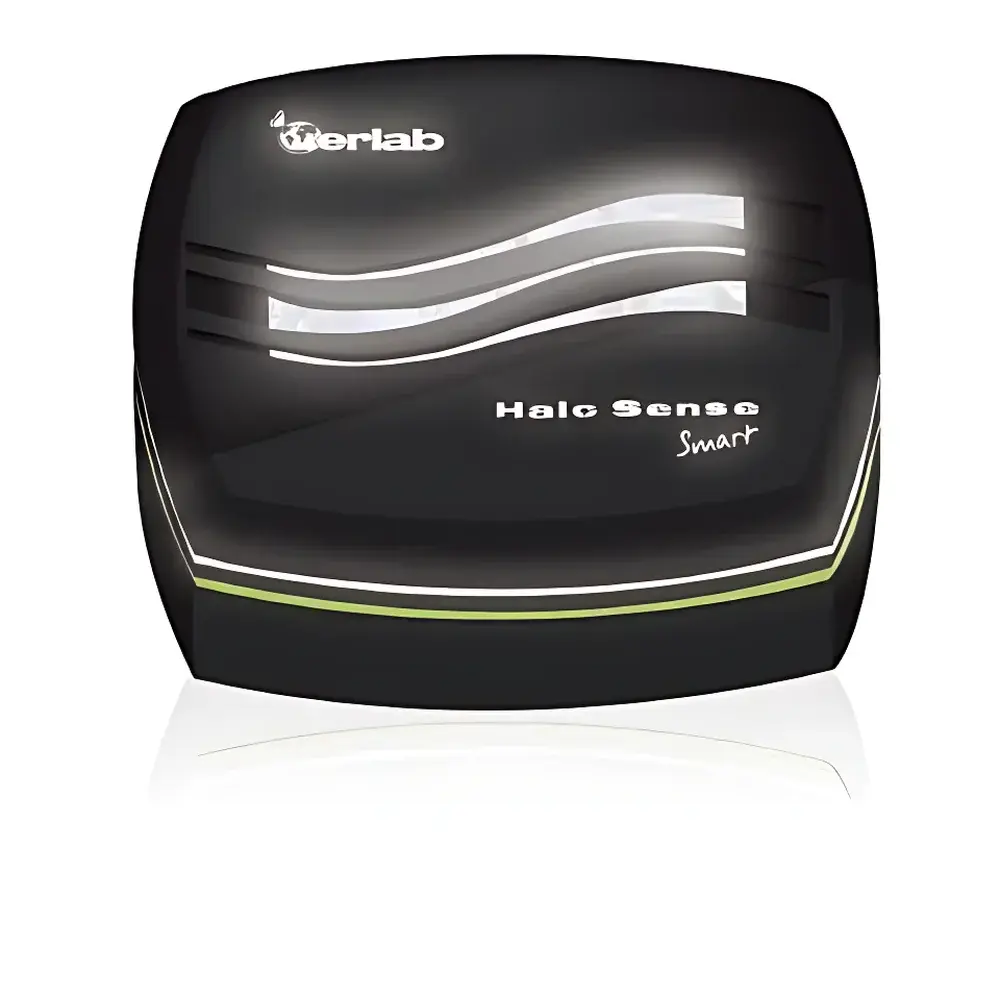
Erlab Halo Sense Laboratory Air Quality Sensor
| Brand | Erlab |
|---|---|
| Model | Halo Sense |
| Detection Targets | VOCs, Formaldehyde, Acidic Gases |
| Sensor Types | Semiconductor (VOCs), Electrochemical (Formaldehyde & Acidic Gases) |
| Mounting | Wall-mounted or Desktop |
| Power Supply | 100–240 V AC, 50–60 Hz |
| Power Consumption | 10 W |
| Enclosure Material | Impact-resistant polymer |
| Weight | 1 kg |
| Connectivity | Ethernet (LAN), USB (for local PC connection), Wi-Fi-enabled via eGuard software |
| Compliance | CE, RoHS, FCC Class B |
| Software Platform | eGuard v3.2+ (Windows/macOS/iOS/Android) |
| Data Logging | Local storage + cloud-synced (optional), audit-trail enabled |
| Alarm Output | Visual (RGB status ring with dynamic pulse pattern), Audible (adjustable 65–85 dB SPL), Relay contact (dry contact, 250 VAC/2 A) |
| Operating Temperature | 5–40 °C |
| Relative Humidity Range | 20–80 % RH (non-condensing) |
Overview
The Erlab Halo Sense Laboratory Air Quality Sensor is an engineered solution for continuous, real-time monitoring of airborne hazardous substances in analytical, synthetic, and teaching laboratories. Designed around a multi-sensor architecture, it simultaneously detects volatile organic compounds (VOCs), formaldehyde (HCHO), and acidic gases (e.g., HCl, HF, NO₂, SO₂) using a hybrid detection principle: metal-oxide semiconductor (MOS) sensing for broad-spectrum VOC response, and dedicated electrochemical cells calibrated for formaldehyde and low-concentration acidic species. Unlike single-gas point monitors, Halo Sense integrates cross-interference compensation algorithms to minimize false positives during solvent-rich operations—critical in environments where acetone, ethanol, or chlorinated solvents coexist with target analytes. Its deployment aligns with occupational exposure frameworks including OSHA PELs, ACGIH TLVs®, and EU Directive 2004/37/EC (Carcinogens and Mutagens), supporting institutional compliance with laboratory safety management systems (e.g., ISO/IEC 17025 Clause 5.4, ANSI Z9.5–2022).
Key Features
- Tri-modal detection capability: Independent, factory-calibrated channels for VOCs (0–100 ppm range, resolution 0.1 ppm), formaldehyde (0–5 ppm, resolution 0.01 ppm), and acidic gases (0–10 ppm, resolution 0.05 ppm)
- Smart Status Ring: 360° RGB LED band provides intuitive, at-a-glance status indication—steady blue (normal operation), pulsing amber (threshold alert), rapid red flash + audible tone (alarm condition)
- eGuard-integrated architecture: Enables remote configuration, firmware updates, alarm threshold adjustment (ppm-based), audio volume control, LED behavior toggling, and export of time-stamped event logs
- Network-resilient operation: Dual connectivity—wired Ethernet (IEEE 802.3) for primary LAN integration; optional Wi-Fi 802.11n (2.4 GHz) for mobile access without local PC dependency
- GLP-compliant data handling: All alarms and parameter changes generate immutable timestamped entries with user ID (if authenticated), satisfying FDA 21 CFR Part 11 requirements when used with eGuard’s audit-log module
- Low-maintenance design: MOS sensor auto-compensation for humidity drift; electrochemical cells rated for ≥24 months operational life under typical lab conditions
Sample Compatibility & Compliance
Halo Sense is validated for use in fume hood perimeters, reagent storage zones, synthesis workstations, and near gas cylinder manifolds—locations identified by ANSI Z9.5 as high-risk for accumulation of undetected vapors. It meets IEC 61000-6-3 (EMC emissions) and IEC 61000-6-2 (immunity), ensuring stable performance amid electromagnetic noise from centrifuges, RF equipment, and HVAC controllers. The device supports integration into broader laboratory infrastructure via Modbus TCP or HTTP API, enabling interoperability with BMS platforms (e.g., Siemens Desigo, Honeywell Experion) and centralized safety dashboards. Calibration verification follows ASTM D6196-21 Annex A3 for formaldehyde and ISO 16000-23:2012 for VOC screening—procedures documented in the included Certificate of Conformance.
Software & Data Management
eGuard software serves as the central interface for Halo Sense deployment. Version 3.2 introduces role-based access control (RBAC), allowing lab managers to assign view-only permissions to technicians and full administrative rights to EHS officers. All historical concentration profiles are stored in encrypted SQLite databases (local) or optionally synced to secure AWS-hosted instances with TLS 1.3 encryption. Reports comply with GLP documentation standards: each exported PDF includes instrument ID, calibration date, analyst signature field, and digital hash for integrity verification. Audit trails record every configuration change—including who modified thresholds, when, and from which IP address—supporting internal audits and regulatory inspections.
Applications
- Real-time verification of fume hood containment integrity during solvent-intensive procedures
- Early-warning detection of formaldehyde leakage from preserved biological specimens or resin curing processes
- Monitoring acid gas breakthrough in scrubber-equipped waste gas lines or near HF etching stations
- Post-maintenance validation of ventilation system efficacy after duct cleaning or filter replacement
- Supporting ISO/IEC 17025 clause 8.9 corrective action workflows by correlating alarm events with incident reports and CAPA records
FAQ
How often does Halo Sense require calibration?
Factory calibration is performed prior to shipment. Field verification is recommended every 6 months using certified span gases (NIST-traceable); full recalibration is required annually or after sensor exposure to >5× full-scale concentration.
Can Halo Sense integrate with existing building management systems (BMS)?
Yes—via Modbus TCP over Ethernet or RESTful HTTP API, enabling alarm forwarding, status polling, and remote reset functionality within enterprise-level infrastructure.
Is eGuard software validated for regulated environments?
eGuard v3.2 includes IQ/OQ documentation packages and supports 21 CFR Part 11 compliance when deployed with Windows Active Directory authentication and encrypted database storage.
What is the expected service life of the electrochemical sensors?
Under typical laboratory conditions (25°C, 50% RH, <1 ppm baseline interference), formaldehyde and acidic gas sensors maintain ±10% accuracy for ≥24 months; MOS VOC sensor life exceeds 36 months.
Does Halo Sense meet explosion-proof or intrinsically safe requirements?
No—it is rated for general laboratory use (Class I, Division 2 Group D per UL 1203 not claimed). Installation must follow ANSI Z9.5 guidance for non-hazardous location placement.
Related Products







