
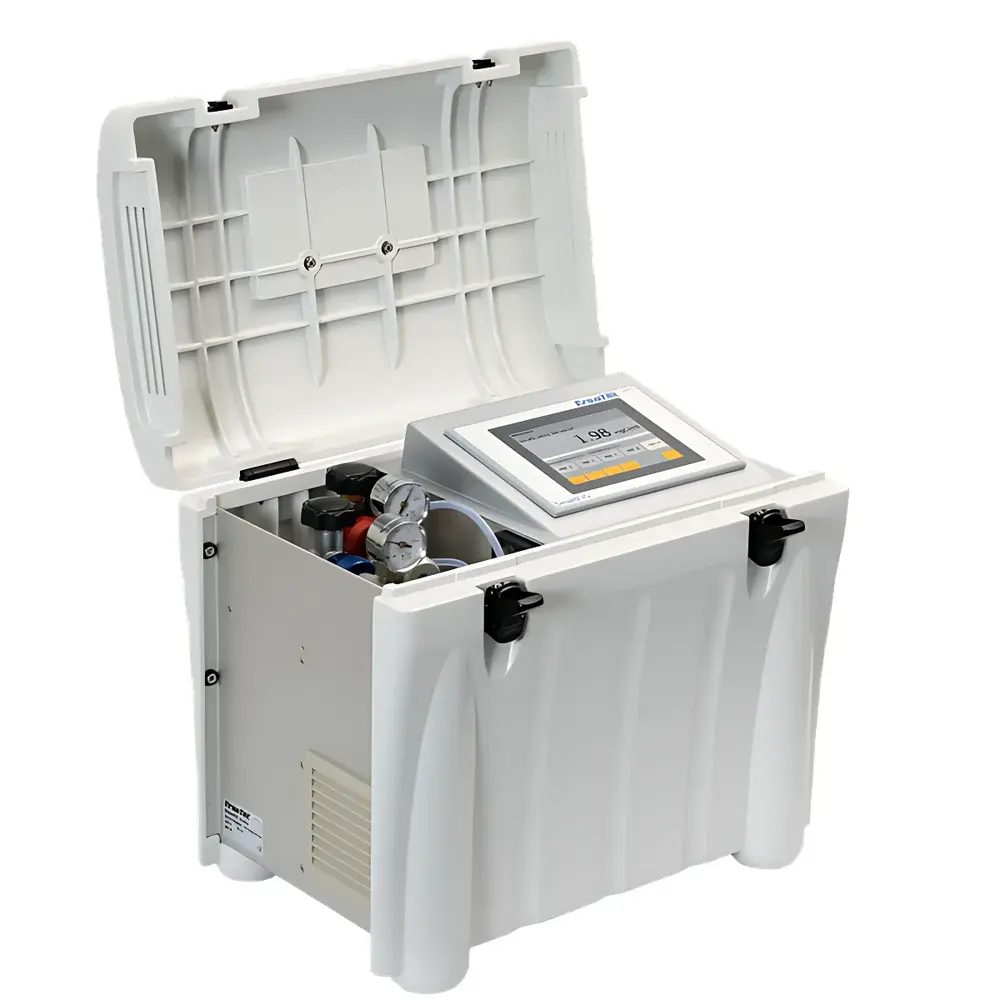
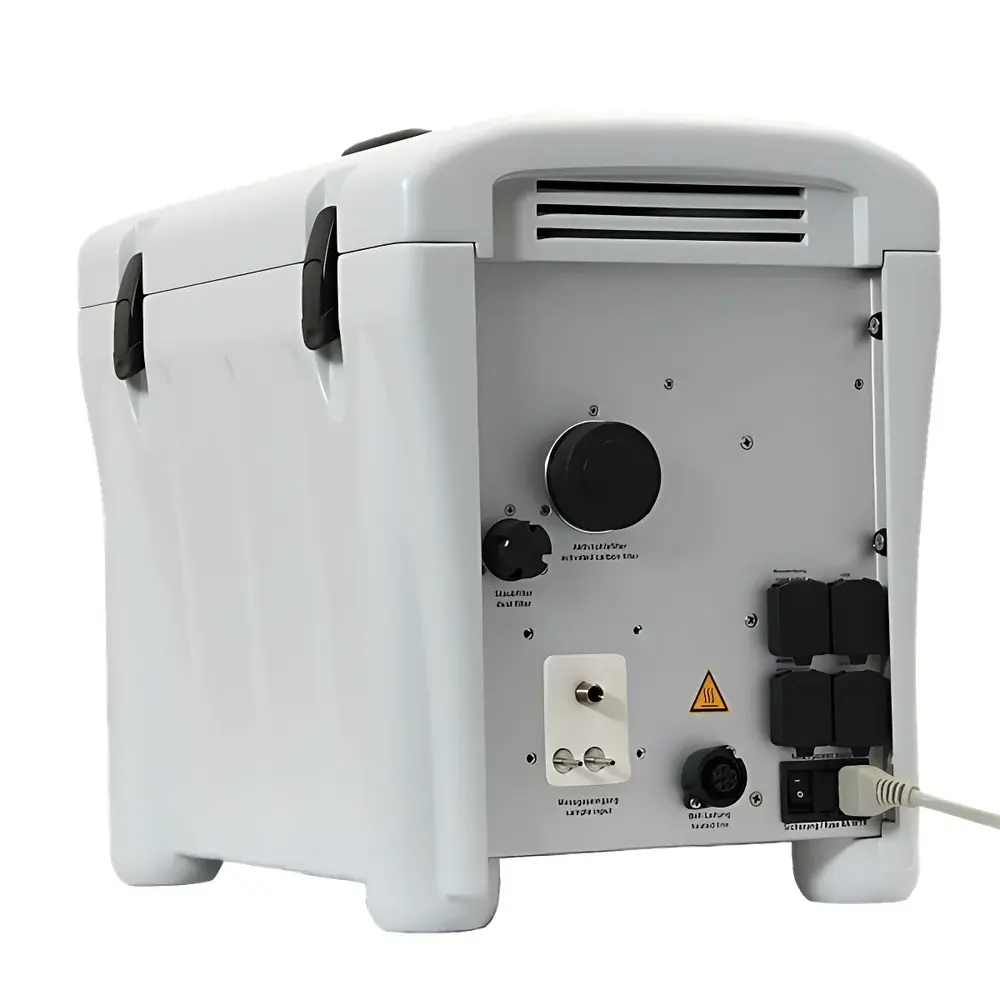
Ersatec SmartFID Portable Total Hydrocarbon Analyzer with Flame Ionization Detection
| Brand | Ersatec |
|---|---|
| Origin | Germany |
| Model | SmartFID |
| Detection Principle | Flame Ionization Detection (FID) |
| Instrument Type | Portable |
| Typical Configuration | Composite VOC Analyzer |
| Measurement Range | 0–100,000 ppm (as C₃H₈) |
| Resolution | 0.01 ppm |
| Accuracy | ±1.0% of reading |
| Response Time (T₉₀) | 1.5 s |
| Operating Temperature (Gas Path) | Up to 200 °C (optional to 230 °C) |
| Sample Flow Rate | 0.8–1.0 L/min |
| Power Supply | 115–230 VAC, 48–63 Hz, 120–150 W |
| Dimensions | 420 × 470 × 310 mm |
| Weight | 16 kg |
| Fuel Gas | H₂ (Grade 5, hydrocarbon residual <0.5 ppm, 3 bar) or H₂/He mixture |
| Zero Gas | Built-in catalytic hydrocarbon scrubber or carbon filter |
| Analog Outputs | Two user-configurable 0/4–20 mA |
| Digital Outputs | Three programmable relay contacts (250 V AC, 1 A) |
| Data Storage | Internal XML logging, USB export to Excel-compatible format |
Overview
The Ersatec SmartFID Portable Total Hydrocarbon Analyzer is a field-deployable, high-stability flame ionization detector (FID) system engineered for quantitative measurement of total hydrocarbons (THC) and volatile organic compounds (VOCs) in gaseous streams. Based on the well-established FID principle—where organic carbon-containing molecules undergo pyrolytic ionization in a hydrogen–air flame, generating ions proportional to carbon mass—the SmartFID delivers trace-to-percent-level detection across a dynamic range spanning 0–100,000 ppm (expressed as propane, C₃H₈). Its fully heated gas path (up to 200 °C standard, extendable to 230 °C) eliminates condensation artifacts, enabling reliable operation in high-humidity, low-temperature, or thermally unstable sampling environments typical of industrial stack emissions, biogas upgrading, engine exhaust, and RTO off-gas monitoring. Designed for compliance-grade field use—not laboratory benchtop validation—the instrument meets core functional requirements for continuous emission monitoring systems (CEMS) pre-screening, process optimization, and regulatory spot-checking under ISO 13845, ASTM D6348, and EN 15267-3 frameworks.
Key Features
- Fully heated sample train (up to 200 °C), including 5-meter heated sampling line and all wetted components, preventing condensate formation and ensuring representative VOC transport.
- Five user-editable measurement ranges (e.g., 0–10 ppm to 0–10 vol.%), with automatic range switching and real-time linearization per IEC 61298-2 Class 1 accuracy class.
- Embedded microprocessor control with self-diagnostics, auto-zero stabilization, and configurable alarm thresholds for critical parameters (flow, pressure, temperature, flame status).
- High-resolution 0.01 ppm resolution at low ppm levels; ±1.0% full-scale accuracy across all ranges; T₉₀ response time ≤1.5 seconds per ISO 13845 Annex B.
- Integrated fuel management: optimized H₂ consumption (1.2 L/h pure H₂ or ~2.4 L/h H₂/He blend); built-in pressure-regulated fuel and zero-air supply interfaces.
- Robust portable enclosure housing internal H₂ and calibration gas cylinders, ruggedized for field transport, vibration resistance (IEC 60068-2-6), and IP54-rated ingress protection.
- Configurable analog outputs (two 0/4–20 mA channels) and digital relays (three SPDT, 250 V AC/1 A) for integration into SCADA or PLC-based control systems.
Sample Compatibility & Compliance
The SmartFID is compatible with a broad spectrum of hydrocarbon species—including aliphatics, aromatics, olefins, and chlorinated VOCs—without chemical discrimination, delivering total carbon response calibrated to propane. It tolerates up to 25% O₂ without significant signal suppression (<4% interference at 80 ppm C₃H₈), and exhibits negligible response to CO, CO₂, NOₓ, SO₂, or water vapor due to FID’s inherent selectivity. All gas-contact surfaces are constructed from electropolished stainless steel (SS316L) or high-purity quartz-lined components. The system supports optional add-ons including non-methane hydrocarbon (NMHC) subtraction modules (via methane-specific catalytic oxidation) and zero-air catalytic converters meeting EPA Method 25A specifications. It is designed to support GLP-compliant data integrity: internal clock-synchronized XML logs include audit-trail metadata (operator ID, calibration timestamp, sensor diagnostics), exportable via USB for traceable post-processing in Excel or LIMS environments.
Software & Data Management
Operation is managed through an embedded Linux-based interface with a backlit 7-inch TFT LCD supporting multilingual menus (English, German, French, Spanish, Chinese). Real-time display includes live concentration curves, flow/pressure/temperature trends, flame status indicators, and diagnostic flags. All measurements are timestamped and stored internally in structured XML format compliant with ASTM E2500-18 Annex A3 for raw data archiving. USB export generates .xlsx-compatible spreadsheets with columnar headers aligned to ISO/IEC 17025 reporting requirements. Optional Ethernet module enables remote configuration, firmware updates, and Modbus TCP readout for centralized data aggregation. No proprietary software installation is required—data files are natively readable by common analytical platforms.
Applications
- RTO and thermal oxidizer stack monitoring for THC compliance verification against local air permits (e.g., TA Luft, US EPA 40 CFR Part 60).
- Biogas and syngas quality control during upgrading to biomethane or Fischer–Tropsch feedstock, where residual hydrocarbons impact catalyst lifetime.
- Engine and turbine exhaust characterization in mobile source testing labs, including transient cycle analysis (e.g., WHSC, NTE).
- Leak detection and repair (LDAR) surveys per EPA Method 21, especially in high-background or humid refinery environments.
- Process safety monitoring in petrochemical plants—continuous detection of hydrocarbon releases in compressor stations, flare headers, or vapor recovery units.
- Research-grade field studies requiring portable, quantitative THC profiling in ambient air, landfill gas, or fugitive emission plumes.
FAQ
What calibration standards are recommended for routine verification?
Propane-in-air certified reference materials (CRM) at 80% of selected span are recommended per ISO 17025; alternative hydrocarbon CRMs (e.g., toluene, hexane) may be used with documented response factors.
Can the SmartFID measure methane separately?
Not natively—but with the optional non-methane hydrocarbon (NMHC) module, it enables NMHC calculation via dual-channel subtraction using a parallel methane-selective catalytic converter.
Is the instrument suitable for use in explosive atmospheres?
The base SmartFID is not ATEX or IECEx certified; however, intrinsically safe versions (e.g., SmartFID-Ex d) are available upon request with Zone 1/21 certification.
How often does the system require zero and span calibration?
Zero drift is ≤0.5% of full scale per month; span drift is ≤2.8% per week under stable conditions—calibration intervals should follow site-specific QA/QC protocols aligned with ISO 14001 or VDI 3859.
Does the instrument support remote diagnostics and firmware updates?
Yes—via optional Ethernet interface with secure HTTPS web server and Modbus TCP protocol; firmware updates are signed and validated prior to installation.







