
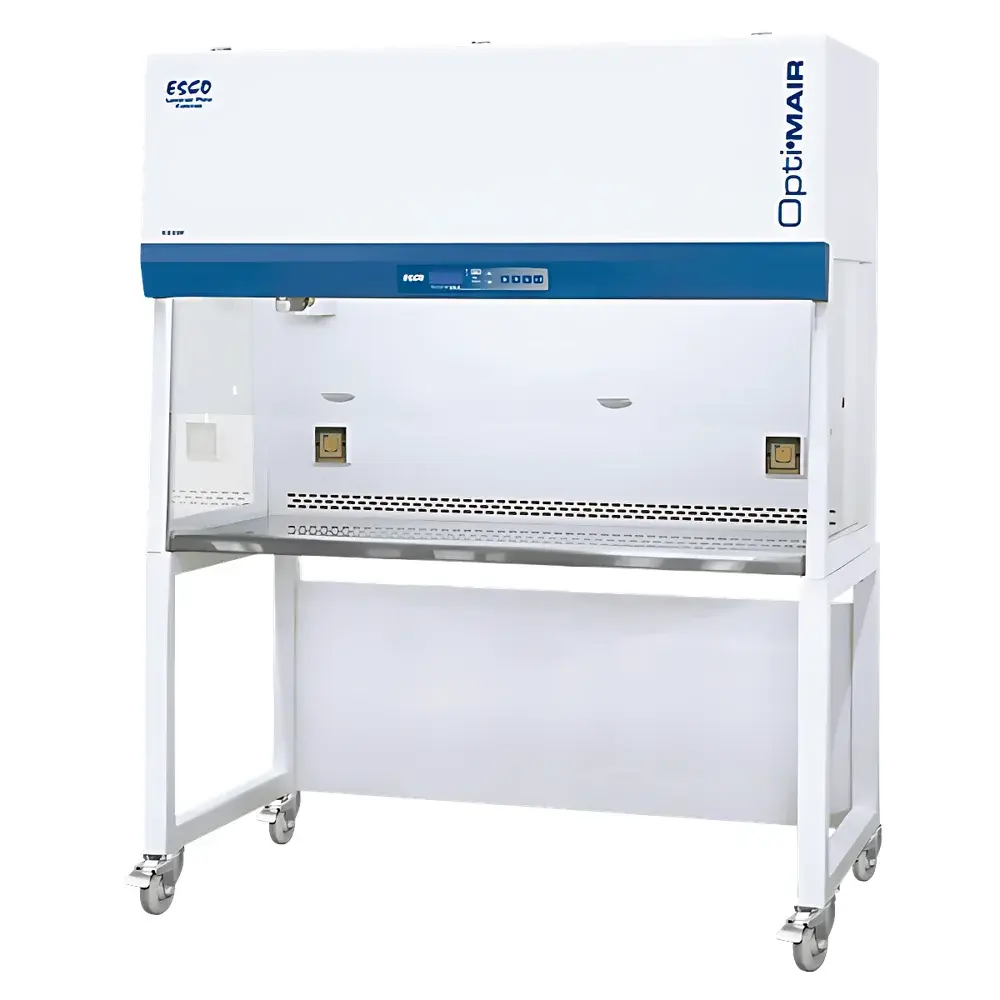
Esco OptiMair ACB Vertical Laminar Flow Clean Bench
| Brand | Esco |
|---|---|
| Origin | Singapore |
| Manufacturer Type | Original Equipment Manufacturer (OEM) |
| Origin Category | Imported |
| Model | ACB |
| Instrument Type | Vertical Laminar Flow Clean Bench |
| Cleanliness Class | ISO 3 (Class 10) |
| Noise Level | ≤61 dBA |
| User Capacity | Dual-Operator, Single-Face Configuration |
| Airflow Pattern | Vertical Downflow |
Overview
The Esco OptiMair ACB Vertical Laminar Flow Clean Bench is an ISO 3 (Class 10) certified laboratory containment system engineered for unidirectional vertical laminar airflow to provide consistent particulate-free working environments. Utilizing a high-efficiency particulate air (HEPA) filtration system with ≥99.995% efficiency at 0.3 µm, the ACB bench delivers continuous, low-turbulence downward airflow across the work surface—ensuring protection of sensitive samples, reagents, and processes from airborne contamination. Designed in accordance with the principles of ISO 14644-1 and validated per EN 12469:2000 for microbiological safety and cross-contamination control, this clean bench supports non-hazardous applications where product or sample integrity is critical, including cell culture, sterile pharmaceutical compounding, diagnostic specimen handling, and precision microfabrication.
Key Features
- Vertical laminar airflow architecture with HEPA-filtered downflow (≥99.995% @ 0.3 µm), ensuring uniform velocity distribution and minimal turbulence across the entire work area.
- Externally mounted centrifugal blower with reverse-curved impeller design—optimized for high static pressure capability, improved volumetric efficiency, and reduced power consumption compared to conventional axial fan systems.
- Dual-stage filtration: pre-filter (G4 grade) integrated into the top plenum to capture coarse particulates (>5 µm), thereby extending main HEPA filter service life and reducing long-term operational costs.
- Industrial-grade electrogalvanized steel cabinet structure with chemical-resistant epoxy-polyester coating—engineered for durability under routine exposure to ethanol, isopropanol, diluted acids/bases, and common laboratory disinfectants.
- One-piece, seamless stainless steel work surface formed via deep-draw stamping; front lip raised 15 mm to contain incidental liquid spills and improve ergonomics during extended procedures.
- Embedded T5 fluorescent lighting with electronic ballast, delivering flicker-free illumination at 5000 K color temperature and ≥600 lux average illuminance—calibrated to minimize operator visual fatigue during prolonged use.
- Factory-certified performance validation: each unit undergoes individual airflow velocity mapping, filter integrity testing (DOP/PAO scan), and microbial challenge assessment per EN 12469 prior to shipment.
Sample Compatibility & Compliance
The OptiMair ACB is intended for use with non-hazardous biological, pharmaceutical, and material science samples requiring ISO 3–class environmental control. It is not suitable for handling volatile toxic compounds, radionuclides, or pathogenic agents requiring biosafety level (BSL)-2 or higher containment. The unit complies with key international standards including EN 12469:2000 (performance requirements for microbiological safety cabinets), IEC 61010-1 (safety requirements for electrical equipment), and ISO 14644-1:2015 (cleanroom classification). All units are CE-marked and manufactured under Esco’s ISO 9001:2015 and ISO 13485:2016 certified quality management system—ensuring traceability, repeatable build specifications, and audit readiness for GLP, GMP, and FDA-regulated environments.
Software & Data Management
The ACB model operates as a standalone mechanical system without embedded digital controllers or network connectivity. However, its design supports integration into facility-wide environmental monitoring networks via optional analog output modules (0–10 V or 4–20 mA signals) for real-time airflow velocity and filter differential pressure logging. Calibration records, filter replacement logs, and annual certification reports—including EN 12469 test data—are maintained in accordance with ISO/IEC 17025 documentation protocols and support 21 CFR Part 11-compliant electronic record retention when paired with validated laboratory information management systems (LIMS).
Applications
- Aseptic preparation of mammalian and insect cell cultures, including transfection, passaging, and cryopreservation workflows.
- Handling of primary tissue explants and stem cell lines under controlled particulate-free conditions.
- Sterile compounding of parenteral nutrition, chemotherapy admixtures, and IV preparations in hospital pharmacy settings.
- Microbiological analysis of food, water, and clinical specimens where sample purity must be preserved prior to plating or molecular assay.
- Assembly and inspection of implantable medical devices and microelectromechanical systems (MEMS) components.
- Quality control testing of raw materials and finished products in biopharmaceutical manufacturing facilities compliant with Annex 1 (EU GMP).
FAQ
Is the OptiMair ACB suitable for handling hazardous biological agents?
No. This is a clean bench—not a biosafety cabinet—and provides only product protection, not personnel or environmental protection.
What is the recommended HEPA filter replacement interval?
Typical service life is 3–5 years under normal laboratory usage; however, replacement must be verified by in-situ filter integrity testing (e.g., DOP/PAO scan) and differential pressure monitoring.
Does the unit require annual recertification?
Yes. Per EN 12469 and institutional biosafety policies, annual performance verification—including airflow velocity profiling, light intensity measurement, and filter leak testing—is mandatory for continued use in regulated environments.
Can the ACB be installed in a standard laboratory room without dedicated HVAC support?
Yes—provided ambient room air meets ISO 8 (Class 100,000) cleanliness and temperature/humidity remain within 18–25°C and 30–70% RH, respectively.
Is the stainless steel work surface resistant to common sterilants like hydrogen peroxide vapor (HPV)?
The 304-grade stainless steel surface withstands routine wipe-downs with 3–6% hydrogen peroxide solutions but is not rated for repeated full-cycle HPV decontamination; consult Esco’s chemical compatibility guide for validated protocols.



