
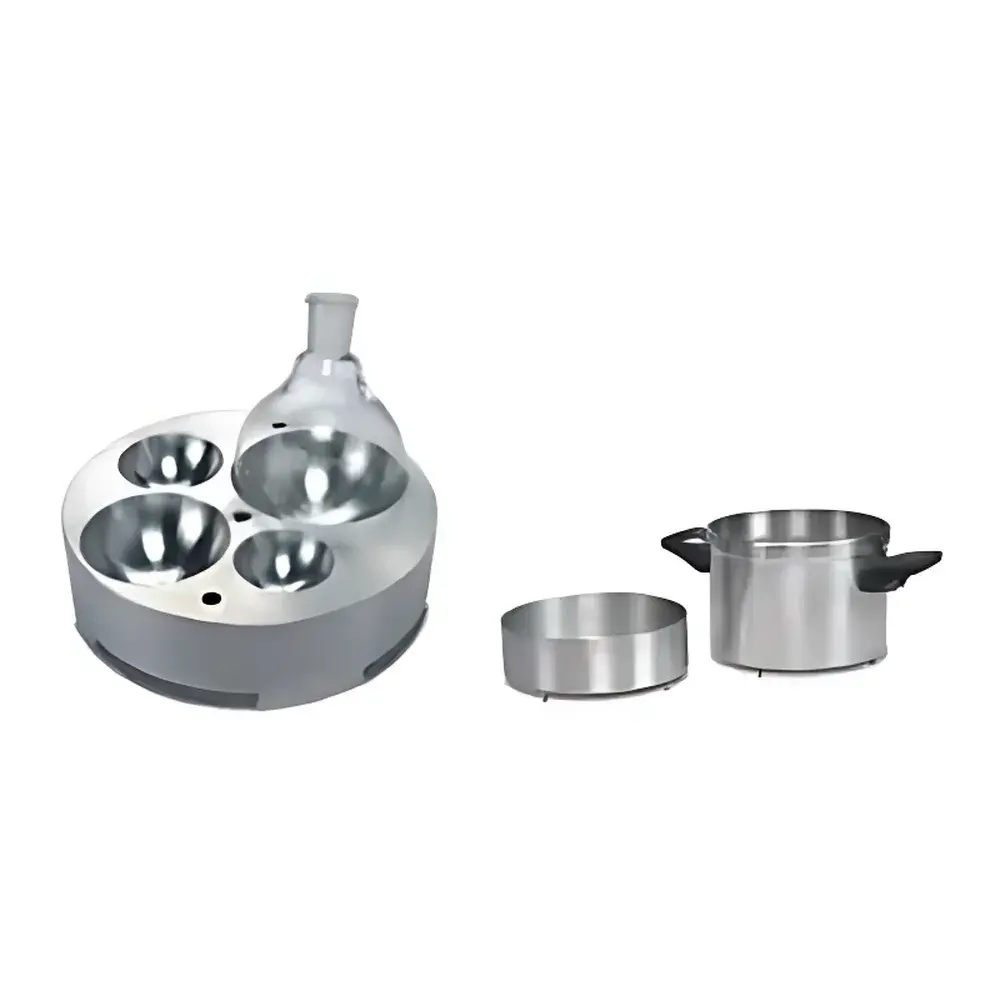
Esco SB16 Series Heating Block & Bath Accessories for Magnetic Stirrers and Hotplates
| Origin | Germany |
|---|---|
| Manufacturer Type | Authorized Distributor |
| Origin Category | Imported |
| Pricing | Available Upon Request |
Overview
The Esco SB16 Series is a modular set of precision-engineered thermal accessories designed to extend the functionality, safety, and application range of standard laboratory magnetic stirrers and hotplates. Unlike integrated heating systems, the SB16 accessories operate as passive thermal transfer modules—relying on conduction from an underlying heating surface—to deliver uniform, controllable, and chemically inert thermal environments for reaction vessels. Each component is purpose-built for distinct thermal management needs: silicone safety shields prevent solvent splashing and boiling-over during vigorous stirring; aluminum oil baths provide stable, homogeneous heat distribution for glassware up to 2 L capacity; sand baths offer dry, gentle heating ideal for temperature-sensitive or moisture-sensitive samples in test tubes or small flasks; and precision-machined aluminum heating blocks enable reproducible, vessel-specific thermal coupling for round-bottom flasks (25 mL, 50 mL, 100 mL, and 250 mL). All units feature four-point corner support for mechanical stability and thermal isolation from the base plate.
Key Features
- Chemical-resistant silicone safety shield (SB16/1–SB16/4) engineered to withstand common organic solvents, acids, and bases—minimizing risk of splash exposure and thermal runaway during exothermic reactions
- Aluminum oil bath (SB16/5) with phenolic resin handle for thermal insulation and ergonomic handling; compatible with borosilicate glass containers up to 2 L volume
- Aluminum sand bath (SB16/6) optimized for dry-heat applications—ideal for dehydration, gentle warming of thermolabile compounds, or use with non-immersible vessels
- Interchangeable round-bottom flask heating block (SB16/7) featuring CNC-machined, tolerance-controlled wells for 25 mL, 50 mL, 100 mL, and 250 mL flasks—ensuring consistent thermal contact and minimizing thermal gradient across the vessel wall
- All metal components constructed from anodized aluminum alloy for corrosion resistance, dimensional stability across thermal cycles, and long-term mechanical integrity
- Modular design supports GLP-compliant workflow documentation—each accessory carries a unique Esco part number (e.g., SB16/5) for traceability and inventory control
Sample Compatibility & Compliance
The SB16 Series accommodates a broad range of standard laboratory glassware and sample formats without requiring equipment modification. The silicone shield fits over flat hotplate surfaces or stirrer housings with minimal clearance; oil and sand baths accept cylindrical vessels with diameters ≤90 mm; the flask block accepts standard taper joints (24/40, 29/32) and maintains alignment under static and low-agitation conditions. These accessories are not standalone instruments and do not carry independent regulatory certifications; however, when used with CE-marked Esco stirrers or hotplates (e.g., Esco SBS series), the combined system complies with IEC 61010-1:2010 for electrical safety and EN 60529 for IP20 ingress protection. The silicone material meets ISO 10993-5 cytotoxicity requirements for indirect contact with laboratory reagents.
Software & Data Management
As passive thermal interface hardware, the SB16 accessories do not incorporate embedded electronics, firmware, or data logging capabilities. Temperature monitoring must be performed externally using calibrated probe-based thermometers (e.g., Pt100 or thermocouple sensors) inserted via pre-drilled ports in the SB16/7 block or immersed directly into oil/sand media. When paired with Esco digital hotplates supporting RS-232 or USB connectivity (e.g., SBS-D series), users may record setpoint temperatures and elapsed time via third-party LabVIEW or Python-based acquisition scripts. No proprietary software is required, and no audit trail or 21 CFR Part 11 compliance features are provided—consistent with their classification as Class I laboratory consumables per FDA guidance.
Applications
- Controlled reflux and distillation setups using round-bottom flasks on magnetic stirrer/hotplate combinations
- Solvent evaporation under inert atmosphere with minimized bumping via SB16/1–SB16/4 shields
- Enzyme kinetics assays requiring stable, non-contact heating of microcentrifuge tubes placed within SB16/6 sand bath
- Preparation of calibration standards in volumetric flasks where immersion in liquid baths is prohibited
- GMP-aligned QC testing workflows where accessory traceability (via SB16 part numbers) supports instrument qualification documentation (IQ/OQ)
- Teaching laboratories requiring durable, reusable, and easily sanitized thermal interfaces for undergraduate organic chemistry experiments
FAQ
Are SB16 accessories compatible with non-Esco hotplates or stirrers?
Yes—provided the base unit has a flat, thermally conductive surface (≥120 mm × 120 mm minimum footprint) and maximum operating temperature ≥200 °C for aluminum components or ≥250 °C for silicone shields.
Can the SB16/7 flask block be used without a stir bar?
Yes—it functions as a conductive heating mantle replacement and does not require magnetic agitation; however, mixing must be performed manually or via external overhead stirrer.
Is autoclaving supported for any SB16 component?
No—silicone shields may be cleaned with isopropanol or mild detergent; aluminum parts are wipe-clean only. Autoclaving will degrade silicone elasticity and oxidize anodized aluminum surfaces.
What is the thermal response time for SB16/5 oil bath when heated from 25 °C to 100 °C?
Approximately 12–18 minutes, depending on hotplate power output (1000–1500 W typical) and ambient conditions—measured at center-point oil temperature using a calibrated immersion probe.
Do SB16 accessories require periodic recalibration?
No—they are passive thermal mass components with no active sensing or feedback elements; verification of thermal uniformity may be performed annually using ASTM E220-17 standard test methods for thermocouple calibration.



