
Excelitas Qioptiq iFLEX-iRIS-488 Low-Noise, High-Stability Diode Laser System
| Brand | Qioptiq |
|---|---|
| Origin | United Kingdom |
| Manufacturer Type | Authorized Distributor |
| Import Status | Imported |
| Model | iFLEX-iRIS-488 |
| Core Technology | Single Transverse/Longitudinal Mode Semiconductor Laser |
| Output Power | 25 mW |
| Beam Diameter (1/e²) | 0.7 mm |
| Beam Divergence | Diffraction-Limited |
| Beam Quality | TEM₀₀, M² < 1.1 |
| Power Stability (8 h) | < 0.5% RMS |
| Intensity Noise | < 0.05% RMS (20 Hz – 20 MHz) |
| Polarization Ratio | >200:1 (Vertical) |
| Polarization Axis Tolerance | ±2° |
| Beam Pointing Stability | <1 µrad/°C |
| Dimensions | 70 mm × 40 mm × 38 mm |
Overview
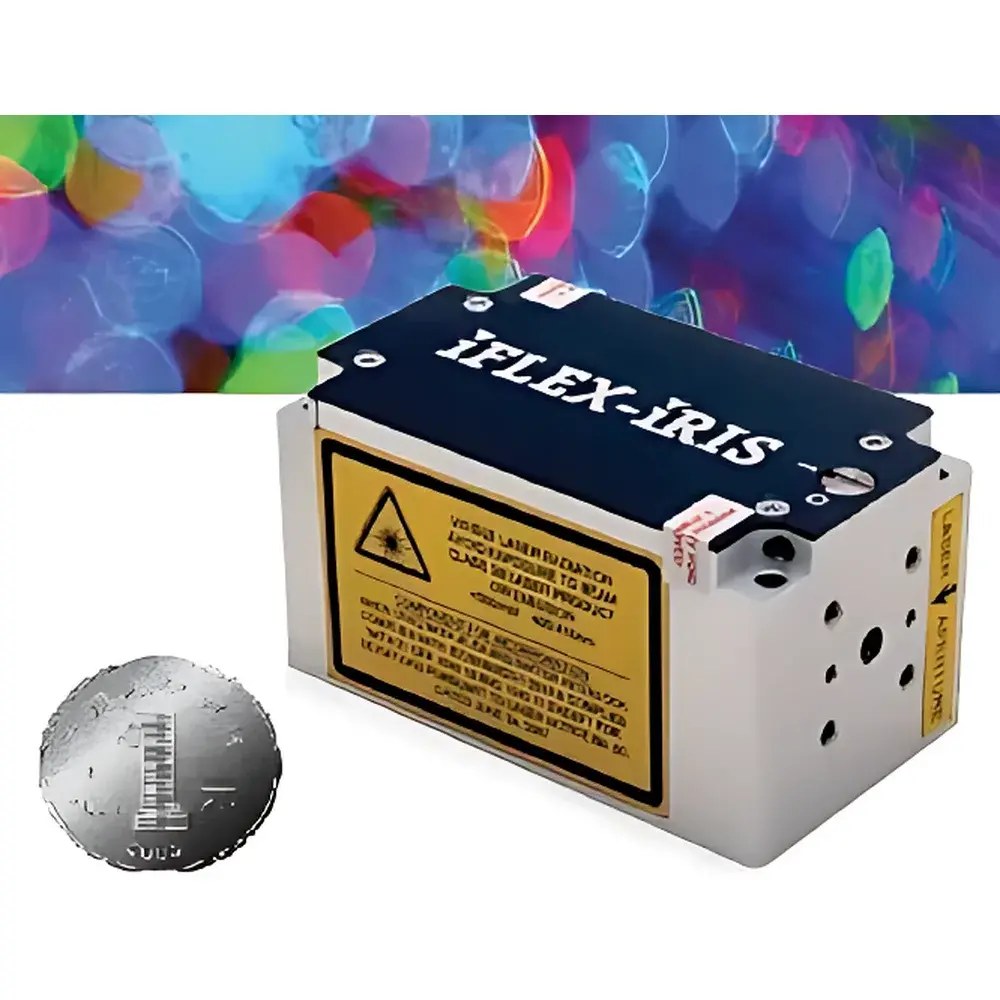
The Excelitas Qioptiq iFLEX-iRIS-488 is a precision-engineered, single longitudinal and transverse mode (TEM₀₀) diode laser system designed for applications demanding ultra-low intensity noise, exceptional long-term power stability, and diffraction-limited beam quality. Operating at the 488 nm spectral line—historically associated with argon-ion lasers but now delivered via robust semiconductor technology—the iFLEX-iRIS-488 leverages advanced thermal management, active feedback control, and hermetically sealed optical cavity design to achieve performance metrics previously attainable only with gas or solid-state lasers. Its core measurement principle relies on stabilized edge-emitting semiconductor gain media coupled with integrated photodiode monitoring and real-time current/temperature compensation algorithms. This architecture ensures sub-0.5% RMS power drift over 8-hour continuous operation and intensity noise below 0.05% RMS across the 20 Hz–20 MHz bandwidth—critical for photon-starved detection modalities such as confocal fluorescence imaging, time-resolved spectroscopy, and interferometric metrology.
Key Features
- TEM₀₀ output with M² < 1.1 and diffraction-limited divergence, enabling efficient coupling into single-mode fibers and high-numerical-aperture microscope objectives
- Beam pointing stability of <1 µrad/°C—achieved through monolithic mechanical design and low-CTE housing—minimizing spatial drift during thermal cycling in environmental chambers or multi-laser alignment setups
- Integrated polarization control with >200:1 extinction ratio and angular tolerance of ±2°, supporting polarimetric assays and ellipsometry without external waveplates
- Compact OEM form factor (70 × 40 × 38 mm) with industry-standard electrical interfaces (TTL modulation, analog power control) and USB/RS-232 communication for system integration
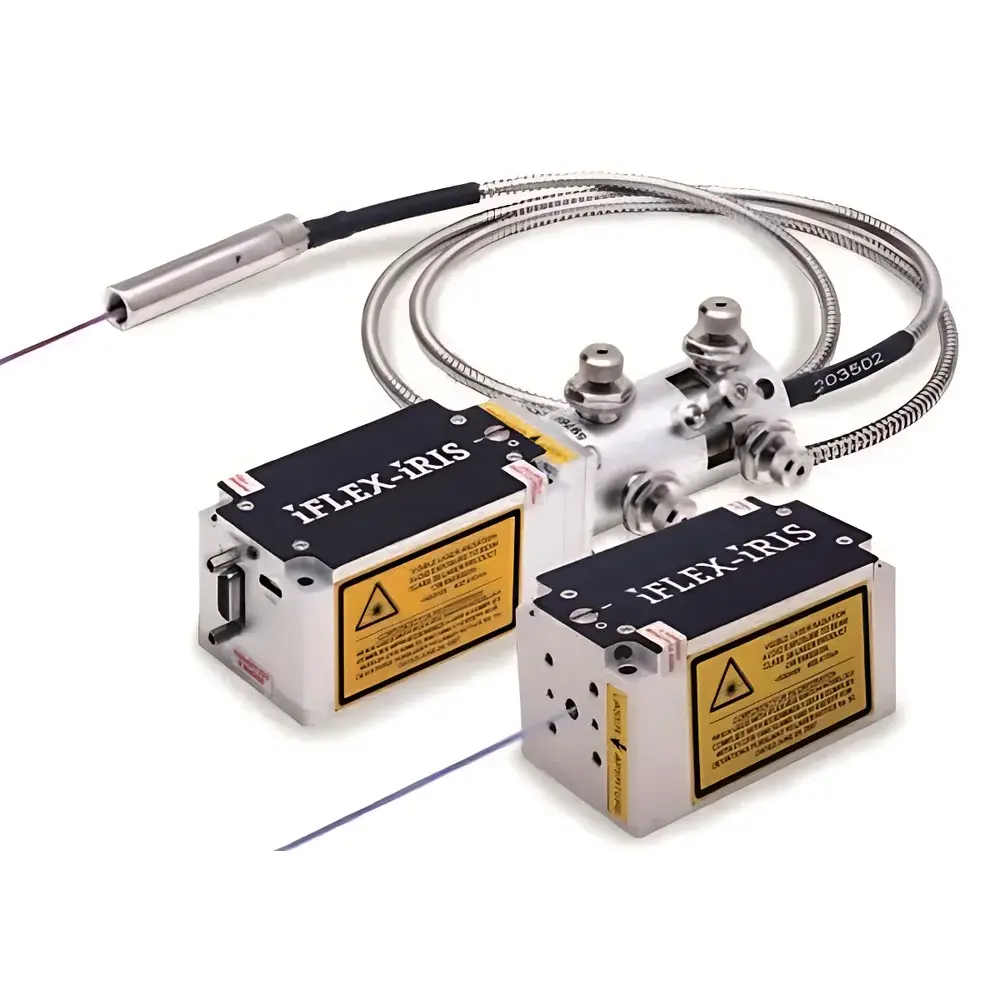
- Native compatibility with Qioptiq’s kineFLEX fiber delivery platform, enabling plug-and-play beam delivery with <50 nm positional repeatability and <0.1 µrad pointing reproducibility after reconnection
Sample Compatibility & Compliance
The iFLEX-iRIS-488 is compatible with standard 100 µm or 200 µm core single-mode fibers (SMF-28, HI1060) and supports direct free-space coupling into commercial confocal, super-resolution, and holographic systems. It meets IEC 60825-1:2014 Class 3B laser safety requirements when operated within specified enclosure configurations. The laser controller firmware implements hardware-enforced interlock protocols compliant with EN 61511 and supports audit-ready operational logging for GLP/GMP environments. While not inherently FDA 21 CFR Part 11–compliant, its digital interface enables traceable parameter logging when integrated with validated third-party data acquisition software adhering to electronic record retention standards.
Software & Data Management
The laser operates via Qioptiq’s proprietary LaserControl Suite (v3.2+), offering real-time monitoring of output power, case temperature, diode current, and photodiode feedback voltage. All parameters are timestamped and exportable in CSV or HDF5 format. Remote control is supported over USB Virtual COM port or Ethernet (optional module), enabling synchronization with camera triggers, stage controllers, or spectrometer acquisition clocks using TTL or programmable delay functions. For OEM integration, a full C/C++ SDK and Python bindings are provided—including callback-based event handling for fault conditions (e.g., over-temperature, interlock break) and support for multi-laser master-slave sequencing.
Applications
- Confocal and STED microscopy requiring stable excitation fluence to minimize photobleaching and enable quantitative intensity calibration
- Ophthalmic biometry and adaptive optics systems where beam pointing stability directly impacts retinal image registration accuracy
- Dynamic light scattering (DLS) instruments needing <0.05% RMS noise to resolve sub-nanometer particle size distributions in polydisperse colloids
- Holographic optical trapping and interferometric particle tracking, where phase coherence and amplitude stability govern trap stiffness and trajectory fidelity
- DNA sequencing platforms utilizing 488 nm excitation for SYBR Gold or Alexa Fluor 488 labeling—where signal-to-noise ratio determines base-calling confidence
- Calibration-grade photonic test benches serving ISO/IEC 17025-accredited metrology labs for validating optical power meters and beam profilers
FAQ
Is the iFLEX-iRIS-488 suitable for use in FDA-regulated diagnostic instruments?
Yes—when integrated into a validated system architecture with appropriate risk management documentation (ISO 14971) and firmware-controlled safety interlocks, it has been deployed in CE-marked and FDA 510(k)-cleared flow cytometers and ophthalmic imaging devices.
Can the laser be modulated at frequencies above 10 MHz?
The analog modulation bandwidth is DC–10 MHz (−3 dB); for digital on/off switching up to 50 MHz, optional high-speed TTL driver modules are available under part number iFLEX-HSD-488.
Does the system include beam collimation optics?
Yes—the integrated collimator delivers a 0.7 mm (1/e²) beam with divergence matched to diffraction limits for 488 nm; no external collimation is required for standard OEM integration.
What is the expected lifetime under continuous operation?
Rated for >20,000 hours MTBF at 25°C case temperature and 70% nominal output power, per Telcordia GR-468-CORE reliability testing protocols.
Is wavelength stabilization available as an option?
Wavelength locking to atomic absorption lines (e.g., potassium D1 line at 488.01 nm) is supported via external grating feedback or Fabry–Pérot etalon modules—contact technical sales for custom configuration options.






