
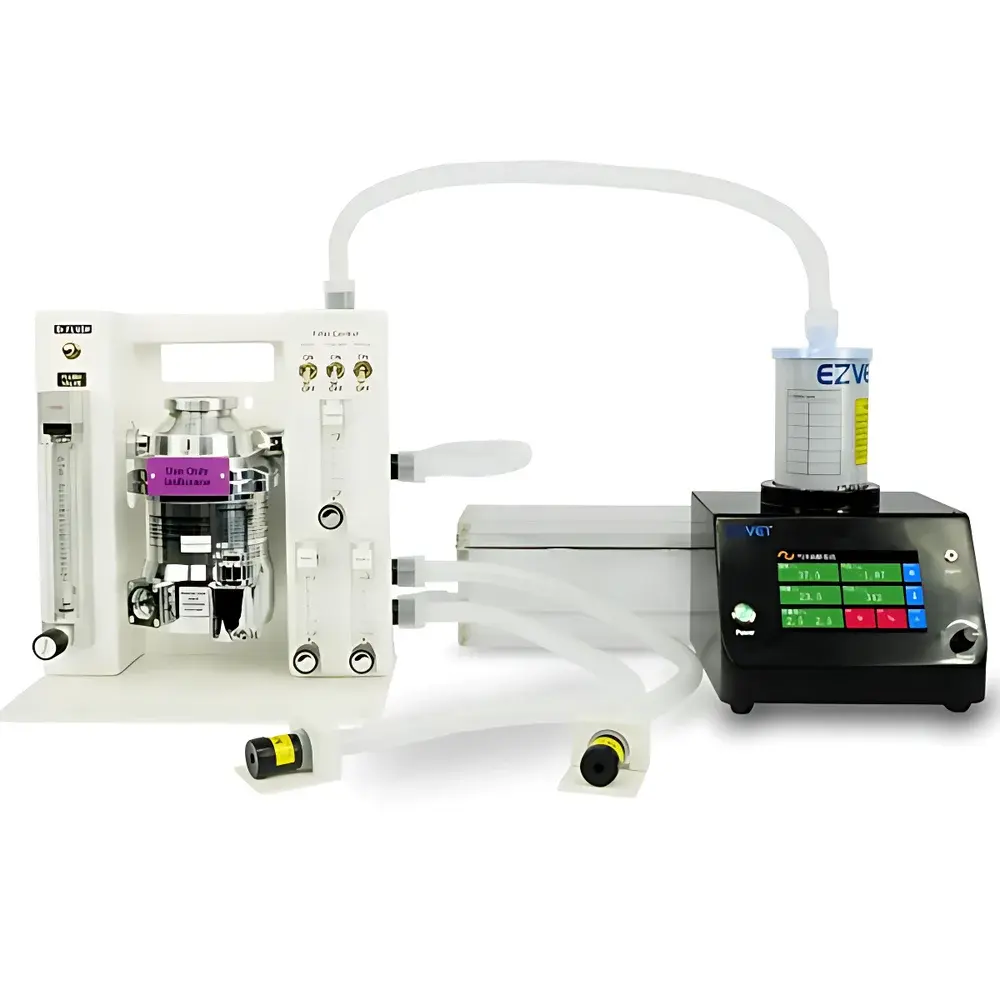
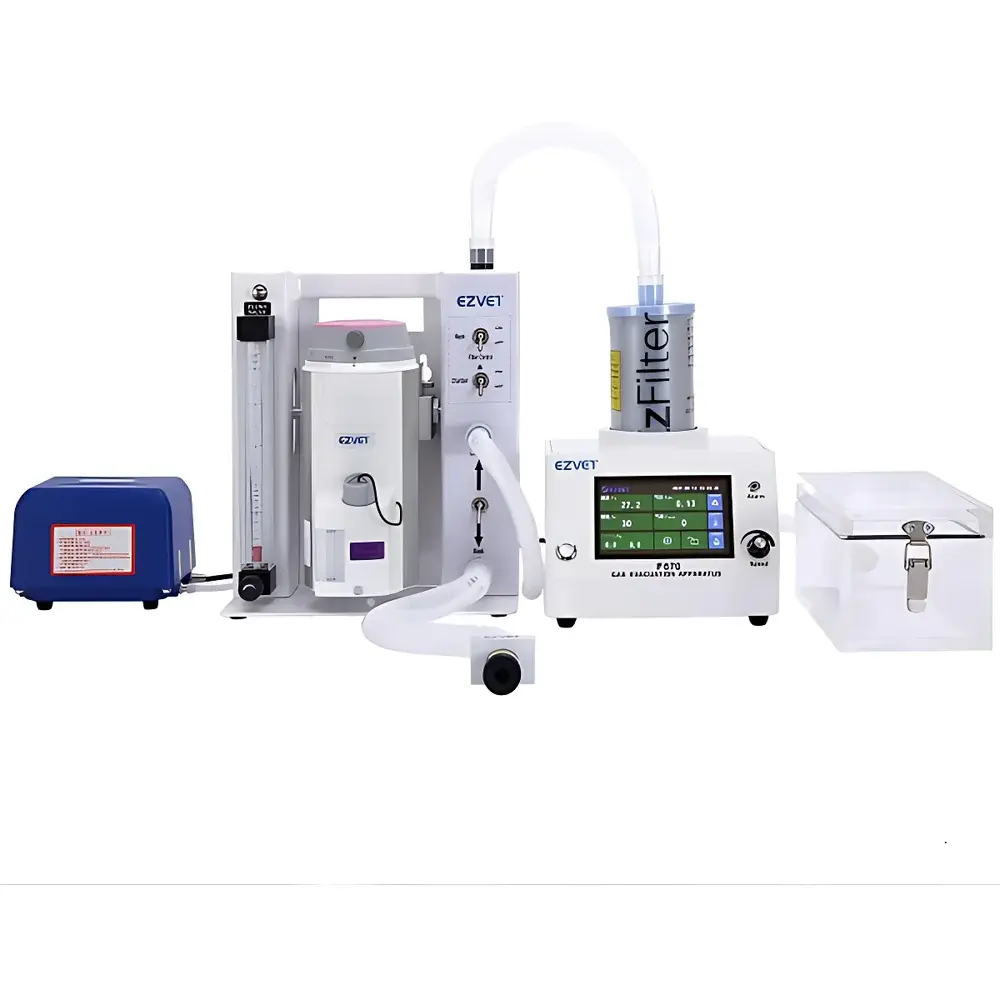
EZ Vet F700 Small Animal Anesthesia Machine
| Brand | EZ Vet |
|---|---|
| Origin | Beijing, China |
| Model | F700 |
| Anesthetic Vaporizer | Imported calibrated isoflurane/sevoflurane vaporizer |
| Animal Weight Range | ≤ 7.0 kg |
| Compatible Species | Mice, rats, guinea pigs, rabbits, cats |
| Oxygen Flow Rate | 1–4 L/min (adjustable) |
| Rapid Oxygen Flush | 10 L/min |
| Anesthetic Concentration Range | 0–5% (v/v) |
| Circuit Type | Coaxial semi-closed rebreathing system |
| Exhaust Gas Management | Active and passive scavenging options |
| Configuration | Benchtop or mobile cart-mounted |
| Mask Interface | Species-specific face masks included |
| Compliance | Designed for GLP-compliant preclinical research environments |
Overview
The EZ Vet F700 Small Animal Anesthesia Machine is an engineered solution for precise, reproducible inhalational anesthesia delivery in preclinical research settings. It operates on the principle of calibrated vaporization—where liquid volatile anesthetics (isoflurane or sevoflurane) are converted into a controlled gaseous mixture via a temperature- and flow-compensated imported vaporizer—and delivered through a coaxial semi-closed rebreathing circuit. This architecture minimizes dead space, reduces gas consumption, and maintains stable inspired anesthetic concentrations across variable respiratory rates typical in small mammals (e.g., mice: 80–200 breaths/min; rats: 60–120 breaths/min). The system is validated for use with animals weighing up to 7.0 kg, including rodents (mice, rats, guinea pigs), lagomorphs (rabbits), and juvenile felines—making it suitable for longitudinal surgical studies, neuroimaging protocols, and terminal procedures requiring strict anesthetic titration.
Key Features
- Coaxial dual-lumen breathing circuit: Integrates inspiratory and expiratory pathways within a single compact conduit—reducing bench footprint by >30% versus conventional Y-shaped circuits while maintaining laminar flow integrity and minimizing resistance.
- Imported calibrated anesthetic vaporizer: Factory-calibrated for both isoflurane and sevoflurane; features built-in temperature compensation and pressure-independent output across 1–4 L/min oxygen flow range.
- Rapid oxygen flush: Delivers 10 L/min medical-grade O₂ for immediate induction or emergency reversal of deep anesthesia—actuated via single-button interface with mechanical lockout to prevent accidental activation.
- Modular expandability: Supports seamless integration with optional accessories—including ventilators (pressure-controlled or time-cycled), multi-animal manifold systems (up to 4 channels), and active charcoal-based waste-gas scavengers compliant with ISO 8573-1:2010 (Class 2 compressed air quality).
- Dual configuration flexibility: Configurable as a fixed benchtop unit or mobile cart-mounted system with locking casters, cable management tray, and integrated O₂ cylinder bracket (D-size compatible).
Sample Compatibility & Compliance
The F700 is validated for consistent anesthetic delivery across species exhibiting divergent respiratory physiology: murine models (tidal volume: 0.15–0.25 mL/g; minute volume: 120–250 mL/kg/min), rabbits (tidal volume: 8–12 mL/kg), and domestic cats (tidal volume: 10–15 mL/kg). All delivered gas pathways comply with ISO 80601-2-13:2021 (medical electrical equipment – anesthesia workstations) for leakage limits (<30 mL/min at 3 kPa), CO₂ absorbent compatibility (soda lime or baralyme), and CO₂ monitoring readiness (standard 15 mm ISO connector). The system supports audit-ready documentation per GLP Annex III (OECD Principles) and aligns with AAALAC International standards for veterinary anesthesia monitoring—including mandatory use of pulse oximetry, capnography, and core temperature tracking (not included, but interface-ready).
Software & Data Management
While the F700 operates as a standalone analog-digital hybrid platform (no embedded OS), its front-panel controls and vaporizer output are fully compatible with third-party data acquisition systems via 0–5 V analog outputs (O₂ flow, vapor concentration, pressure). Optional RS-232/USB interface modules enable timestamped logging of anesthetic concentration, flow rate, and flush events into LabChart, MATLAB, or custom Python-based acquisition pipelines. All configuration changes—vaporizer selection, flow setpoint, or circuit mode—are recorded with operator ID and UTC timestamp when paired with compliant electronic lab notebooks (ELNs) satisfying FDA 21 CFR Part 11 requirements for audit trails.
Applications
- Preclinical surgical models: Craniotomy, orthotopic tumor implantation, vascular cannulation, and spinal cord injury studies where stable plane maintenance is critical for hemodynamic stability.
- Functional imaging: fMRI, PET, and optical coherence tomography requiring motion-free anesthesia over extended durations (≥2 hr) without hypothermia or hypercapnia.
- Toxicology and pharmacokinetic studies: Precise dose-response characterization using volatile anesthetics as co-interventions or procedural enablers.
- Veterinary teaching laboratories: Standardized demonstration of inhalational anesthetic principles, circuit mechanics, and scavenging safety protocols per AVMA guidelines.
- Regulatory submissions: Data generated using the F700 meets ICH S5(R3) and OECD 407/422 requirements for animal welfare documentation during nonclinical safety studies.
FAQ
What anesthetic agents are supported by the F700 vaporizer?
The imported vaporizer is calibrated for isoflurane and sevoflurane only. Desflurane and halothane are not supported due to differing vapor pressure and thermal sensitivity profiles.
Is the coaxial circuit compatible with CO₂ monitoring?
Yes—the expiratory limb includes a standard 15 mm ISO sampling port positioned upstream of the CO₂ absorbent canister, enabling accurate mainstream capnography without flow disruption.
Can the F700 be used in GMP-regulated manufacturing environments?
It is designed for GLP-compliant research use. For GMP applications, additional IQ/OQ/PQ validation documentation and vendor-supplied calibration certificates (traceable to NIST standards) must be obtained separately.
Does the system include oxygen supply integration?
The F700 accepts medical-grade oxygen from D-size cylinders (via CGA 540 regulator) or central pipeline supply (50 psi inlet); external pressure regulators and check valves are required for pipeline use.
How often does the CO₂ absorbent require replacement?
Under typical rodent use (2–4 hr/day), soda lime should be replaced every 6–8 hours of cumulative flow or when color indicator shifts from white to violet—consistent with ASTM F2069-21 recommendations for absorbent endpoint detection.



