
BTX Electroporation Cuvettes by Harvard Apparatus
| Brand | Harvard Apparatus |
|---|---|
| Origin | USA |
| Distributor Type | Authorized Distributor |
| Import Status | Imported |
| Models | BTX 610, BTX 620, BTX 640 |
| Sterility | Gamma-Irradiated, Individually Packed |
| Electrode Material | Embedded Aluminum |
| Electrode Gap Options | 1.0 mm, 2.0 mm, 4.0 mm |
| Maximum Electric Field Strength | 25 kV/cm |
| Cap Design | Leak-Resistant Snap-On Cap |
| Volume Range per Cuvette | 20–800 µL |
| Packaging | 50 sterile units per box |
Overview
BTX electroporation cuvettes are precision-engineered disposable electroporation accessories designed for reliable, reproducible nucleic acid or macromolecule delivery into prokaryotic and eukaryotic cells. Developed in collaboration with Harvard Apparatus and manufactured under stringent ISO 13485-compliant processes in the United States, these cuvettes operate on the principle of transient membrane permeabilization via controlled high-voltage electric pulses. The embedded aluminum electrodes ensure low-resistance current pathways and minimal joule heating, critical for maintaining cell viability post-pulse. Each cuvette is pre-sterilized using validated gamma irradiation (25–35 kGy), certified to ISO 11137, and supplied in individually sealed, pyrogen-free packaging—ensuring compliance with GLP and GMP-aligned laboratory workflows. The standardized geometry and precise electrode gap tolerances (< ±0.05 mm) enable consistent field strength calculation (E = V/d), facilitating protocol transferability across instruments including BTX ECM 830, ECM 630, and compatible third-party electroporators.
Key Features
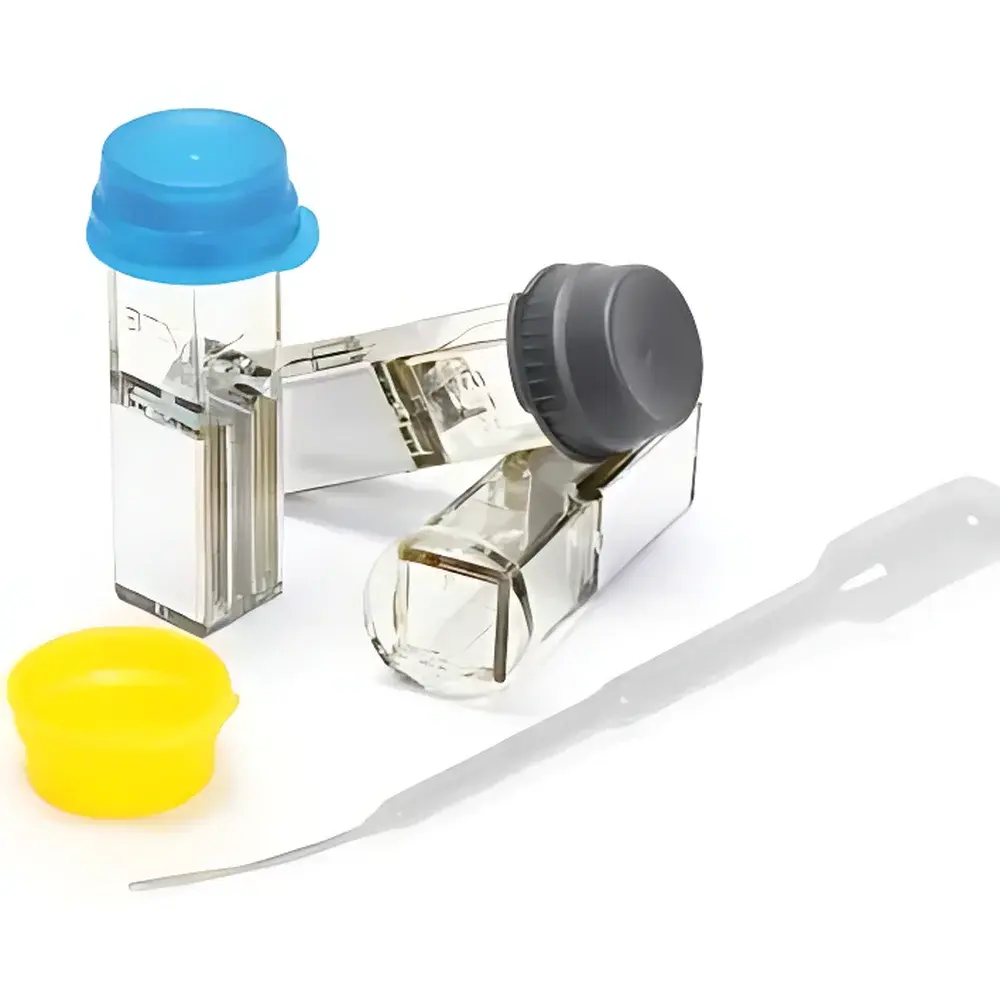
- Three precisely calibrated electrode gap options: 1.0 mm (BTX 610, gray), 2.0 mm (BTX 620, blue), and 4.0 mm (BTX 640, yellow), enabling optimization of electric field strength for diverse cell types and applications.
- Volume-optimized internal geometry: nominal working volumes of 20–70 µL (610), 40–400 µL (620), and 80–800 µL (640), supporting both low-input plasmid transfection and high-yield bacterial electroporation.
- Integrated leak-resistant snap-on cap with positive sealing mechanism—enables single-finger removal without compromising sterility or sample integrity during handling.
- Electrodes fabricated from high-purity aluminum with passivated surface finish to minimize electrochemical side reactions and metal ion leaching during pulse delivery.
- Consistent wall thickness and optical clarity (UV-transparent polycarbonate body) support post-electroporation viability assessment via microscopy or spectrophotometric quantification.
Sample Compatibility & Compliance
These cuvettes are validated for use with a broad spectrum of biological samples, including Escherichia coli, Bacillus subtilis, Saccharomyces cerevisiae, primary mammalian neurons, CHO-K1, HEK293T, and suspension-grown plant protoplasts. All lots undergo endotoxin testing (LAL assay; ≤0.03 EU/mL) and bioburden verification per USP . Packaging conforms to ASTM D4169 performance standards for medical device shipping containers. Documentation includes Certificate of Conformance, Sterilization Validation Report, and Material Safety Data Summary—supporting audit readiness for FDA 21 CFR Part 11, ISO 17025, and EU Annex 1 environments.
Software & Data Management
While the cuvettes themselves are passive consumables, their dimensional specifications and material properties are integrated into Harvard Apparatus’ ECM Series instrument firmware (v4.2+). Pulse parameter libraries auto-calculate recommended voltage settings based on selected model (e.g., 610 → 1.2 kV for 12 kV/cm), reducing operator-dependent error. Audit trails generated during electroporation runs—including cuvette lot ID, timestamp, voltage, capacitance, and resistance—can be exported in CSV or XML format for integration with LIMS or ELN systems compliant with ALCOA+ principles.
Applications
- High-efficiency plasmid transformation in E. coli DH5α and electrocompetent strains (transformation efficiency >1 × 10¹⁰ CFU/µg pUC19).
- CRISPR-Cas9 RNP delivery into primary T cells and iPSCs with >85% editing efficiency and >70% post-electroporation viability (measured by Annexin V/PI flow cytometry).
- Transient siRNA transfection in hard-to-transfect adherent lines (e.g., MCF-7, A549) with ≥90% knockdown at 48 h post-treatment.
- Agrobacterium-mediated plant protoplast transformation and somatic hybridization protocols requiring uniform field distribution across heterogeneous cell suspensions.
- Preclinical vaccine development workflows involving DNA vaccine delivery into dendritic cells and ex vivo antigen-presenting cell activation assays.
FAQ
Are BTX 610/620/640 cuvettes compatible with non-BTX electroporators?
Yes—provided the instrument accepts standard 0.5 cm path-length cuvettes and supports adjustable voltage output up to 2.5 kV (for 610) or 10 kV (for 640). Users must manually calculate field strength (kV/cm) using the formula E = V / d.
Can these cuvettes be reused after sterilization?
No. They are single-use, gamma-irradiated devices. Reuse compromises electrode integrity, increases arcing risk, and invalidates sterility claims per ISO 13408-1.
What is the shelf life and storage requirement?
36 months from manufacture date when stored at 15–25°C, protected from UV light and humidity. Do not freeze or autoclave.
How is lot-to-lot consistency verified?
Each production lot undergoes dimensional metrology (CMM), electrical resistance mapping, and sterility assurance testing per ISO 11737-2, with full traceability to raw material batch numbers.
Do you provide custom packaging or OEM labeling?
Yes—Harvard Apparatus offers private-label options and bulk configurations (e.g., 250-unit master cases) under NDA, subject to minimum order quantities and regulatory alignment review.





