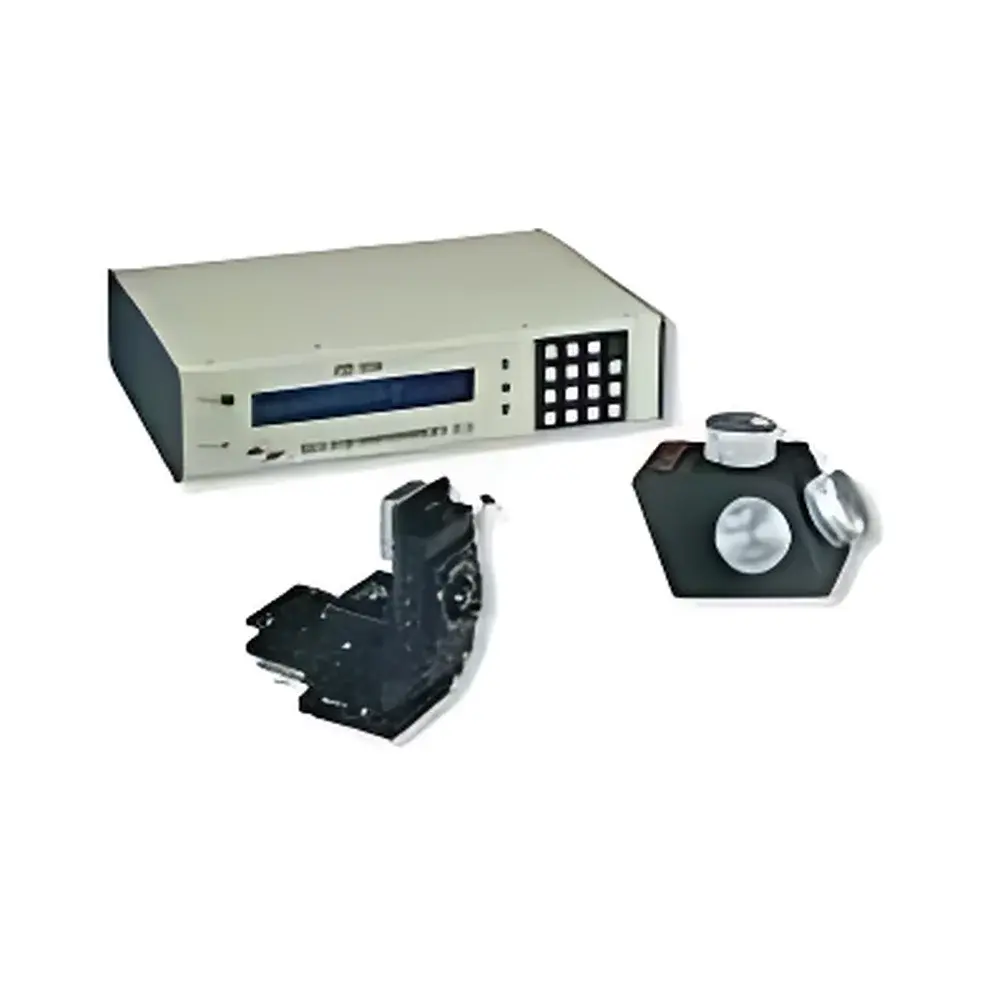
Sutter MP-285 Motorized Micromanipulator
| Brand | Sutter |
|---|---|
| Origin | USA |
| Model | MP-285 |
| Drive Type | Motorized (DC stepper motor) |
| Axes | 4-axis (X, Y, Z, Oblique) |
| Travel Range | 25 mm per axis |
| Minimum Step Resolution | 0.04 µm (high-res mode) / 0.2 µm (low-res mode) |
| Maximum Speed | 2.9 mm/sec |
| Drift | ≤10 nm/hr at 24°C |
| Position Display | LCD with real-time X/Y/Z coordinate readout (µm resolution) |
| Control Modes | Continuous motion and discrete step motion |
| Programmability | RS-232 and USB interface for external computer control |
| Homing Function | Yes (user-defined HOME position) |
| Microscope Compatibility | Universal mounting (standard dovetail and adapter plates) |
| Compliance | Designed for GLP-compliant electrophysiology workflows |
| Software Integration | Compatible with SutterPatch, PatchMaster, and third-party acquisition platforms (e.g., Axon pCLAMP, HEKA PatchMaster) |
Overview
The Sutter MP-285 Motorized Micromanipulator is a precision-engineered electromechanical positioning system designed for high-fidelity, sub-micron manipulation of microelectrodes, pipettes, and optical probes in live-cell electrophysiology and intracellular recording applications. Based on closed-loop DC stepper motor actuation and low-thermal-drift mechanical architecture, the MP-285 delivers exceptional positional stability and repeatability under prolonged experimental conditions. Its core operational principle relies on digitally controlled motorized translation along four orthogonal degrees of freedom—X, Y, Z, and oblique (diagonal)—enabling precise 3D navigation within the focal plane of upright or inverted research-grade microscopes. The device is widely deployed in patch-clamp electrophysiology, single-cell injection, optogenetic probe placement, and simultaneous multi-electrode positioning where nanoscale positional fidelity and thermal drift minimization are critical to data integrity.
Key Features
- Four-axis motorized control (X, Y, Z, and oblique) with independent, synchronized motion capability
- High-resolution positioning: 0.04 µm minimum step size in fine-resolution mode; 0.2 µm in coarse mode
- Full travel range of 25 mm per axis (1 inch), compatible with standard microscope stages and chamber configurations
- Real-time LCD display showing absolute X/Y/Z coordinates in micrometers and adjustable velocity (0.1–2.9 mm/sec)
- Thermally stable design achieving ≤10 nm/hr positional drift at ambient 24°C—validated per ASTM E2550 thermal drift testing protocols
- Dual operation modes: continuous analog-style motion and discrete step-based positioning for reproducible electrode advancement
- Programmable homing function with user-definable reference origin for rapid return to calibrated starting positions
- RS-232 and USB 2.0 interfaces enabling integration with electrophysiology acquisition software (e.g., pCLAMP 11+, PatchMaster 2x, SutterPatch)
- Modular mechanical interface supporting universal microscope mounting via standard dovetail rails and optional adapter kits
- Onboard firmware supports command-line ASCII protocol for custom LabVIEW, Python, or MATLAB automation scripts
Sample Compatibility & Compliance
The MP-285 is optimized for use with glass micropipettes (1–5 MΩ tip resistance), sharp intracellular electrodes, patch-clamp pipettes, and fiber-optic cannulae. Its low-vibration drive system and rigid aluminum-alloy frame minimize mechanical coupling to sensitive biological preparations, making it suitable for acute brain slice recordings, cultured neuron assays, and oocyte voltage-clamp experiments. The instrument conforms to IEC 61000-6-3 (EMC emissions) and IEC 61010-1 (safety requirements for laboratory equipment). While not a medical device per FDA 21 CFR Part 820, its design supports GLP/GMP-aligned documentation practices—including audit-trail-capable software logging when used with compliant acquisition platforms—and meets essential performance criteria referenced in ISO/IEC 17025 for calibration traceability of motion systems in accredited labs.
Software & Data Management
The MP-285 operates natively via its front-panel keypad and LCD interface but achieves full experimental integration through bidirectional serial communication. Sutter’s official MP-285 Command Set provides ASCII-based instruction syntax for position queries, speed configuration, axis enable/disable, and macro execution. Third-party support includes native drivers for HEKA PatchMaster (v2.82+), Molecular Devices pCLAMP (via Digidata 1550B interface), and open-source tools such as PySerial-based control libraries. All position commands and responses are timestamped and machine-readable, enabling synchronization with electrophysiological event markers. When deployed in regulated environments, users may implement 21 CFR Part 11-compliant electronic signatures and audit trails using validated acquisition software—though the MP-285 itself does not store or encrypt operational logs.
Applications
- Patch-clamp electrophysiology: Precise approach and seal formation with recording electrodes on neurons, cardiomyocytes, and HEK293 cells
- Intracellular microinjection: Controlled delivery of dyes, siRNA, or CRISPR-Cas9 complexes into single cells
- Optogenetic probe alignment: Accurate positioning of optical fibers or waveguides relative to targeted neural structures
- Multi-pipette array manipulation: Coordinated movement of dual or triple patch electrodes for paired recordings
- Correlative microscopy: Synchronized repositioning of electrodes during concurrent confocal or two-photon imaging sessions
- Developmental biology: Micromanipulation of zebrafish embryos, C. elegans gonads, or Drosophila larval tissues
FAQ
What is the positional accuracy specification of the MP-285?
The MP-285 achieves ±0.1 µm repeatability over its full 25 mm range under standard lab conditions (22–25°C, no air currents). Absolute accuracy depends on calibration against NIST-traceable interferometric standards.
Can the MP-285 be integrated with Nikon or Zeiss microscope stages?
Yes—via optional dovetail-to-stage adapters (e.g., Sutter DA-100 for Nikon Eclipse series; DA-200 for Zeiss Axio Observer). Mechanical clearance and Z-height compatibility must be verified per microscope model.
Is firmware upgrade supported in the field?
Firmware updates require Sutter-provided utility software and a USB-to-serial converter; upgrades are performed only by authorized service personnel to maintain calibration integrity.
Does the MP-285 support analog voltage input for manual joystick control?
No—the MP-285 is digital-only; however, third-party analog-to-serial converters (e.g., National Instruments USB-6009 + custom VI) can emulate step commands via voltage mapping.
How is thermal drift compensated during long-duration experiments?
Drift mitigation is passive: the unit’s low-coefficient aluminum chassis, thermally isolated motor mounts, and ambient-stabilized enclosure design collectively limit drift to ≤10 nm/hr—no active temperature feedback loop is implemented.