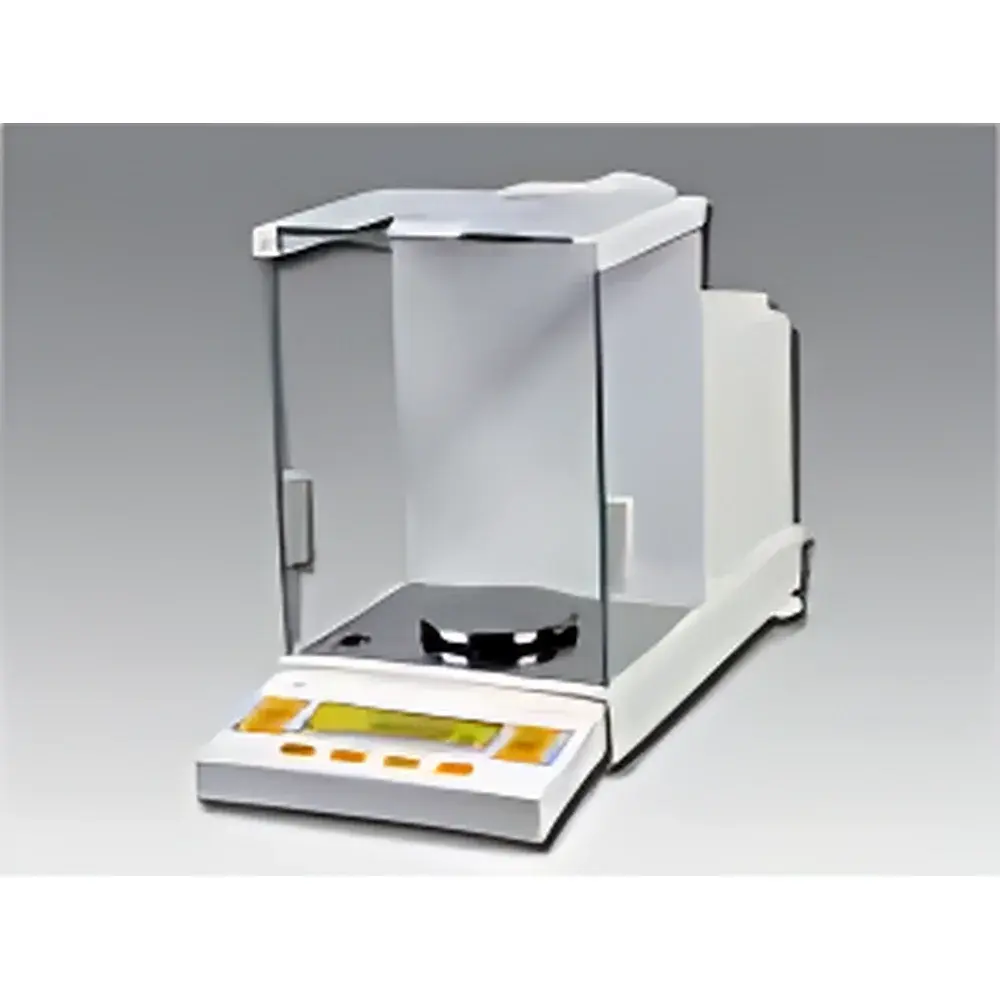
FB124 Automatic Internal Calibration Precision Analytical Balance
| Key | Capacity: 120 g |
|---|---|
| Readability | 0.1 mg |
| Repeatability | ≤ 0.1 mg |
| Linearity | ±0.2 mg |
| Pan Diameter | Φ90 mm |
| Draft Shield Dimensions | 195 × 160 × 235 mm |
| Overall Dimensions | 195 × 445 × 300 mm |
| Power Options | AC adapter or 9 V DC battery |
| Interface | RS232 serial port |
| Sensor Type | High-sensitivity rear-mounted electromagnetic force compensation sensor |
| Calibration | Dual internal calibration weights with digital multi-point linear correction |
| Compliance | Designed for GLP-compliant environments |
Overview
The FB124 Automatic Internal Calibration Precision Analytical Balance is an electromagnetic force compensation-based analytical instrument engineered for high-accuracy mass measurement in regulated and research-intensive laboratory environments. Operating on the principle of magnetic force restoration—where sample weight induces displacement in a precision coil system, and feedback current restores equilibrium—the FB124 delivers stable, drift-resistant readings without mechanical levers or strain gauges. Its 0.1 mg readability (1 part in 1,200,000 of full scale) meets the performance threshold required for pharmacopeial assays, reference standard preparation, and quantitative gravimetric analysis per USP , ISO/IEC 17025, and ASTM E898 guidelines. The balance integrates dual internal calibration masses and real-time digital linearization algorithms to compensate for thermal drift, positional sensitivity, and long-term sensor hysteresis—eliminating reliance on external weights during routine operation while maintaining traceability to national standards.
Key Features
- Rear-mounted electromagnetic force sensor architecture ensures superior resolution, minimal creep, and immunity to mechanical wear—addressing fundamental limitations of traditional strain-gauge transducers.
- Automatic dual-weight internal calibration system performs full-range verification at user-defined intervals or upon power-on, temperature shift (>1.5 °C), or time-based triggers—fully compliant with ISO 9001 calibration management requirements.
- Digital multi-point linear correction applies dynamic offset and gain compensation across the entire weighing range, reducing linearity error to ±0.2 mg and repeatability to ≤0.1 mg under controlled ambient conditions (20 ±2 °C, RH <65%).
- Front-access, pillar-free transparent draft shield (195 × 160 × 235 mm) provides unobstructed sample handling and optimal airflow control—critical for volatile, hygroscopic, or static-prone samples.
- Six-key integrated front panel with backlit LCD display enables intuitive navigation through tare, counting, unit conversion (g, oz, ct, dwt, grain), and memory recall functions—no menu nesting or firmware-dependent workflows.
- Standard RS232 interface supports bidirectional communication with LIMS, ELN, or QC software platforms; optional drivers available for LabArchives, Thermo Fisher SampleManager, and Waters Empower.
Sample Compatibility & Compliance
The FB124 accommodates standard analytical sample formats—including crucibles, vials, filter papers, and microcentrifuge tubes—on its Φ90 mm stainless-steel weighing pan. Its draft shield design complies with ISO 17025 clause 5.5.2 for environmental isolation during critical measurements. The balance supports Good Laboratory Practice (GLP) documentation protocols: all calibration events, zero checks, and user-initiated operations are timestamped and logged internally (up to 1,000 entries). When connected via RS232, it exports ASCII-formatted data with operator ID, date/time stamp, net weight, tare value, and status flags—enabling 21 CFR Part 11–compliant electronic records when paired with validated host software. It is routinely deployed in pharmaceutical QC labs performing assay validation (ICH Q2(R2)), excipient blending uniformity testing, and residual solvent gravimetric recovery studies.
Software & Data Management
No proprietary software installation is required for basic data capture: the FB124 outputs ASCII text streams compatible with Excel, Notepad++, and statistical process control (SPC) tools. For automated reporting, third-party middleware (e.g., BalanceLink Pro or LabX Lite) can be configured to trigger print-to-PDF, database insertion, or email alerts upon completion of predefined weighing sequences. All internal logs retain metadata including calibration certificate IDs, environmental sensor readings (if externally interfaced), and firmware revision numbers—facilitating internal audits and regulatory inspections. Audit trails are immutable once generated and cannot be edited or deleted—a requirement aligned with GMP Annex 11 and EU GMP Chapter 4 data integrity principles.
Applications
- Pharmaceutical: Preparation of primary reference standards, content uniformity testing of tablets, and loss-on-drying (LOD) determinations per USP .
- Academic Research: Gravimetric synthesis of nanomaterials, catalyst loading quantification, and stoichiometric reagent dispensing in organic chemistry labs.
- Materials Science: Density determination of polymer pellets, ash content analysis of composites, and particulate matter collection efficiency validation.
- Environmental Testing: Weighing of quartz fiber filters pre- and post-PM2.5 sampling per EPA Method IO-3.2.
- Food & Agriculture: Moisture content analysis in grains, additive concentration verification, and nutritional labeling compliance checks.
FAQ
Does the FB124 require external calibration weights for daily verification?
No—the dual internal calibration masses enable full-range verification without manual intervention. External weights are only required for periodic metrological verification (e.g., annual accredited calibration per ISO/IEC 17025).
Is the RS232 interface compatible with modern Windows 11 systems?
Yes—when used with a certified USB-to-RS232 adapter and standard COM port configuration, the FB124 integrates seamlessly with current OS platforms and enterprise data systems.
Can the balance operate continuously on battery power?
It supports 9 V DC battery operation for field use or backup, but continuous weighing depletes standard alkaline cells within ~8 hours; for lab deployment, AC power is recommended to ensure thermal stability and uninterrupted calibration cycles.
What environmental conditions affect measurement stability?
Ambient temperature fluctuations >1.5 °C/hour, air currents exceeding 0.2 m/s near the draft shield, and electrostatic discharge from synthetic lab coats may induce transient errors—mitigated by proper placement on a vibration-isolated bench and use of ionizing bars where necessary.
How is traceability maintained during internal calibration?
Each internal calibration mass is factory-certified against NIST-traceable standards; calibration certificates include uncertainty budgets, measurement procedures, and accreditation details from CNAS-accredited laboratories (Certificate No. CNAS LXXXXX).