
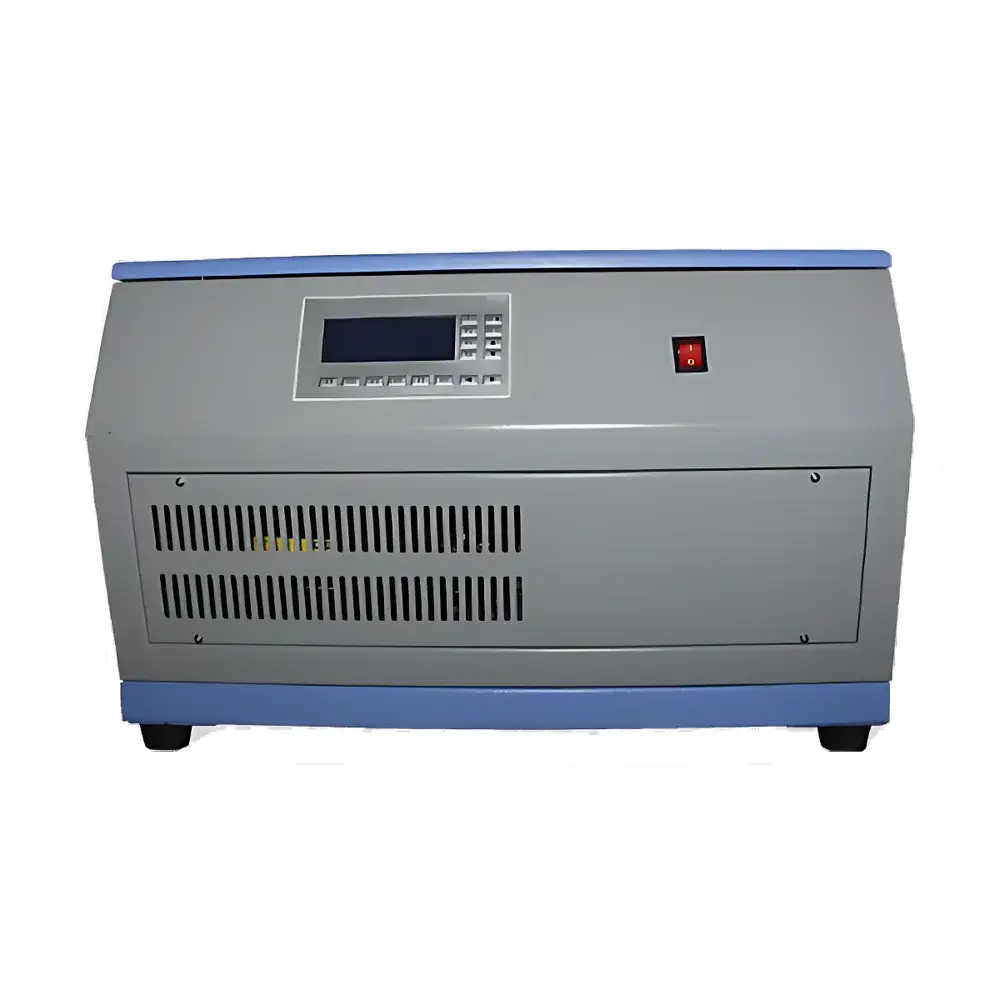
FDT-0304 Petroleum Pour Point Tester by CSFriend
| Brand | CSFriend |
|---|---|
| Origin | Hunan, China |
| Model | FDT-0304 |
| Temperature Range | Ambient to –70 °C (customizable) |
| Compliant Standard | GB/T 510 |
| Cooling System | Imported Refrigeration Compressor |
| Control Accuracy | ±0.5 °C |
| Power Supply | AC 220 V ±10%, 50 Hz |
| Max Power Consumption | ≤1000 W |
| Operating Environment | ≤30 °C, RH ≤85% |
| Display | LCD with Bilingual (Chinese/English) Interface |
| Timing & Alert | Automated Timing and Audible/Visual Alerts |
| Temperature Calibration | Built-in Offset Correction and Calibration Functionality |
Overview
The CSFriend FDT-0304 Petroleum Pour Point Tester is an automated, dual-bath thermal analysis instrument engineered for precise determination of the pour point of petroleum products in accordance with GB/T 510—China’s national standard equivalent to ASTM D97 and ISO 3016. The pour point is defined as the lowest temperature at which a petroleum sample remains fluid under specified cooling and observation conditions; it serves as a critical low-temperature performance indicator for lubricating oils, diesel fuels, crude oils, and residual fuels. Unlike manual tilt-and-observe methods, the FDT-0304 implements controlled, stepwise cooling in two thermally isolated but identically regulated baths, enabling reproducible sample conditioning and standardized tilt evaluation per GB/T 510 Clause 6. Its core architecture integrates a high-efficiency imported refrigeration compressor, PID-based digital temperature control, and real-time thermal stability monitoring—ensuring compliance with GLP-aligned laboratory practices where traceable, auditable thermal profiles are required.
Key Features
- Dual-bath constant-temperature design: Two independent yet isothermal cooling chambers allow simultaneous conditioning and testing—reducing cycle time and eliminating inter-sample thermal carryover.
- Precision temperature control: Achieves ±0.5 °C stability across the full operating range (ambient to –70 °C), with optional extended-range customization available upon request.
- Bilingual LCD interface: Intuitive Chinese/English menu navigation with context-sensitive prompts, reducing operator training time and minimizing procedural errors.
- Automated timing and alert system: Integrated microcontroller initiates and logs cooling intervals per GB/T 510 protocol (e.g., 3 °C increments, 3-minute dwell per step), triggering visual and audible alerts at each evaluation stage.
- Thermal calibration suite: Onboard offset correction and reference-point calibration functions support routine verification against certified NIST-traceable thermometer standards.
- Robust thermal insulation and compressor cooling: Engineered for continuous operation in ambient environments ≤30 °C and ≤85% relative humidity, with total power draw capped at 1000 W for lab-scale deployment.
Sample Compatibility & Compliance
The FDT-0304 accommodates standard GB/T 510 test tubes (Φ20 mm × 170 mm) and supports viscous and paraffinic samples including base oils, aviation turbine fuels, marine distillates, and heavy fuel oils. It strictly adheres to the procedural sequence defined in GB/T 510—including sample preparation, preheating, controlled cooling rate, and manual tilt assessment at specified temperature intervals. While the instrument does not automate the physical tilt-and-observe step (as mandated by the standard), its thermal uniformity and repeatability significantly enhance inter-laboratory agreement. For regulatory environments requiring audit trails, users may pair the FDT-0304 with external data loggers compliant with FDA 21 CFR Part 11 for electronic record retention.
Software & Data Management
The FDT-0304 operates via embedded firmware without proprietary PC software. All operational parameters—including setpoint temperature, dwell duration, calibration offsets, and test history—are stored in non-volatile memory. Test logs include date/time stamps, final reported pour point, and user ID (if configured). While the unit lacks Ethernet or USB export, printed reports can be generated via optional RS-232–connected thermal printers. Laboratories implementing LIMS integration typically interface the device through serial-to-MQTT gateways or custom SCADA drivers, enabling structured logging into platforms supporting ISO/IEC 17025 documentation workflows.
Applications
- Quality control laboratories in refineries verifying conformance of finished diesel and jet fuel to specification limits (e.g., ASTM D97 ≤ –20 °C).
- R&D centers evaluating wax inhibition additives and cold-flow improvers in paraffinic base stocks.
- Third-party testing labs performing contract analyses for import/export clearance under Chinese customs regulations.
- Academic research on crystallization kinetics of hydrocarbon mixtures under controlled thermal gradients.
- Storage and transportation risk assessment for crude blends prone to wax deposition in sub-zero pipeline environments.
FAQ
Does the FDT-0304 comply with international standards beyond GB/T 510?
Yes—it follows the same fundamental methodology as ASTM D97 and ISO 3016; however, formal certification to those standards requires independent validation per the respective annexes.
Can the –70 °C low-temperature limit be extended further?
Custom configurations down to –80 °C are available upon engineering review, subject to compressor derating and extended stabilization time requirements.
Is tilt-angle adjustment automated?
No—the instrument does not replace the manual tilt step defined in GB/T 510; it ensures precise thermal conditioning only.
What maintenance is required for the refrigeration system?
Annual inspection of condenser coils and refrigerant pressure verification is recommended; no user-serviceable parts exist within the sealed compressor module.
How is temperature uniformity verified across both baths?
A two-point verification using calibrated platinum resistance thermometers (PRTs) at center and edge positions is performed during factory acceptance testing and documented in the CoC.





