
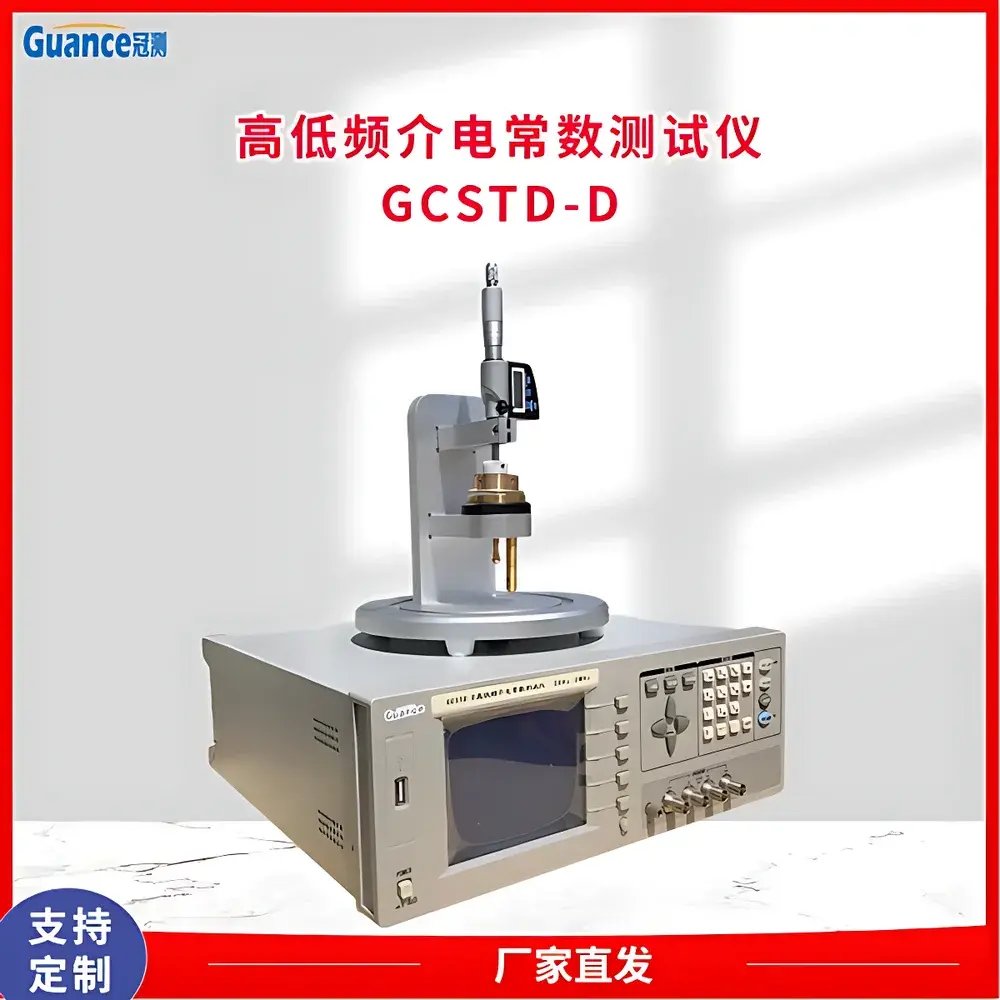
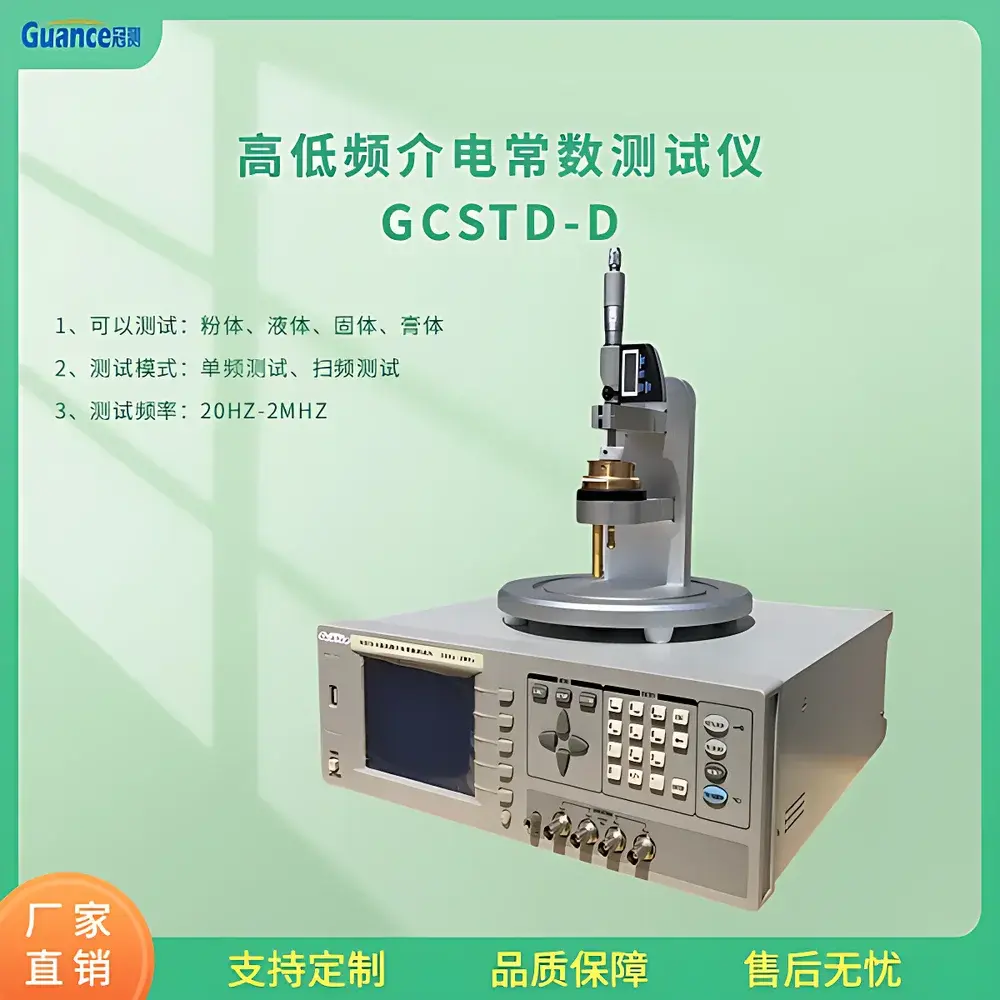
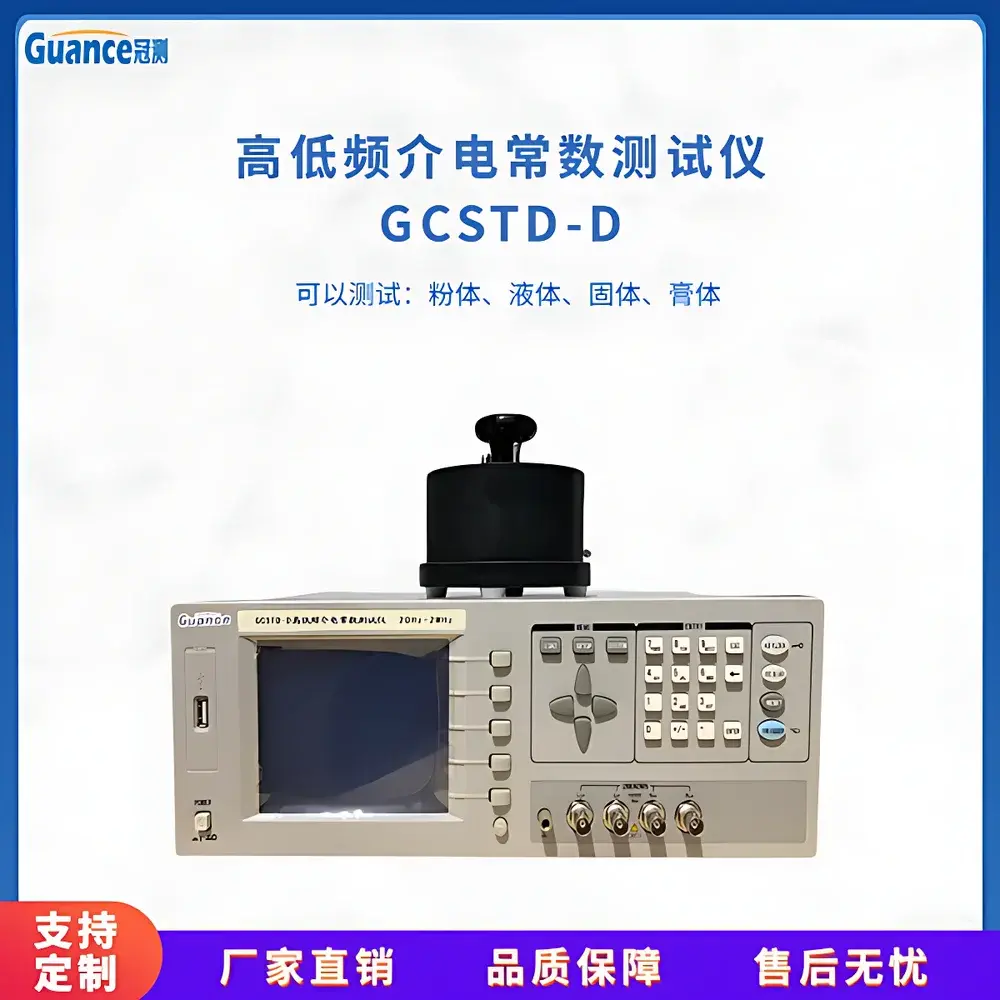
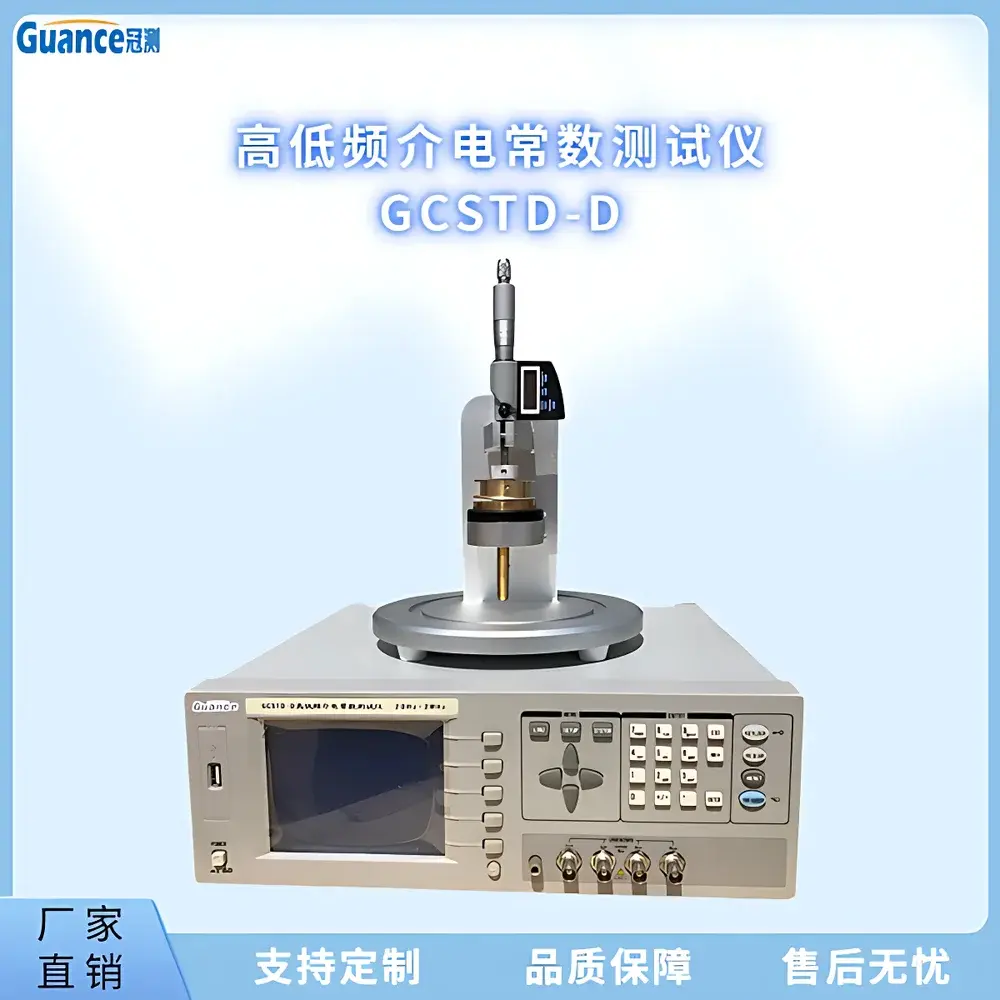
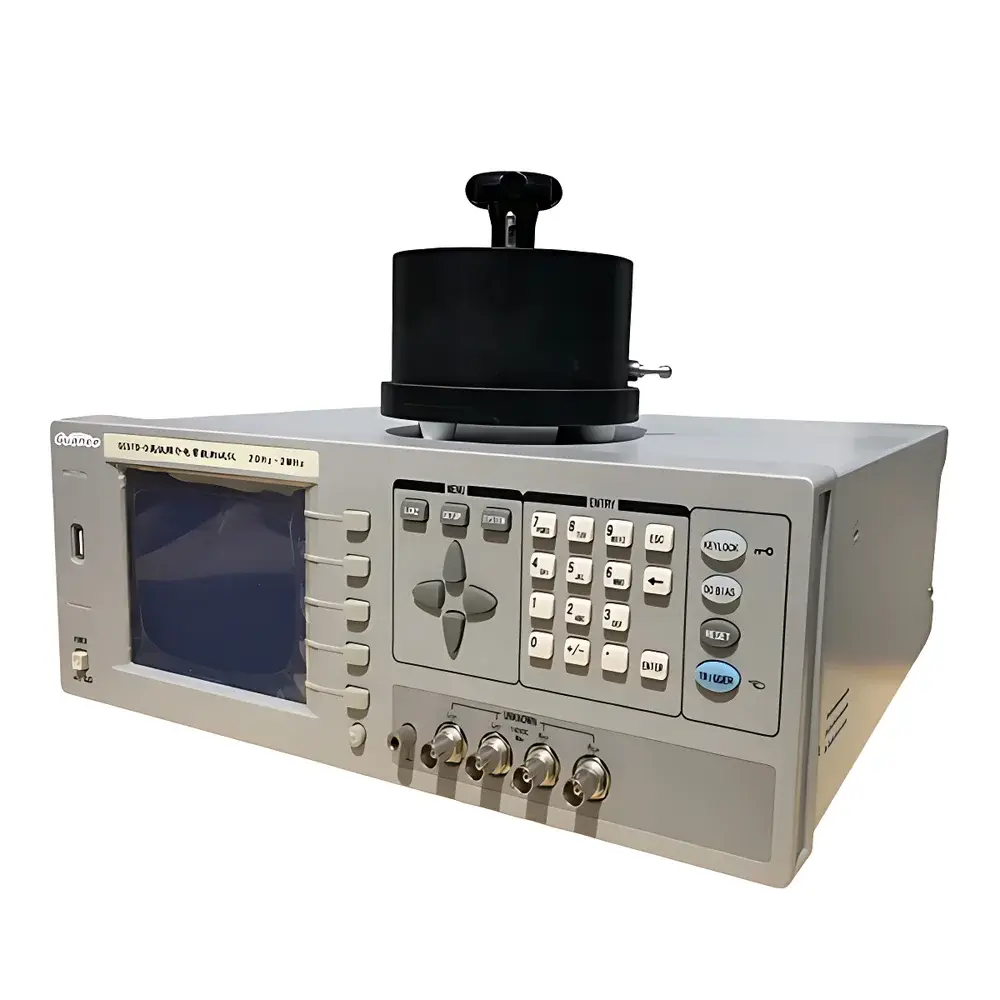
GuanCe Instruments GCSTD-D2 High-Frequency Dielectric Constant Analyzer
| Brand | GuanCe Instruments |
|---|---|
| Origin | Beijing, China |
| Manufacturer Type | Authorized Distributor |
| Country of Origin | China |
| Model | GCSTD-D2 |
| Price Range | USD 1,550 – 5,600 |
| Frequency Range | 20 Hz – 2 MHz (10 mHz resolution) |
| Test Signal Level | 10 mV – 5 V (1 mV step) |
| Basic Accuracy | ±0.1% |
| Measurement Speed | Up to 200 readings/s |
| Display | 320 × 240 dot-matrix graphical LCD |
| Resolution | 5-digit |
| Impedance Parameters | 22 configurable combinations |
| DC Bias Source | Internal |
| External DC Bias Current Support | Up to 40 A (with dual TH1776 units, optional) |
| ALP/ALC | Automatic Level Control with V/I monitoring |
| Sweep Modes | 10-point list sweep, graphical analysis |
| Memory | 20 instrument setups |
| Comparator | 10-bin sorting with counting |
| Interfaces | USB Host, RS232, GPIB (optional), Handler I/O |
| Electrode Options | Fixed disk electrodes (Ø38 mm / Ø50 mm standard), liquid cell (15 mL capacity), powder-specific electrode kits |
| Sample Types | Solids, liquids, powders, pastes, regular or irregular geometries |
Overview
The GuanCe Instruments GCSTD-D2 High-Frequency Dielectric Constant Analyzer is an impedance-based precision measurement system engineered for the quantitative characterization of dielectric properties across a broad frequency spectrum—from 20 Hz to 2 MHz. It operates on the principle of AC impedance spectroscopy using a four-terminal (Kelvin) configuration to minimize lead and contact impedance errors. The instrument applies a stable, low-distortion sinusoidal test signal and measures the complex admittance (Y = G + jB) or impedance (Z = R + jX) response of the material under test. From this, it computes the relative permittivity (εr = ε′ − jε″) and loss tangent (tan δ = ε″/ε′), which are fundamental parameters for evaluating polarization mechanisms, interfacial charge storage, and energy dissipation in insulating and semi-insulating media. Designed for laboratory- and quality control–level use, the GCSTD-D2 supports standardized evaluation per GB/T 1409–2006 (equivalent to IEC 60250), GB/T 1693–2007, and ASTM D150, ensuring traceable, repeatable results in compliance with international materials testing protocols.
Key Features
- Wide frequency coverage from 20 Hz to 2 MHz with 10 mHz resolution, enabling dispersion analysis across relaxation regimes (e.g., α, β, γ relaxations in polymers).
- High-resolution 5-digit measurement capability with ±0.1% basic accuracy—calibrated against NIST-traceable standards.
- Programmable test signal level (10 mV–5 V RMS) with automatic level control (ALC) to maintain constant voltage/current excitation across variable sample impedances.
- Dual-mode electrode support: contact-type fixed-disk electrodes (standard Ø38 mm, optional Ø50 mm), temperature-stable liquid cells (15 mL volume), and customizable powder electrodes accommodating bulk density variations.
- Integrated DC bias source (±10 V, ±100 mA) and compatibility with external high-current DC bias systems (up to 40 A via dual TH1776 units) for semiconductor C–V profiling and ferroelectric hysteresis analysis.
- Real-time graphical scanning—including Cole–Cole, Bode, and Nyquist plots—with 10-point list sweep and user-defined frequency stepping.
- Full-featured internal memory storing up to 20 instrument configurations, including calibration offsets, limit settings, and test sequences.
Sample Compatibility & Compliance
The GCSTD-D2 accommodates heterogeneous sample forms without requiring geometric idealization: rigid solids (films, sheets, molded parts), viscous liquids (resins, oils), granular powders (ceramic precursors, battery cathode materials), and soft pastes (electrode slurries, gels). Its electrode modularity ensures metrological validity regardless of surface roughness or dimensional variability—non-contact measurement modes eliminate air-gap errors common in conventional parallel-plate setups. All test methods align with ISO/IEC 17025–accredited practices. The system satisfies mandatory reporting requirements for GLP-compliant materials qualification, including audit-ready data logging (timestamped, operator-ID tagged), electronic signature support (via optional software), and full traceability to national standards (CNAS-certified calibration certificates available). It further supports FDA 21 CFR Part 11 readiness when paired with validated PC-based control software.
Software & Data Management
Instrument operation is fully programmable via USB Host interface, supporting firmware updates and script-driven batch testing. Raw impedance data (Z, θ, Y, G, B, C, L, R, Q, D, ε′, ε″, tan δ) export in CSV and TXT formats ensures seamless integration with MATLAB, Python (NumPy/Pandas), or statistical process control (SPC) platforms. Optional PC software provides advanced modeling tools—including equivalent circuit fitting (Randles, Voigt, Havriliak–Negami), Arrhenius and Williams–Landel–Ferry (WLF) thermal shift analysis, and multi-frequency permittivity mapping. All exported datasets include metadata headers specifying test conditions (frequency, bias, temperature if external sensor connected), electrode geometry, and calibration epoch—enabling reproducible re-analysis and regulatory submission.
Applications
- Determination of εr and tan δ in polymer films, laminates, and composite matrices per ASTM D150 for aerospace and automotive insulation validation.
- Quality assurance of ceramic dielectrics (MLCCs, substrates) through frequency-dependent permittivity screening to detect sintering defects or phase impurities.
- C–V profiling of semiconductor wafers and thin-film transistors to extract dopant concentration, depletion width, and interface trap density.
- Characterization of battery electrolytes and separator membranes to quantify ionic conductivity, dielectric relaxation time, and SEI layer evolution.
- Research-grade analysis of ferroelectric hysteresis loops, piezoelectric coupling coefficients, and liquid crystal director alignment dynamics.
- QC release testing of medical-grade silicone elastomers and hydrogel dressings per ISO 10993–biocompatibility electrical property requirements.
FAQ
What standards does the GCSTD-D2 comply with for dielectric measurements?
It implements test methodologies defined in GB/T 1409–2006, GB/T 1693–2007, ASTM D150, and IEC 60250, with full adherence to electrode geometry, guard ring specifications, and environmental conditioning requirements.
Can the GCSTD-D2 measure anisotropic or layered materials?
Yes—when used with custom electrode fixtures (e.g., interdigitated arrays or coaxial probes), it supports directional permittivity mapping; layered structures require deconvolution using transmission-line or effective-medium models, supported by optional analysis software.
Is calibration required before each test series?
A full open/short/load calibration is recommended before daily operation or after environmental shifts >5°C; stored calibration files remain valid for ≤72 hours under stable lab conditions (23 ± 2°C, RH < 60%).
Does the system support temperature-controlled measurements?
The base unit does not integrate thermal control, but it is compatible with third-party environmental chambers and temperature-probe inputs (via analog voltage interface) for synchronized εr(T) acquisition.
How is data integrity ensured during long-term stability studies?
All measurements include embedded timestamps, instrument serial number, operator ID (if configured), and checksum-verified binary logging—meeting ISO/IEC 17025 clause 7.5.2 for record retention and ALCOA+ principles (Attributable, Legible, Contemporaneous, Original, Accurate).



