
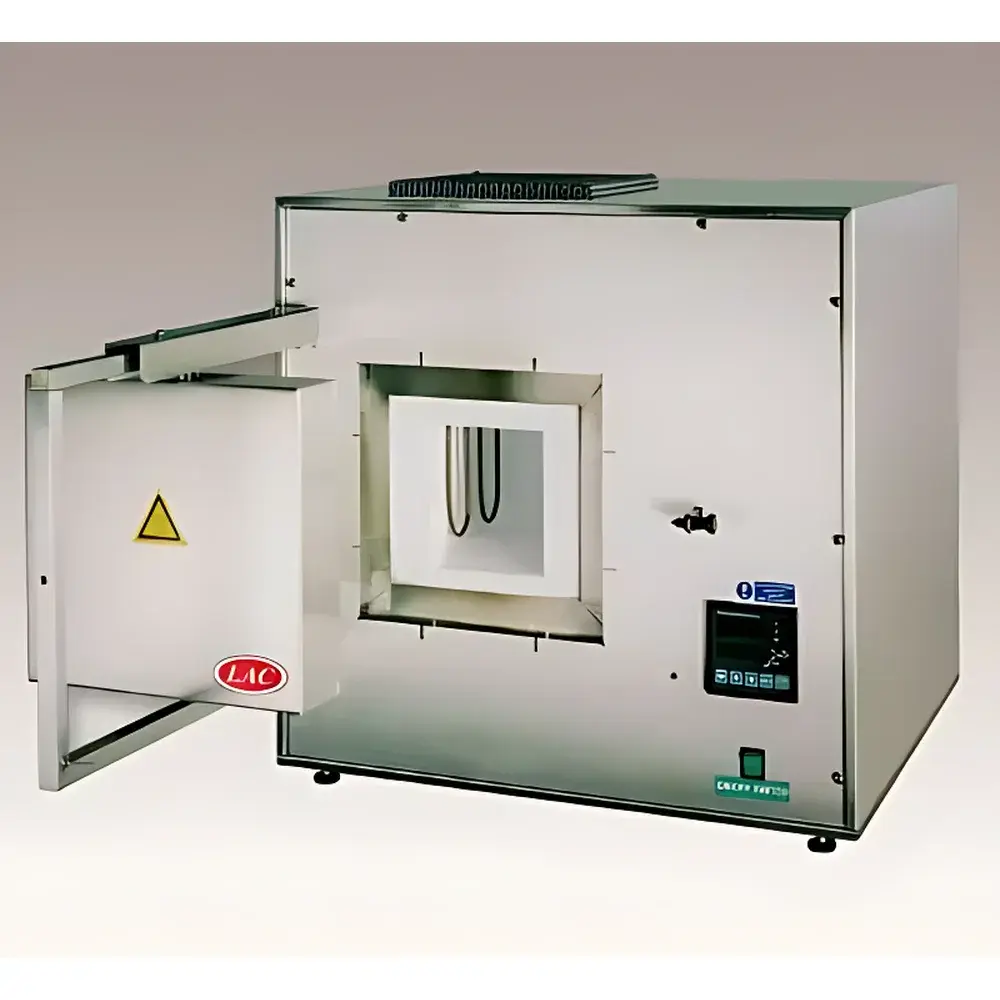
LAC VP Series High-Temperature Box Furnace
| Brand | LAC |
|---|---|
| Origin | Czech Republic |
| Model | VP |
| Type | Box-type Muffle Furnace |
| Max Temperature | 1600 °C / 1700 °C (depending on variant) |
| Chamber Volume | 2–70 L |
| Internal Dimensions (W×H×D) | 130×150×135 mm to 400×300×600 mm |
| External Dimensions (W×H×D) | 660×680×740 mm to 1100×1750×1150 mm |
| Power Input | 3–18 kW |
| Voltage | 230 V or 400 V |
| Heating Elements | Kanthal Super (MoSi₂) |
| Temperature Sensor | Type B Thermocouple (PtRh30/PtRh6) |
| Controller | INDUSTRY Programmable Controller (30 programs × 15 segments, real-time clock, ramp/soak profiling) |
| Safety | Door-mounted safety limit switch, forced-air cooling for electronics, rust-free stainless steel housing |
| Compliance | DIN 17052-1 (temperature uniformity), CE-marked |
Overview
The LAC VP Series High-Temperature Box Furnace is a precision-engineered laboratory furnace designed for demanding thermal processes up to 1700 °C. Built upon a frameless, rigid stainless steel chassis and insulated with high-purity, low-conductivity ceramic fiber modules, the VP furnace delivers exceptional thermal stability, rapid heat-up rates, and outstanding temperature uniformity across the working chamber—verified per DIN 17052-1. Its core heating architecture employs Kanthal SUPER molybdenum disilicide (MoSi₂) elements, offering long service life, oxidation resistance in air, and precise power modulation via solid-state relays. Unlike conventional resistance-wire furnaces, the VP series maintains structural integrity and dimensional stability under repeated thermal cycling, making it suitable for sintering quartz glass, ceramic matrix composites, refractory metals, and high-purity oxide materials. The furnace operates as a true muffle configuration: the heating elements are fully isolated from the process chamber by insulating barriers, eliminating contamination risk and enabling clean, inert, or oxidizing atmospheres.
Key Features
- Rust-free, electropolished stainless steel exterior housing with reinforced corner joints and seamless panel welding
- Kanthal SUPER MoSi₂ heating elements mounted in optimized radial symmetry for uniform radiant heat distribution
- Integrated safety limit switch on the side-opening door, automatically cutting power upon door actuation
- Forced-air cooling system dedicated to controller electronics and terminal blocks—ensuring stable operation during extended high-temperature cycles
- Type B thermocouple (PtRh30/PtRh6) permanently mounted at the chamber ceiling for accurate reference-zone monitoring
- INDUSTRY-series programmable controller with non-volatile memory supporting 30 independent thermal profiles, each with up to 15 ramp-soak steps and user-defined time/date triggers
- High-efficiency insulation package combining low-density ceramic fiber board and vacuum-formed fiber modules—reducing standby losses and enabling <15-minute stabilization at 1600 °C
- Low-noise solid-state relay switching (<35 dB(A)), minimizing electromagnetic interference and mechanical vibration transmission to adjacent instrumentation
Sample Compatibility & Compliance
The VP furnace accommodates crucibles and sample holders made of alumina, zirconia, graphite, or molybdenum—compatible with both air and controlled-atmosphere processing. Optional gas inlet ports support single- or multi-gas purging (e.g., N₂, Ar, H₂/N₂ mixtures) with mass flow control integration. All variants comply with CE directives for electromagnetic compatibility (2014/30/EU) and low-voltage safety (2014/35/EU). Temperature uniformity meets DIN 17052-1 Class 2 specifications (±5 °C at 1600 °C over 90% of usable volume). The controller firmware supports audit-trail logging and password-protected parameter modification—facilitating GLP/GMP-aligned workflows where traceability and operator accountability are required.
Software & Data Management
The optional RS-232/RS-485 interface enables bidirectional communication with external PCs running LAC’s proprietary temperature cycle monitoring software. This application provides real-time graphical visualization of setpoint, measured temperature, and power output; exports timestamped CSV data compliant with ASTM E230/E2022 formats; and generates PDF reports with digital signatures for regulatory submissions. When paired with the optional graphic temperature recorder, analog strip-chart outputs meet legacy validation requirements for ISO 17025-accredited labs. All recorded datasets include metadata (operator ID, furnace ID, program name, start/stop timestamps), satisfying FDA 21 CFR Part 11 electronic record retention criteria when deployed with validated IT infrastructure.
Applications
- Sintering of fused quartz, borosilicate, and optical-grade specialty glasses
- Heat treatment of advanced ceramics (Al₂O₃, SiC, ZrO₂) and ceramic-metal composites
- Ashing and residue analysis of polymer composites and pharmaceutical excipients
- Calibration of high-temperature reference materials and thermocouple wire annealing
- Thermal gravimetric pre-treatment prior to XRD or SEM-EDS analysis
- Development of refractory coatings and high-entropy alloy precursors
FAQ
What atmosphere options are supported inside the VP furnace chamber?
Standard operation is in ambient air; optional gas inlets allow continuous purging with inert (N₂, Ar), reducing (H₂/N₂), or oxidizing (O₂-enriched) atmospheres—compatible with standard flanged fittings and pressure-rated seals.
Is the INDUSTRY controller compatible with third-party SCADA systems?
Yes—via Modbus RTU over RS-485, the controller exposes all critical parameters (setpoint, PV, power %, alarm status) as read/write registers, enabling integration into LabVIEW, Ignition, or Siemens SIMATIC environments.
How is temperature uniformity verified and documented for qualification?
LAC provides a factory-issued Uniformity Test Report (UTR) per DIN 17052-1, including 9-point mapping at three temperatures (e.g., 1000 °C, 1400 °C, 1600 °C), traceable to national standards. On-site IQ/OQ protocols are available upon request.
Can the VP furnace be operated unattended overnight?
Yes—the real-time clock, automatic program start scheduling, and dual-stage overtemperature protection (hardware cut-off + software watchdog) permit safe autonomous operation for up to 168 hours, provided environmental conditions meet IEC 60529 IP20 requirements.
What maintenance intervals are recommended for MoSi₂ elements and insulation?
Under typical usage (≤10 cycles/week to 1600 °C), MoSi₂ elements require no scheduled replacement for ≥5 years; ceramic fiber insulation retains >95% thermal performance after 2000 hours at maximum temperature—verified by annual thermal loss testing.



