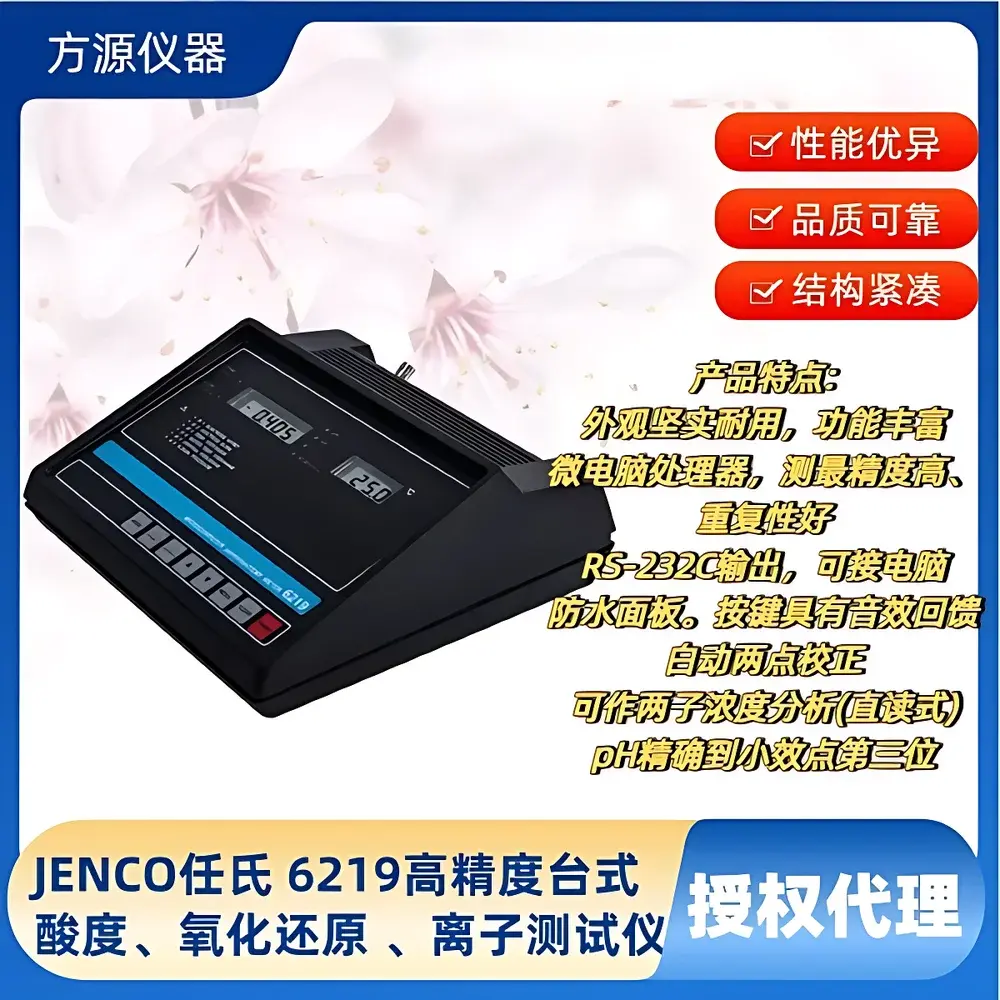
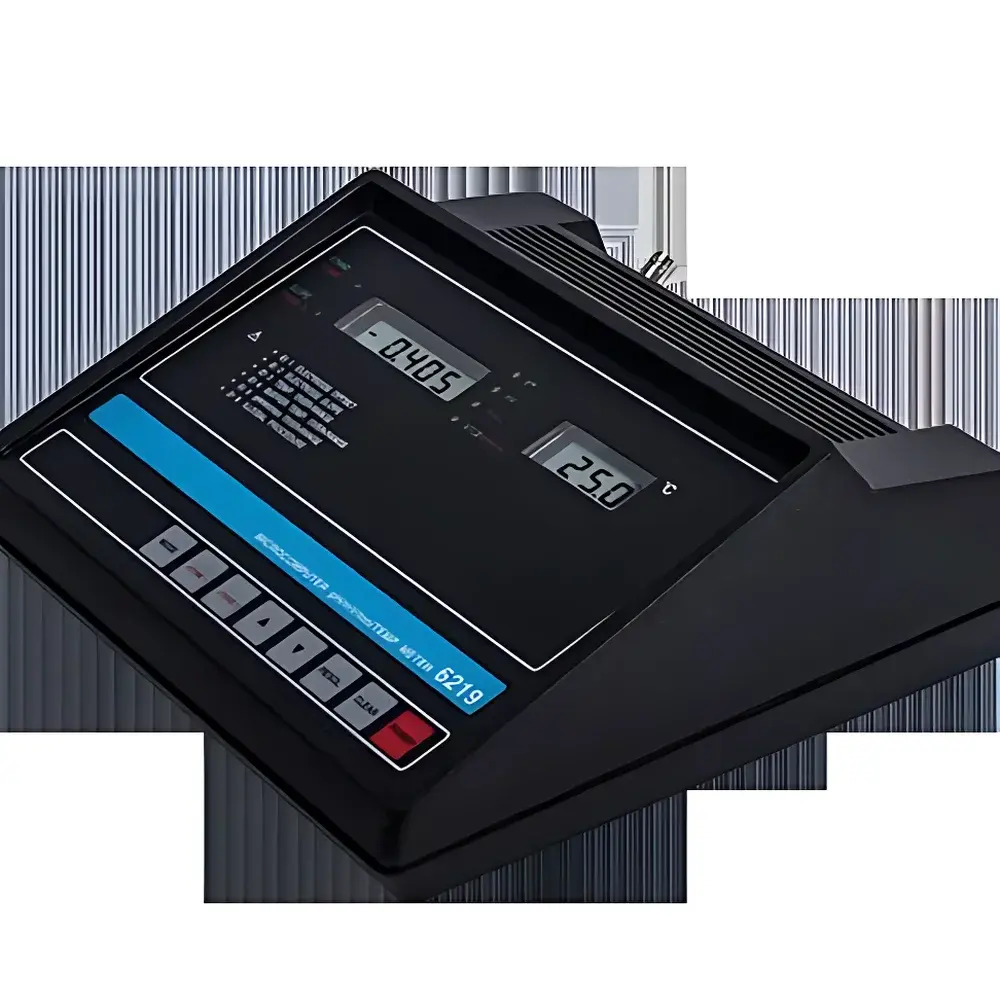
JENCO 6219 Advanced Benchtop pH/ORP/Ion Concentration Meter
| Brand | JENCO |
|---|---|
| Origin | USA |
| Model | JENCO 6219 |
| pH Range | -2.000–16.000 pH |
| pH Resolution | 0.01/0.001 pH |
| pH Accuracy | ±0.1% of full scale ±1 digit |
| ORP Range | -1999.9–1999.9 mV |
| ORP Resolution | 1/0.1 mV |
| ORP Accuracy | ±0.1% of full scale ±1 digit |
| Ion Concentration Range | 0.0–119.8 conc. |
| Ion Resolution | 0.05/0.1 |
| Ion Accuracy | ±2 digits |
| Temperature Range | -5.0–125.0 °C |
| Temperature Resolution | 0.1 °C |
| Temperature Accuracy | ±0.5 °C |
| Input Impedance | >10¹³ Ω |
| Temperature Sensor | 10 kΩ thermistor (25 °C) |
| Calibration | Auto two-point with standard buffers (pH 4.00, 6.86, 9.18) |
| Endpoint Detection & Hold Function | Yes |
| Data Storage | Calibration history and settings |
| Communication Interface | RS-232C |
| Power Supply | AC adapter (DC 9 V output) or 6 × AA batteries |
| Dimensions | 250 × 240 × 100 mm |
| Weight | 1.07 kg (including batteries) |
Overview
The JENCO 6219 is a high-precision benchtop multiparameter meter engineered for rigorous laboratory and quality control environments requiring simultaneous, traceable measurement of pH, oxidation-reduction potential (ORP), and ion concentration. Based on potentiometric principle using glass electrode technology, the instrument delivers stable, reproducible readings across an extended pH range (–2.000 to 16.000), enabling reliable analysis in strongly acidic, alkaline, and non-aqueous media. Its high-input-impedance amplifier (>10¹³ Ω) minimizes loading effects on reference electrodes—critical for low-conductivity samples such as deionized water, pharmaceutical buffers, and electroplating baths. The integrated 10 kΩ thermistor enables automatic or manual temperature compensation from –5.0 to 125.0 °C, supporting measurements in sterilization validation, bioreactor monitoring, and high-temperature process development.
Key Features
- Triple-parameter capability: Simultaneous real-time display of pH, ORP (mV), and ion concentration (conc.) with configurable units and slope calculation.
- High-resolution dual-mode display: Selectable 0.01 or 0.001 pH resolution; 0.1 mV ORP resolution; programmable ion concentration scaling for monovalent/multivalent ions.
- Intelligent calibration management: Auto-recognition of standard buffers (pH 4.00, 6.86, 9.18); slope and offset diagnostics; storage of up to three calibration profiles with timestamps.
- Endpoint detection and data hold: Automatic stabilization sensing with visual/audible confirmation; freeze function for recording transient or unstable readings.
- Robust input architecture: Compatible with all JENCO’s certified pH, ORP, and ion-selective electrodes—including refillable glass, tri-combined, high-temperature, and low-conductivity variants.
- RS-232C serial interface: Enables direct connection to PCs or LIMS for automated data logging, report generation, and audit trail compliance per FDA 21 CFR Part 11 requirements when paired with validated software.
Sample Compatibility & Compliance
The JENCO 6219 supports diverse sample matrices—from ultrapure water (using F695 or 600C electrodes) to viscous organic solvents (IP-600-1), protein-rich biological fluids, and aggressive industrial electrolytes. Its wide temperature range and configurable ATC/MTS modes ensure metrological consistency under varying thermal conditions. The instrument meets IEC 61010-1 safety standards for laboratory electrical equipment and complies with ISO/IEC 17025 guidelines for calibration traceability when used with NIST-traceable buffer solutions and certified electrodes. All factory calibration records are documented per GLP/GMP practices, and optional software provides electronic signature support and user-access-level controls.
Software & Data Management
Bundled PC software (supplied on CD-ROM) enables bidirectional communication via RS-232C for configuration, real-time graphing, and export to CSV or Excel formats. The software logs measurement time stamps, operator ID, electrode serial numbers, calibration parameters, and environmental metadata—facilitating full audit readiness. Raw data files include checksums and embedded calibration certificates. When deployed in regulated environments (e.g., pharmaceutical QC labs), the system can be configured to enforce password-protected method locking, change history tracking, and electronic audit trails aligned with FDA 21 CFR Part 11 Annex 11 expectations.
Applications
- Pharmaceutical manufacturing: pH and ion monitoring during API synthesis, buffer preparation, and final product release testing per USP and EP 2.2.3.
- Water and wastewater treatment: ORP trending for disinfection efficacy validation; pH control in coagulation/flocculation basins.
- Food & beverage QA: Acid titration endpoint verification, shelf-life stability studies, and organic acid quantification (e.g., citric, lactic).
- Electrochemistry research: Redox potential profiling in battery electrolyte development and corrosion inhibitor evaluation.
- Academic teaching labs: Multi-parameter experiments illustrating electrode kinetics, Nernst equation derivation, and temperature dependence of ion activity.
FAQ
What electrode types are compatible with the JENCO 6219?
The meter accepts all JENCO-certified BNC-input electrodes, including GB700E (refillable glass), 600S/600L (ORP), 6005P (tri-combined), 600C (low-conductivity), F695 (high-temp/organic), and IP-600-1 (viscous media). Electrode compatibility is verified via impedance matching and signal stability thresholds.
Does the instrument support GLP-compliant data archiving?
Yes—when used with the included software and properly configured user accounts, it generates timestamped, operator-identified records with calibration history, electrode IDs, and environmental metadata required for GLP audits.
Can the 6219 perform automatic temperature compensation without an external probe?
No. ATC requires the bundled 10 kΩ thermistor probe (6230AST) or a compatible JENCO temperature sensor; manual temperature entry is available if no probe is connected.
Is the RS-232C interface opto-isolated?
No—the interface is electrically isolated via internal DC-DC conversion but does not include optical isolation. For EMI-prone industrial settings, use shielded cables and ground-loop mitigation practices.
What is the recommended recalibration frequency for routine QC use?
Per ISO 5725 and ASTM D1293, daily two-point calibration is advised for critical applications; weekly verification suffices for stable, low-risk processes—always conditioned on electrode performance and SOP-defined acceptance criteria.