
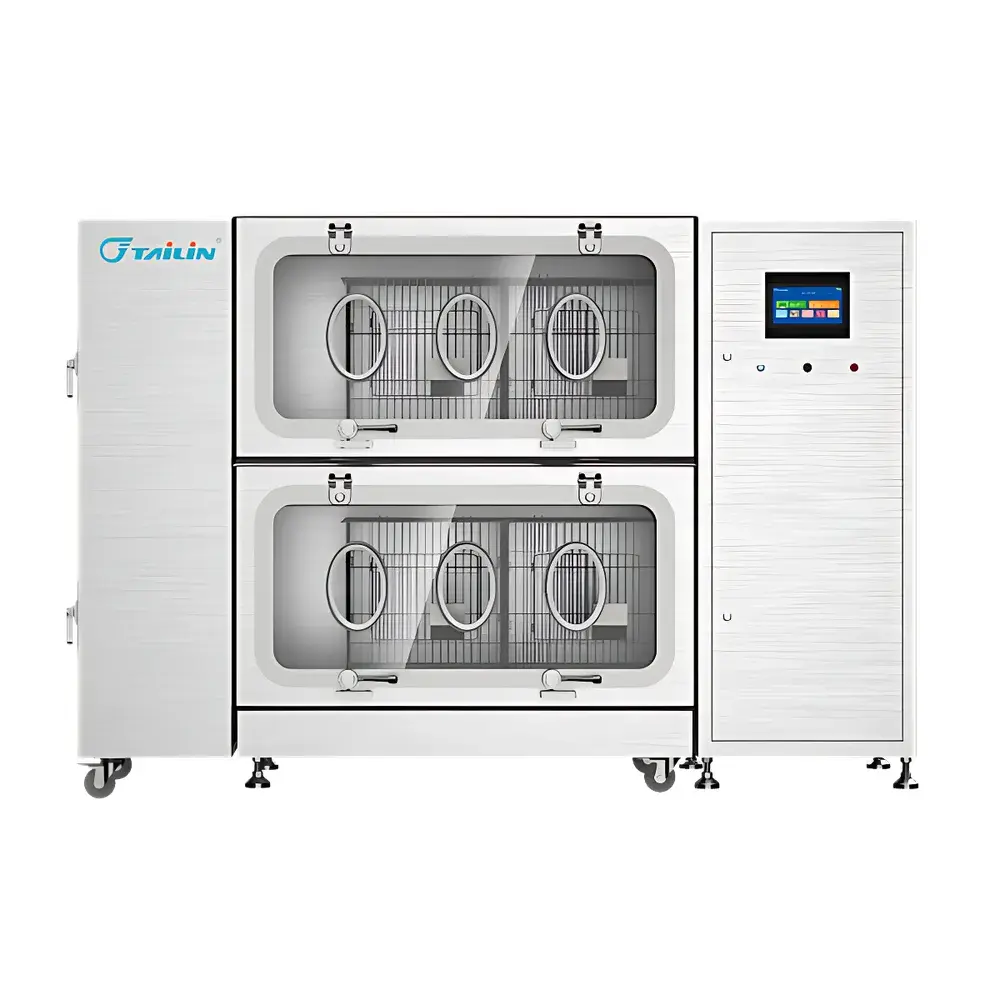
Ferret Isolator by Tailin Biotech
| Brand | Tailin Biotech |
|---|---|
| Origin | Zhejiang, China |
| Manufacturer Type | OEM/ODM Manufacturer |
| Origin Category | Domestic (China) |
| Model | Ferret Isolator |
| Pricing | Available Upon Request |
Overview
The Ferret Isolator by Tailin Biotech is a Class III biological containment system engineered for safe housing, observation, and experimental manipulation of ferrets in BSL-3 (Biosafety Level 3) and higher laboratory environments. Designed in strict accordance with ISO 14644-1 (cleanroom classification), EN 12469 (microbiological safety cabinets), and GB 19489–2008 (Chinese national standard for biosafety laboratories), this isolator employs negative-pressure engineering principles to maintain a continuous inward airflow gradient across all sealed interfaces. Its core containment architecture relies on dual-chamber or single-chamber rigid stainless steel construction, validated leak integrity at −250 Pa differential pressure (leak rate < 0.25 %Vol/hr), and fully redundant air handling with real-time differential pressure monitoring. The system integrates primary and secondary barriers—mechanical glove ports, HEPA-filtered supply and exhaust, and VHP-compatible internal surfaces—to ensure operator protection, animal welfare compliance (per AAALAC International standards), and environmental containment during high-consequence pathogen studies.
Key Features
- Rigid stainless steel chamber with radiused internal corners, electropolished finish, and zero crevice design—optimized for autoclave-compatible cleaning and residue-free decontamination.
- Modular dual-chamber configuration with independent environmental control per chamber; optional single-chamber layout for space-constrained installations.
- Redundant exhaust train featuring parallel backup fans with automatic switchover upon pressure drop detection—ensuring uninterrupted negative-pressure integrity.
- Multi-stage exhaust filtration: pre-filter + H14-grade HEPA (EN 1822 MPPS efficiency ≥ 99.995%) with integrated automated scanning leak test, efficiency-based integrity verification, in-situ vaporized hydrogen peroxide (VHP) sterilization, and bag-in/bag-out (BIBO) filter replacement protocol.
- Front access via optically clear acrylic viewport and ergonomically angled glove ports secured via multi-point mechanical clamping—validated for static and dynamic seal integrity under sustained negative pressure.
- Dedicated pass-through chamber per isolator unit, configurable with pulsed UV-C irradiation or aerosolized disinfectant delivery; optional CDCV (Cycle Development & Validation) support for sterilization process qualification per ISO 14937 and USP <1229>.
- Integrated VHP interface (ISO 13485-compliant port) compatible with external vaporized hydrogen peroxide generators; optional built-in VHP generator module available upon specification.
- Real-time environmental monitoring of intra-chamber parameters: differential pressure (±0.5 Pa resolution), temperature (±0.3 °C), relative humidity (±2 %RH), and ammonia concentration (electrochemical sensor, 0–100 ppm range).
- LED lighting system with adjustable intensity and spectral profile aligned with ferret circadian rhythm requirements (peak sensitivity ~440 nm).
Sample Compatibility & Compliance
The Ferret Isolator supports long-term housing and acute challenge studies involving Mustela putorius furo, including aerosol transmission models, vaccine efficacy trials, and therapeutic antibody evaluation under BSL-3 containment. Chamber dimensions accommodate standard ferret caging configurations (up to 4 adult animals per 1.2 m³ chamber) while preserving IACUC-defined floor space and enrichment requirements. All materials in contact with animals or effluent streams are non-toxic, non-leaching, and compliant with USP Class VI and ISO 10993-5 cytotoxicity testing. System validation documentation includes IQ/OQ/PQ protocols traceable to ASTM E2918, ISO 13485:2016, and GLP Annex 11 (electronic records and signatures). Full audit trails for environmental data, alarm events, and maintenance logs meet FDA 21 CFR Part 11 requirements when paired with Tailin’s validated LIMS integration package.
Software & Data Management
Embedded controller firmware (v3.2+) provides local touchscreen HMI with password-protected user tiers (Operator, Technician, Administrator). All monitored parameters are timestamped and stored locally (SD card, 12-month retention) with optional encrypted Ethernet export to centralized SCADA or ELN platforms. Alarm logic includes configurable thresholds, hysteresis, and escalation pathways (email/SMS via Modbus TCP or SNMP). Data export formats include CSV, PDF summary reports, and XML for LIMS ingestion. Audit trail functionality records every parameter change, login/logout event, and manual override with immutable digital signature—fully compliant with ALCOA+ (Attributable, Legible, Contemporaneous, Original, Accurate, Complete, Consistent, Enduring, Available) data integrity principles.
Applications
- Respiratory pathogen research (e.g., influenza A/H5N1, SARS-CoV-2 variants) requiring ferret models for transmission dynamics and immunogenicity assessment.
- Preclinical evaluation of antiviral therapeutics and mucosal vaccines under GLP-compliant conditions.
- Biosafety validation of PPE, ventilation systems, and decontamination protocols using ferret-generated bioaerosols.
- Longitudinal toxicology studies where metabolic stability and pharmacokinetic profiling demand strict environmental control and minimal stress-induced confounding.
- Training platform for BSL-3 operational procedures, including emergency response drills and glovebox technique certification.
FAQ
What biosafety level is this isolator certified for?
It is engineered and validated for continuous operation in BSL-3 laboratories; structural integrity and filtration performance meet or exceed requirements outlined in CDC/NIH Biosafety in Microbiological and Biomedical Laboratories (BMBL), 6th Edition.
Can the isolator be integrated into an existing building HVAC system?
Yes—exhaust ducting is designed for connection to dedicated lab exhaust manifolds with variable air volume (VAV) control; supply air may be drawn from ambient lab air or conditioned supply, depending on facility specifications.
Is third-party certification available for installation validation?
Tailin Biotech provides IQ/OQ documentation packages and supports third-party PQ execution by accredited laboratories (e.g., NSF, TÜV SÜD) per ISO/IEC 17025.
Does the system support remote monitoring and alarm notification?
Standard Ethernet connectivity enables secure remote access via TLS 1.2-encrypted web interface; alarm notifications are configurable via SMTP email or REST API webhook to enterprise alerting systems.
What maintenance intervals are recommended for HEPA filters and sensors?
HEPA filters require integrity testing every 6 months and replacement every 18–24 months under typical BSL-3 usage; ammonia sensors are calibrated annually, and pressure transducers are verified quarterly per manufacturer’s PM schedule.




