
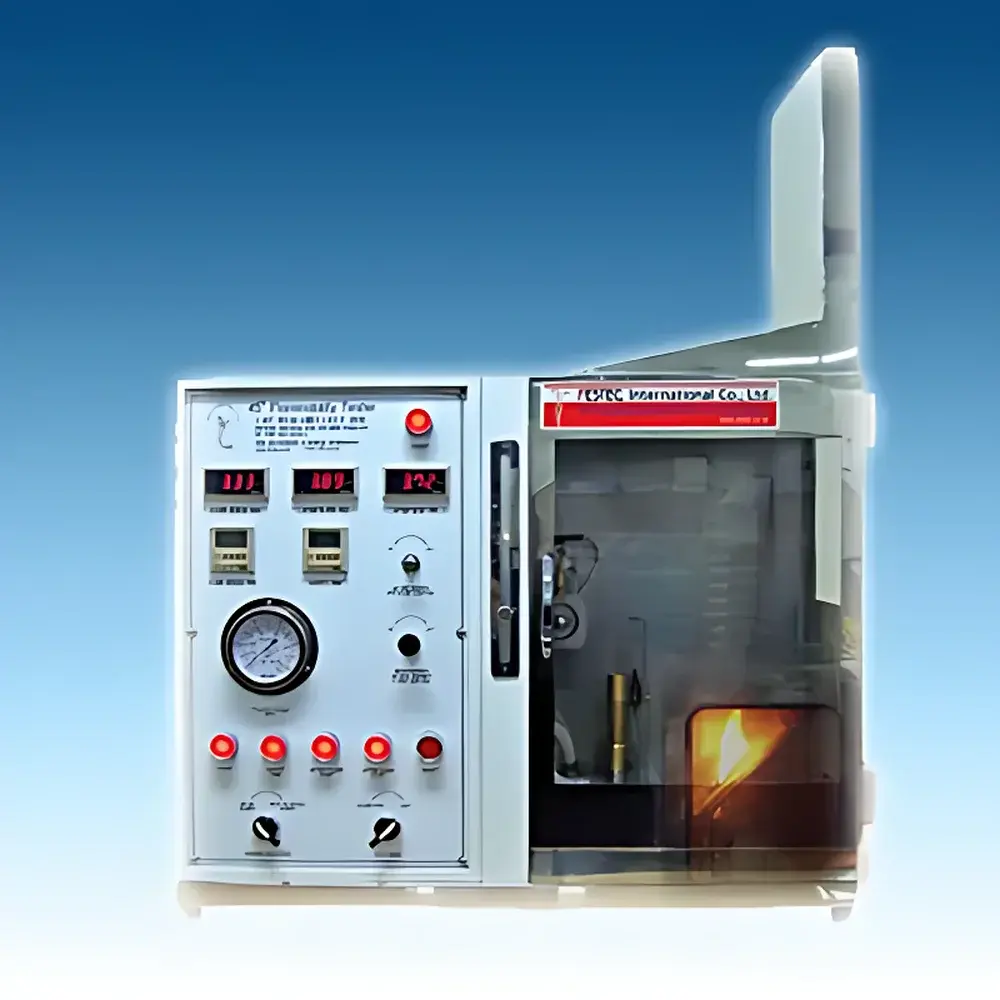
FESTEC 45° Combustion Test Chamber
| Brand | FESTEC |
|---|---|
| Origin | South Korea |
| Model | 45D |
| Chamber Construction | Stainless Steel Enclosure with Polycarbonate Viewing Window |
| Test Angle | Fixed 45° Specimen Mounting |
| Applicable Standards | ASTM D3823, ISO 6927 (adapted), UL 94 HB/VTM-0 pre-screening context, KSL 2017 (Korean Standard for Surface Burning Characteristics) |
| Burner Options | Air-Mix Burner & Micro/Meker Burner |
| Flame Impingement Control | Adjustable Pressure Regulators for Both Burners |
| Timing System | Dual Independent Digital Timers (Afterflame Time & Afterglow Time) |
| Specimen Thickness Limit | ≤5 mm |
| Sample Types | Rigid & Semi-Rigid Flat Panels (Wood, Metal, Plastic Laminates, Paperboard, Thin Composites) |
Overview
The FESTEC 45° Combustion Test Chamber is a precision-engineered apparatus designed to evaluate the surface burning behavior of flat, non-metallic and metallic sheet materials under controlled flame impingement at a fixed 45-degree angle. It operates on the principle of standardized radiant–convective thermal exposure, where a calibrated burner applies defined heat flux to the inclined specimen surface while quantitative metrics—namely afterflame time (time from flame removal until visible flame extinguishes) and afterglow time (duration of glowing combustion without flame)—are recorded under repeatable environmental conditions. This methodology aligns with internationally referenced test protocols used in preliminary fire hazard screening, particularly for materials intended for interior construction, transportation interiors, and electronic enclosures. The chamber’s architecture ensures thermal stability, optical observation integrity, and operator safety through its fully enclosed stainless steel housing and polycarbonate viewing window—engineered to withstand transient thermal gradients without distortion or outgassing.
Key Features
- Dual-burner configuration: Independently switchable Air-Mix burner (for broader, lower-intensity flame) and Micro/Meker burner (for focused, high-temperature impingement), each with dedicated pressure regulation valves for precise thermal input control.
- Fixed 45° specimen holder: Precision-machined aluminum cradle with mechanical locking, ensuring consistent angular orientation and minimizing positional drift during testing.
- Dual independent digital timers: One timer measures afterflame duration (activated upon flame removal); the second measures afterglow duration (initiated when afterflame ceases), both with manual stop controls and zero-reset functionality.
- Integrated pressure monitoring: Analog pressure gauge calibrated for both burner gas supply lines, enabling real-time verification of combustion gas flow consistency per test cycle.
- Mode-select switch: Allows seamless transition between calibration mode (for flame height verification and specimen alignment check) and operational test mode.
- Fail-safe electrical interface: Master power switch with circuit protection; emergency stop logic prevents unintended timer activation or burner ignition outside defined operational sequences.
- Low-outgassing chamber interior: Interior surfaces fabricated from low-carbon stainless steel (AISI 304); non-metallic components (e.g., gaskets, insulation) selected per ISO 16000-9 for minimal volatile organic compound (VOC) emission during thermal cycling.
Sample Compatibility & Compliance
The FESTEC 45D accommodates flat specimens up to 5 mm thickness and dimensions compliant with ASTM D3823 (typically 150 mm × 50 mm). Compatible material classes include wood-based panels, coated metals, thermoplastic and thermoset laminates, fiber-reinforced composites, and dense paperboard. While not a full-scale fire resistance furnace, it supports classification tiers aligned with Korean Standard KSL 2017: Class I (char length ≤5 cm, no afterflame), Class II (char length ≤10 cm, afterflame ≤5 s), and Class III (char length ≤15 cm, afterflame ≤5 s). Its design facilitates documentation traceability required under GLP-compliant laboratories—timers log start/stop events with millisecond resolution, and all operational parameters (burner type, pressure, angle, ambient temperature/humidity) are manually recorded per test report per ISO/IEC 17025 clause 7.8.
Software & Data Management
The FESTEC 45D operates as a standalone hardware platform without embedded firmware or network connectivity. All measurements are captured via front-panel digital timers and manually transcribed into laboratory notebooks or LIMS-compatible spreadsheets. For regulated environments, users integrate the instrument into validated data workflows by pairing it with external timestamped video recording (e.g., synchronized GoPro or industrial camera with IR filter) and digital logbooks that enforce audit trails. While no proprietary software is supplied, the device’s deterministic mechanical-electrical interface enables straightforward integration with third-party DAQ systems via dry-contact TTL outputs (optional retrofit). Calibration records—including burner orifice certification, pressure gauge NIST-traceable calibration, and timer accuracy verification (±0.1 s)—must be maintained per ISO/IEC 17025 Section 6.4.
Applications
- Preliminary fire performance screening of automotive interior trim panels prior to FMVSS 302 or UN ECE R118 compliance testing.
- Quality control verification of flame-retardant treated plywood and MDF used in modular building systems.
- R&D evaluation of intumescent coatings on thin-gauge steel substrates under angled flame exposure.
- Comparative assessment of smoke development characteristics across halogen-free vs. brominated FR additives in polyolefin sheets.
- Academic research on charring kinetics and pyrolysis front propagation in anisotropic cellulose-based materials.
FAQ
Does the FESTEC 45D comply with UL 94?
No—it is not certified for UL 94 vertical/horizontal burn testing, which requires distinct specimen orientation, flame application geometry, and pass/fail criteria. However, it serves as a functional surrogate for early-stage material triage before formal UL 94 submission.
Can the chamber be modified for 0° or 90° testing?
No. The mechanical structure, burner alignment, and specimen holder are permanently configured for 45° testing only. Altering the angle voids calibration validity and compromises repeatability.
Is NIST-traceable calibration provided with the unit?
Calibration certificates for pressure gauges and timers are available upon request at time of purchase, but routine recalibration must be performed annually by an ISO/IEC 17025-accredited provider using documented procedures.
What gas supply is required for operation?
Both burners operate on commercial-grade propane or butane (LPG) with regulated inlet pressure between 7–15 kPa, depending on selected burner and desired flame height. A dedicated gas manifold with dual-stage regulator is recommended.
How is smoke opacity quantified in this system?
The FESTEC 45D does not measure smoke density optically. Smoke generation is observed qualitatively; quantitative smoke measurement requires coupling with a separate ASTM E662 cone calorimeter or DIN 53436 smoke density chamber.



