
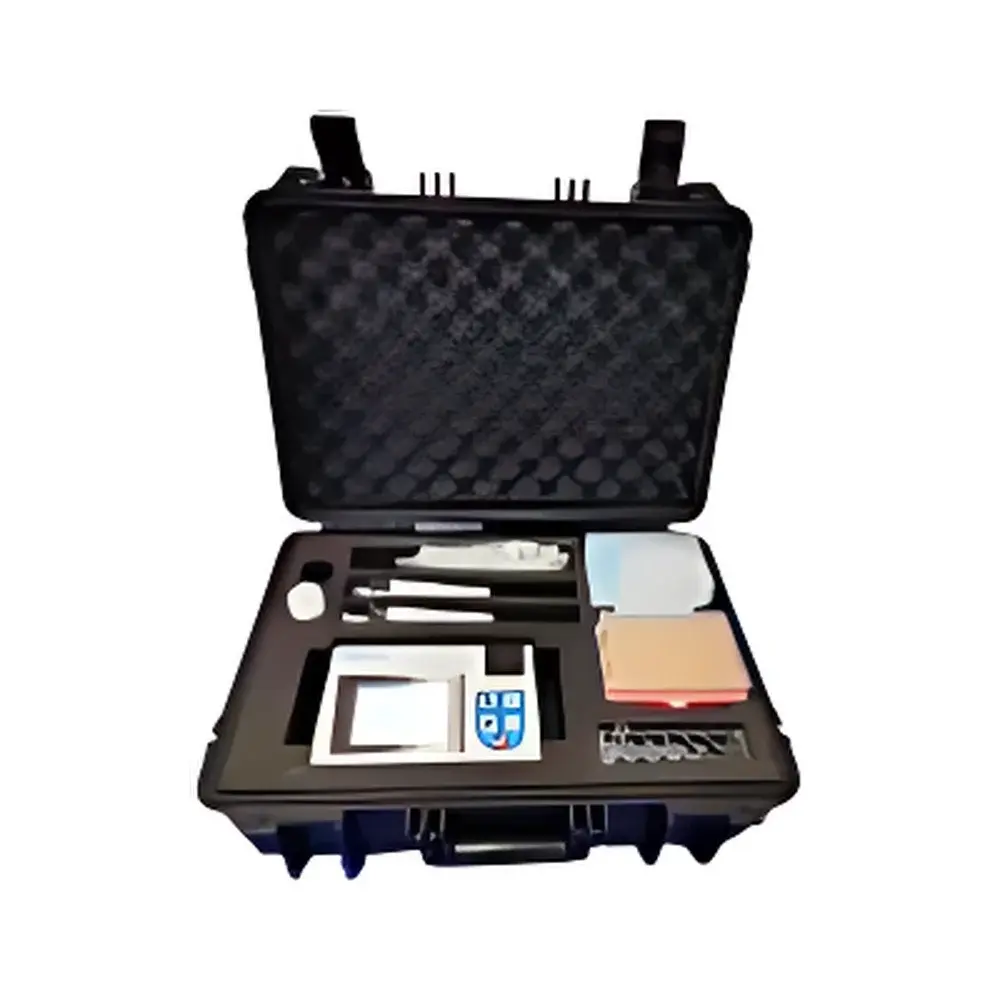
Fitlylab QTOX-60 Portable Bioluminescent Bacterial Toxicity Analyzer
| Brand | Fitlylab |
|---|---|
| Origin | Shenzhen, China |
| Model | QTOX-60 |
| Instrument Type | Portable |
| Biological Agent | *Aliivibrio fischeri* (formerly *Vibrio fischeri*) |
| Repeatability | ≤5% CV |
| Assay Duration | 5, 15, or 30 minutes |
| Detection Range | −120% to +100% inhibition |
| Blank Water Inhibition | ≤±5% |
| Data Storage | 2000 test records via USB |
| Display | Color LCD screen |
| Power Supply | Internal rechargeable Li-ion battery (≥10 h standby), AC adapter, and external power bank compatible |
| Weight | <480 g |
| Accessories | 10 disposable assay tubes, 2 calibrated pipettes, tube rack, standard reagent kit (lyophilized *A. fischeri*, reconstitution buffer, control solution), rugged carrying case |
Overview
The Fitlylab QTOX-60 Portable Bioluminescent Bacterial Toxicity Analyzer is an ISO 11348-3–compliant field-deployable instrument designed for rapid, quantitative assessment of acute aquatic toxicity in water samples. It employs the standardized bioluminescence inhibition method using freeze-dried *Aliivibrio fischeri*, a marine Gram-negative bacterium whose constitutive luminescence—centered at 450–490 nm—is metabolically coupled to cellular respiration and ATP synthesis. Exposure to toxicants—including heavy metals (e.g., Cu²⁺, Hg²⁺, Cd²⁺), organophosphates, carbamates, chlorinated phenols, quinones, and cyanobacterial toxins—disrupts electron transport chain activity, resulting in dose-dependent reduction of light output. The QTOX-60 quantifies this inhibition as a percentage relative to unexposed controls, providing a physiologically relevant, integrative endpoint that reflects combined effects of mixture toxicity—a critical advantage over single-analyte chemical assays.
Key Features
- Dual-optical-path kinetic detection architecture: Simultaneous real-time measurement of sample and reference channels enables continuous monitoring of luminescence decay profiles over 5–30 min, supporting time-resolved toxicity assessment and distinguishing transient vs. irreversible inhibition.
- Field-optimized engineering: Weighing under 480 g with integrated Li-ion battery (≥10 h standby), it operates autonomously during extended environmental surveys without external power infrastructure.
- Pre-qualified biological reagents: Lyophilized *A. fischeri* cultures are manufactured under controlled conditions to ensure lot-to-lot consistency; each kit includes validated reconstitution buffer and negative/positive controls traceable to ISO 11348-3 calibration protocols.
- On-device data management: Color LCD interface displays inhibition rate (%), absolute luminescence intensity (relative light units, RLU), and full kinetic curves; all results are timestamped and stored locally (2000 records) with USB export capability for audit-ready reporting.
- Regulatory alignment: Designed to support compliance with EU Water Framework Directive (WFD) monitoring requirements, EPA Method 1002.0 (for acute toxicity screening), and GLP-aligned laboratory workflows where raw kinetic data and metadata retention are essential.
Sample Compatibility & Compliance
The QTOX-60 accepts untreated or minimally filtered aqueous matrices including surface water, wastewater influent/effluent, drinking water pre-treatment streams, landfill leachate, and industrial process water. Samples requiring pH adjustment (pH 6.5–8.5) or dilution (to avoid osmotic shock or matrix interference) are accommodated via built-in protocol guidance. All assays adhere strictly to ISO 11348-3:2018 (“Water quality — Determination of the inhibitory effect of water samples on the light emission of *Vibrio fischeri* (luciferase test) — Part 3: Method using freeze-dried bacteria”), including mandatory controls (solvent blank, toxicity standard, system suitability), replicate requirements (n ≥ 3 per sample), and acceptance criteria for coefficient of variation (≤5%). Instrument firmware supports audit trail logging per FDA 21 CFR Part 11 principles when paired with secure data export workflows.
Software & Data Management
No proprietary desktop software is required for basic operation; however, optional PC-based analysis tools (available upon request) enable advanced curve fitting (e.g., logistic inhibition models), statistical comparison across sample sets, and automated report generation compliant with ISO/IEC 17025 documentation standards. All onboard data include embedded metadata: operator ID, sample ID, assay duration, temperature (ambient sensor logged), reagent lot number, and instrument serial number—ensuring full traceability for regulatory submissions or inter-laboratory validation studies.
Applications
- Emergency response screening by environmental protection agencies and CDC field teams following chemical spills or algal bloom events.
- Routine toxicity verification at municipal wastewater treatment plants (influent, activated sludge supernatant, final effluent).
- Source water vulnerability assessment for drinking water utilities, including groundwater monitoring wells and reservoir intakes.
- Industrial pretreatment compliance checks for electroplating, pesticide formulation, and pharmaceutical manufacturing facilities.
- Academic research in ecotoxicology, including comparative toxicity profiling of novel nanomaterials or degradation intermediates.
FAQ
What biological strain is used in the QTOX-60 assay?
The instrument uses lyophilized *Aliivibrio fischeri* (ATCC 49387 or equivalent), certified for consistent luminescence output and sensitivity per ISO 11348-3.
Can the QTOX-60 detect non-polar organic compounds such as PAHs or PCBs?
Yes—while solubility limits apply, the assay responds to bioavailable fractions of hydrophobic toxicants when appropriate sample preparation (e.g., solvent-assisted extraction or passive dosing) is implemented per ISO guidelines.
Is calibration verification required before each use?
A system suitability check using the included positive control (e.g., 3,5-dichlorophenol at 10 mg/L) is mandatory prior to any analytical run to confirm bacterial viability and optical path integrity.
How is data integrity maintained during field deployment?
All measurements are digitally signed with internal clock timestamps; USB exports generate CSV files with SHA-256 checksums to prevent post-acquisition tampering.
Does the QTOX-60 meet requirements for regulatory submission under EU REACH or US TSCA?
While not a standalone compliance instrument, its ISO 11348-3–aligned methodology is accepted as a Tier 1 screening tool for prioritization under both frameworks when conducted within a validated QA/QC framework.
Related Products







