
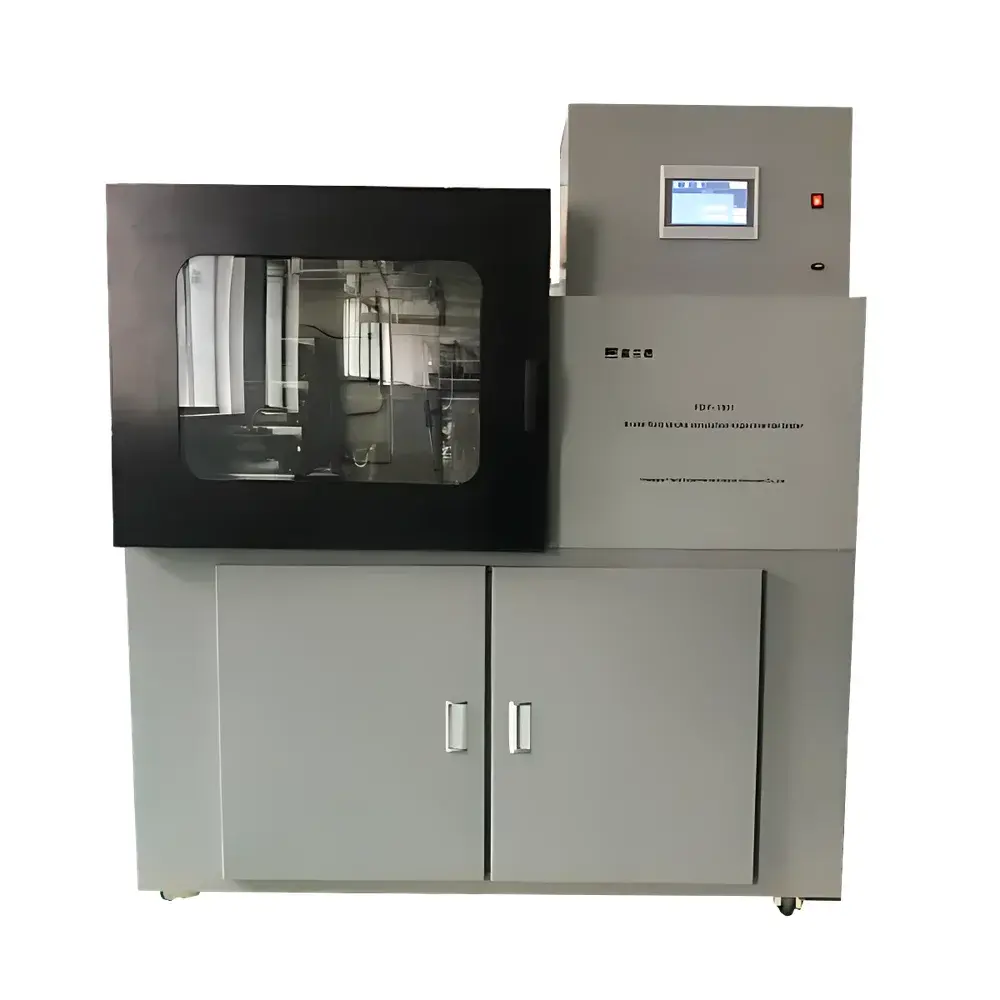
Flanland FDY-1301 Brake Fluid Stroke Simulation Tester
| Brand | Flanland / csfriend |
|---|---|
| Origin | Hunan, China |
| Manufacturer Type | Authorized Distributor |
| Country of Manufacture | China |
| Model | FDY-1301 |
| Operating Pressure | 7 MPa ± 0.3 MPa |
| Temperature Range | 20–150 °C ± 2 °C |
| Stroke Frequency | 1000 cycles/h |
| Total Cycle Capacity | 85,000 cycles |
| Cooling Method | Hermetic Compressor-Based Air-Circulation System |
| Heating Method | Non-Radiative Resistive Heating |
| Temperature Sensor | PT100 Platinum RTD |
| Control System | Microprocessor-Based PID Controller with Digital Display |
| Pressure Regulation | Precision Pressure-Regulating Valve |
| Pressure Indication | Analog Precision Pressure Gauge |
| Stroke Monitoring | Digital Linear Displacement Rate Display with Adjustable Actuation Mechanism |
| Compliance Standard | ISO 4925-2 |
Overview
The Flanland FDY-1301 Brake Fluid Stroke Simulation Tester is an engineered test platform designed to evaluate the long-term functional stability and compressibility resistance of automotive brake fluids under dynamic mechanical stress and controlled thermal conditions. It replicates the real-world operational environment of hydraulic brake systems by subjecting brake fluid samples to repeated piston displacement within precisely dimensioned master and wheel cylinders—mimicking the volumetric expansion, vapor lock susceptibility, and seal compatibility behavior observed during service life. The system operates on a validated stroke simulation principle: a cast-iron master cylinder (bore: 28.58–28.65 mm) actuates three aluminum-alloy wheel cylinders (bore: 28.60–28.66 mm), all fitted with compliant rubber cups meeting ISO 4925-2 material specifications. This architecture ensures repeatable volumetric displacement while maintaining geometric fidelity to OEM brake system tolerances.
Key Features
- Integrated dual-mode thermal management: non-radiative resistive heating combined with hermetically sealed compressor-based air-circulation cooling enables precise temperature control across the full 20–150 °C range (±2 °C accuracy), critical for evaluating high-temperature fluid degradation and low-temperature flow resistance.
- Digital linear stroke rate display with fine-tuning adjustment mechanism supports consistent cycle timing at 1,000 strokes per hour—calibrated to match industry-standard endurance protocols.
- High-fidelity hydraulic actuation: a dedicated drive train delivers regulated working pressure up to 7 MPa ± 0.3 MPa via a precision pressure-regulating valve; pressure is continuously monitored using a calibrated analog pressure gauge traceable to national metrological standards.
- Microprocessor-controlled PID temperature regulation with PT100 platinum resistance thermometers ensures stable thermal profiles and minimal overshoot during ramp-and-soak sequences.
- Full-cycle endurance capability: programmable digital timer supports up to 85,000 total strokes with audible buzzer alarm upon completion—enabling compliance verification against ISO 4925-2’s minimum durability requirements.
- Rigid one-piece structural frame with dedicated pump-mounting alignment plate minimizes mechanical drift and maintains cylinder coaxiality throughout extended testing campaigns.
Sample Compatibility & Compliance
The FDY-1301 is configured exclusively for evaluation of DOT 3, DOT 4, DOT 5.1, and polyglycol-based brake fluids in accordance with ISO 4925-2:2021 (“Road vehicles — Brake fluids — Part 2: Requirements and test methods”). All wetted components—including master cylinder bores, wheel cylinder bores, and rubber sealing elements—are dimensionally and chemically aligned with the standard’s material interface specifications. The system does not support silicone-based (DOT 5) or mineral-oil-based fluids due to incompatibility with the specified elastomer formulation and thermal expansion characteristics. Test reports generated using this instrument may serve as primary data sources for regulatory submissions requiring ISO 4925-2 conformance evidence, including OEM qualification dossiers and third-party certification audits.
Software & Data Management
The FDY-1301 operates as a standalone hardware platform without embedded firmware-based data logging. All operational parameters—including elapsed time, stroke count, real-time pressure indication, and chamber temperature—are displayed via discrete digital readouts and analog gauges. For GLP/GMP-aligned laboratories, external validation-grade data acquisition systems (e.g., certified DAQ modules with 21 CFR Part 11-compliant audit trail functionality) may be interfaced via standard 4–20 mA or 0–10 V analog outputs (available upon request). Temperature and pressure transducers are calibrated per ISO/IEC 17025 requirements, and calibration certificates—including as-found/as-left data and uncertainty budgets—are provided with each unit shipment.
Applications
- Endurance assessment of brake fluid compressibility retention after prolonged thermal-mechanical cycling.
- Evaluation of rubber cup swelling, extrusion, or adhesion failure under sustained high-pressure exposure.
- Comparative analysis of fluid aging kinetics across different base-stock formulations (e.g., borate ester vs. polyalkylene glycol).
- Verification of fluid compatibility with aluminum alloy cylinder surfaces under elevated temperature and pressure.
- Supporting R&D activities for next-generation low-viscosity, high-boiling-point brake fluid development.
- Quality control release testing for batch-to-batch consistency in manufacturing environments governed by IATF 16949.
FAQ
Does the FDY-1301 comply with ISO 4925-2:2021 test method requirements?
Yes—the mechanical configuration, pressure regulation tolerance (±0.3 MPa), temperature control accuracy (±2 °C), stroke frequency (1,000/h), and total cycle capacity (85,000) are all explicitly aligned with Clause 6.3 and Annex A of ISO 4925-2:2021.
Can the system accommodate custom stroke profiles or variable pressure setpoints?
No—the FDY-1301 implements fixed-parameter operation per ISO 4925-2. Variable-profile testing requires integration with external programmable motion controllers and pressure servo systems.
Is calibration documentation included with shipment?
Yes—each unit ships with factory calibration certificates for the PT100 sensor, pressure gauge, and digital timer, traceable to CNAS-accredited reference standards.
What maintenance intervals are recommended for the hydraulic components?
Master and wheel cylinder bores should be inspected for scoring or corrosion after every 20,000 cycles; rubber cups must be replaced prior to each new test series to ensure dimensional repeatability and avoid cross-contamination.
Is the unit suitable for use in accredited testing laboratories?
Yes—when operated within its validated parameter envelope and supported by documented calibration, preventive maintenance, and environmental monitoring records, the FDY-1301 meets the technical adequacy criteria for ISO/IEC 17025 clause 6.4.





