
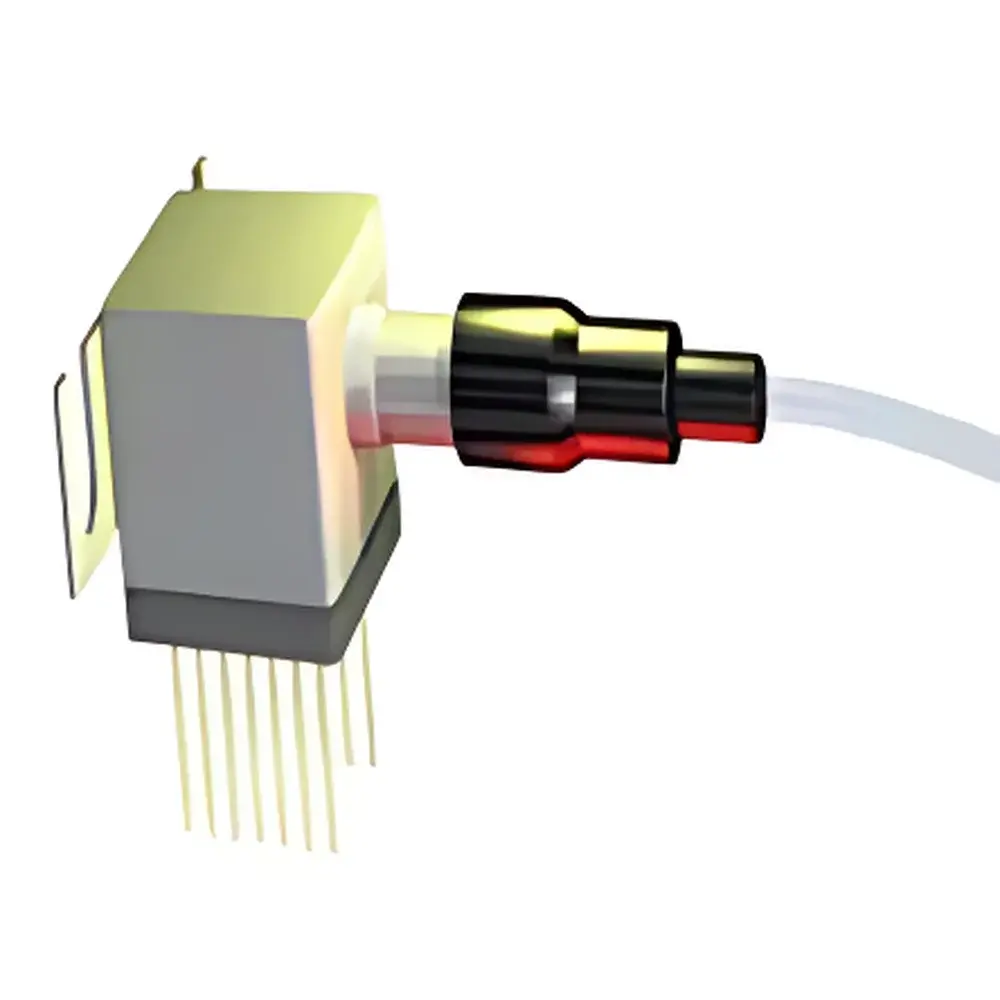
FLC FLX Coupled Laser Diode
| Brand | FLC |
|---|---|
| Origin | USA |
| Manufacturer Type | Authorized Distributor |
| Origin Category | Imported |
| Model | FLX |
| Core Component | Solid-State Laser System |
| Wavelength Range | 785–1940 nm |
| Output Power | 0.5–750 W |
| Primary Applications | Industrial Processing, R&D, Medical Laser Systems |
Overview
The FLC FLX Coupled Laser Diode is a high-stability, fiber-coupled semiconductor laser source engineered for demanding industrial, scientific, and medical applications requiring precise wavelength selection and scalable optical power delivery. Unlike free-space diode modules, the FLX integrates thermally optimized laser bars or single-emitter stacks with high-numerical-aperture (NA ≤ 0.22) multimode or polarization-maintaining (PM) fiber coupling—enabling efficient transmission of near-infrared (NIR) radiation across its broad spectral range (785 nm to 1940 nm). Its design adheres to fundamental principles of diode laser physics, including carrier injection efficiency, quantum well gain dynamics, and thermal management via conductive micro-channel heatsinking. The system operates in continuous-wave (CW) mode with optional analog or TTL modulation capability, supporting stable output under varying ambient conditions (15–35 °C) and long-term duty cycles typical of automated manufacturing environments.
Key Features
- Fiber-coupled architecture with SMA905 or QBH-style connectors, ensuring compatibility with standard OEM optical train interfaces
- Wavelength selection across three NIR bands: 785–850 nm (e.g., for silicon absorption-driven thermal processing), 915–980 nm (optimized for Yb-doped fiber laser pumping), and 1470–1940 nm (targeting water absorption peaks in soft-tissue interaction)
- Output power scalability from 0.5 W (low-noise alignment and diagnostic use) up to 750 W (high-throughput welding and cladding)
- Integrated thermoelectric cooler (TEC) and PID-controlled temperature stabilization (±0.1 °C), minimizing wavelength drift (< 0.05 nm/°C) and power fluctuation (< ±1.5% RMS over 8 hours)
- Ruggedized aluminum housing rated IP54, compliant with IEC 60825-1:2014 Class 4 laser safety requirements when properly interlocked
- Modular driver interface supporting RS-485, USB-CDC, and analog 0–5 V control inputs for integration into PLC-based production lines or laboratory automation frameworks
Sample Compatibility & Compliance
The FLX series supports direct integration with a wide range of optical payloads—including scanning galvanometers, collimation optics, process monitoring sensors (e.g., pyrometers, photodiodes), and beam delivery fibers up to 1000 µm core diameter. It meets key regulatory and quality benchmarks relevant to its application domains: ISO 13849-1 (PL e) for functional safety in industrial machinery; FDA 21 CFR Part 11 readiness via optional audit-trail-enabled firmware (for medical device OEMs); and conformity with EN 61000-6-2/6-4 for electromagnetic immunity and emissions. All units undergo factory calibration traceable to NIST standards, and full test reports—including L-I-V curves, spectral width (FWHM), and pointing stability (< 5 µrad/°C)—are supplied with each shipment.
Software & Data Management
FLC provides the FLX Control Suite—a cross-platform (Windows/macOS/Linux) application built on Qt framework—for real-time parameter monitoring, waveform logging, and firmware updates. The software supports SCPI command syntax for seamless integration with LabVIEW, Python (PyVISA), and MATLAB environments. Critical operational data—including junction temperature, drive current, optical power feedback (via integrated photodiode), and error codes—is timestamped and exportable in CSV or HDF5 format. For regulated environments, optional GxP-compliant configuration allows role-based access control, electronic signatures, and 21 CFR Part 11–compliant audit trails with immutable log storage.
Applications
- Industrial Manufacturing: Selective de-soldering of PCB assemblies, hermetic sealing of metal and polymer enclosures, and remote welding of dissimilar materials (e.g., Cu–Al battery tabs) using wavelength-specific absorption tuning
- Laser Pumping: High-efficiency optical pumping of ytterbium-, thulium-, and holmium-doped fiber amplifiers and bulk solid-state lasers
- Medical Device Integration: Enabling contact-based tissue ablation (1470 nm), coagulation (1940 nm), and collagen denaturation (980 nm) in minimally invasive surgical platforms approved under ISO 13485 QMS
- R&D Instrumentation: Serving as tunable excitation sources in spectroscopic setups, photoacoustic imaging systems, and nonlinear frequency conversion experiments (e.g., OPO seeding)
FAQ
Is the FLX compatible with third-party fiber delivery systems?
Yes—the FLX uses industry-standard connectorization (SMA905, QBH, or custom FC/APC upon request) and maintains NA and core-diameter matching specifications per IEC 60793-2-10.
What cooling method is required for continuous 750 W operation?
A closed-loop chiller with ≥3 L/min flow rate and ≤22 °C setpoint is mandatory; air-cooled variants are limited to ≤150 W output.
Can output power be modulated at kHz frequencies?
Analog modulation bandwidth reaches 10 kHz (−3 dB) with <5% overshoot; digital TTL modulation supports pulse widths ≥10 µs with jitter <20 ns.
Does FLC provide OEM labeling and custom firmware?
Yes—white-labeling, mechanical form-factor adaptation, and application-specific firmware development are available under NDA and subject to minimum order volume agreements.





