
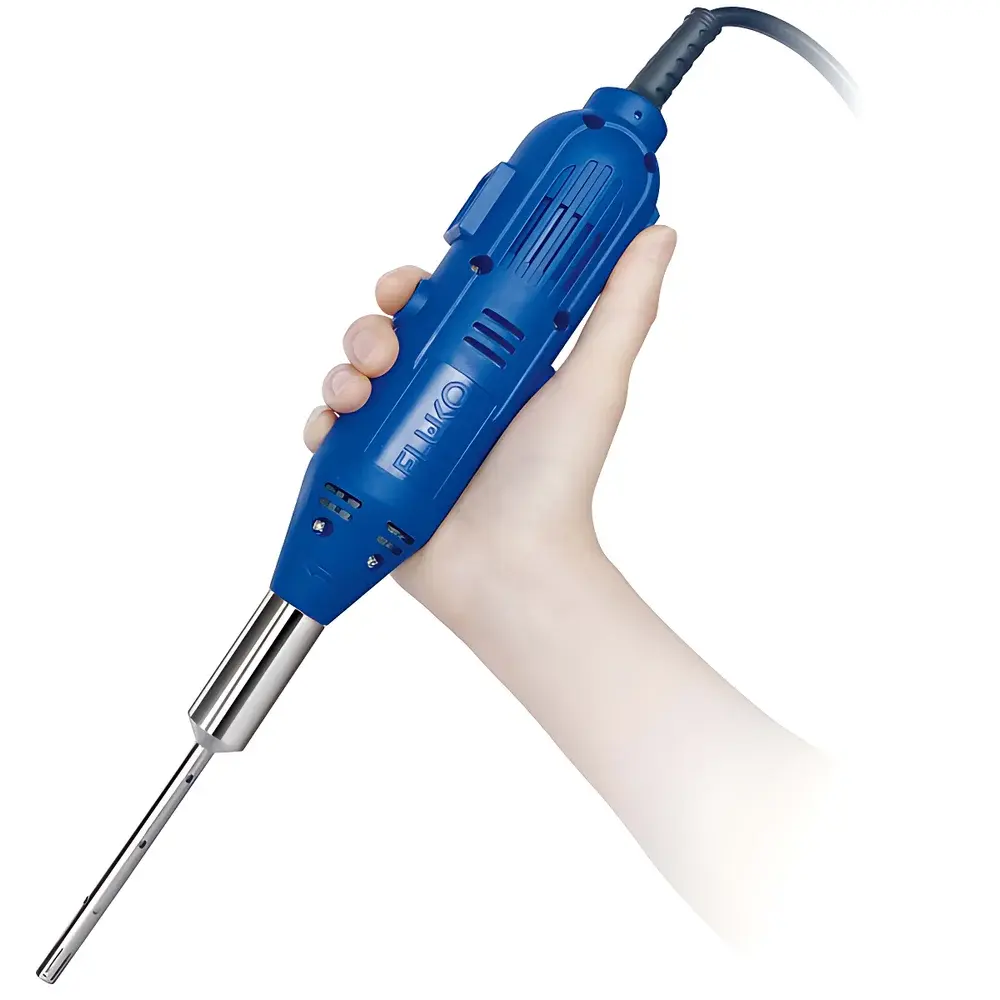
FLUKO F10 Handheld High-Shear Homogenizer
| Brand | FLUKO |
|---|---|
| Origin | Shanghai, China |
| Model | F10-101-S |
| Instrument Type | Probe-type rotor-stator homogenizer |
| Dimensions (W×D×H) | 420 × 100 × 50 mm |
| Processing Volume | 0.1–150 mL |
| Power | 160 W |
| Voltage/Frequency | 220 V, 50/60 Hz |
| Speed Range | 5,000–35,000 rpm |
| Speed Control | Continuously variable (analog dial) |
| Max. Viscosity | 200 mPa·s |
| Material in Contact | SS316L stainless steel |
| Shaft Sleeve Material | PTFE |
| Standard Generator Probe | 10GZL-1 (10 mm diameter, L = 120 mm) |
| Operating Environment | 5–40 °C, ≤80% RH |
| Process Mode | Batch, micro-to-small scale |
| Weight | ~0.85 kg |
| Safety | Double-insulated housing, IP20 rating |
| Compliance | CE-marked per EN 61000-6-2/6-4, EN 61000-3-2/3-3 |
Overview
The FLUKO F10 Handheld High-Shear Homogenizer is an engineered solution for rapid, reproducible cell disruption, tissue homogenization, and nano-scale dispersion in research and quality control laboratories. Based on the rotor-stator principle—where a high-speed rotating shaft (rotor) shears fluid against a fixed concentric sleeve (stator)—the F10 generates intense hydrodynamic forces including cavitation, turbulent flow, and hydraulic shear. These mechanisms enable efficient mechanical lysis of mammalian, bacterial, and plant cells; uniform dispersion of nanoparticles, liposomes, or polymers; and stable emulsification of aqueous-organic systems at volumes as low as 0.1 mL. Designed for benchtop agility and operator ergonomics, the F10 integrates a compact, lightweight chassis with a thermally optimized 160 W brushless motor capable of sustained operation across its full 5,000–35,000 rpm range. Its double-insulated housing meets IEC 61000-1-1 safety requirements for Class II portable equipment, making it suitable for use in GLP-compliant labs and ISO 17025-accredited testing environments.
Key Features
- High-shear probe-based architecture delivering consistent energy input across micro-to-small batch volumes (0.1–150 mL)
- Continuously variable analog speed control enables precise tuning for sensitive samples—e.g., avoiding protein denaturation during lysate preparation
- SS316L generator probe (standard 10GZL-1, 10 mm Ø) ensures corrosion resistance, cleanability, and compatibility with sterilization protocols (autoclaving up to 121 °C, 20 min)
- PTFE-coated shaft sleeve minimizes sample adhesion and facilitates residue-free cleaning between runs
- Ergonomic handheld design with balanced weight distribution (~0.85 kg) reduces operator fatigue during extended use
- IP20-rated enclosure provides protection against solid ingress and limited moisture exposure in standard lab conditions (5–40 °C, ≤80% RH)
- CE-certified to electromagnetic compatibility (EN 61000-6-2/6-4) and harmonic current emission (EN 61000-3-2/3-3) standards
Sample Compatibility & Compliance
The F10 supports a broad spectrum of biological and synthetic matrices: soft animal tissues (liver, spleen), cultured cells (HEK293, CHO), bacterial pellets (E. coli, B. subtilis), plant leaves, and viscous suspensions (up to 200 mPa·s). Its SS316L/PTFE wetted path complies with USP Class VI biocompatibility requirements and meets material traceability criteria outlined in ISO 10993-1 for short-term contact devices. While not intrinsically validated for GMP manufacturing, the F10 is routinely deployed in upstream R&D workflows aligned with ICH Q5A (viral clearance studies) and ASTM D445 (viscosity-sensitive dispersion validation). Documentation packages—including factory calibration records, material certificates, and CE DoC—are provided upon request to support internal audit readiness.
Software & Data Management
The F10 operates as a standalone analog instrument without embedded firmware or digital connectivity. Speed settings are manually adjusted via front-panel dial and verified using an optional external tachometer (not included). For laboratories requiring traceable parameter logging, integration with third-party data acquisition systems (e.g., LabVIEW, MATLAB) is achievable via analog voltage output (0–10 V) when paired with compatible signal conditioners. All operational parameters—including run duration, probe immersion depth, and post-run cleaning verification—must be recorded manually in laboratory notebooks or ELN systems to satisfy FDA 21 CFR Part 11 requirements for audit trails.
Applications
- Pre-analytical sample prep: homogenization of biopsy specimens for PCR, ELISA, and Western blot analysis
- Nanomaterial formulation: dispersion of graphene oxide, TiO₂, or PLGA nanoparticles into aqueous carriers
- Vaccine development: emulsification of oil-in-water adjuvant systems (e.g., MF59 analogues)
- Pharmaceutical QC: reconstitution and mixing of lyophilized reference standards
- Food microbiology: enumeration of pathogens from enriched food homogenates (per ISO 6887-1)
- Environmental testing: extraction of microplastics from sediment slurry prior to µFTIR analysis
FAQ
Is the F10 suitable for sterile processing?
Yes—the 10GZL-1 probe and SS316L housing are autoclavable (121 °C, 20 min, saturated steam). PTFE components retain dimensional stability under these conditions.
Can the F10 process high-viscosity samples like hydrogels?
It is rated for liquids up to 200 mPa·s; hydrogels exceeding this threshold require pre-dilution or alternative rotor geometry (e.g., macro-probes, sold separately).
What maintenance is required?
Routine inspection of probe concentricity, cleaning of stator grooves with non-abrasive tools, and periodic lubrication of motor bearings per FLUKO Technical Bulletin TB-F10-MNT.
Does FLUKO provide application support for method development?
Yes—application engineers offer protocol optimization guidance (e.g., rpm/time matrices for specific tissue types) via email and remote video consultation.
Is the F10 compliant with ISO/IEC 17025 documentation requirements?
While the device itself is not accredited, its CE certification, calibration traceability, and material compliance documentation support inclusion in accredited lab scope assessments when used within defined SOPs.



