
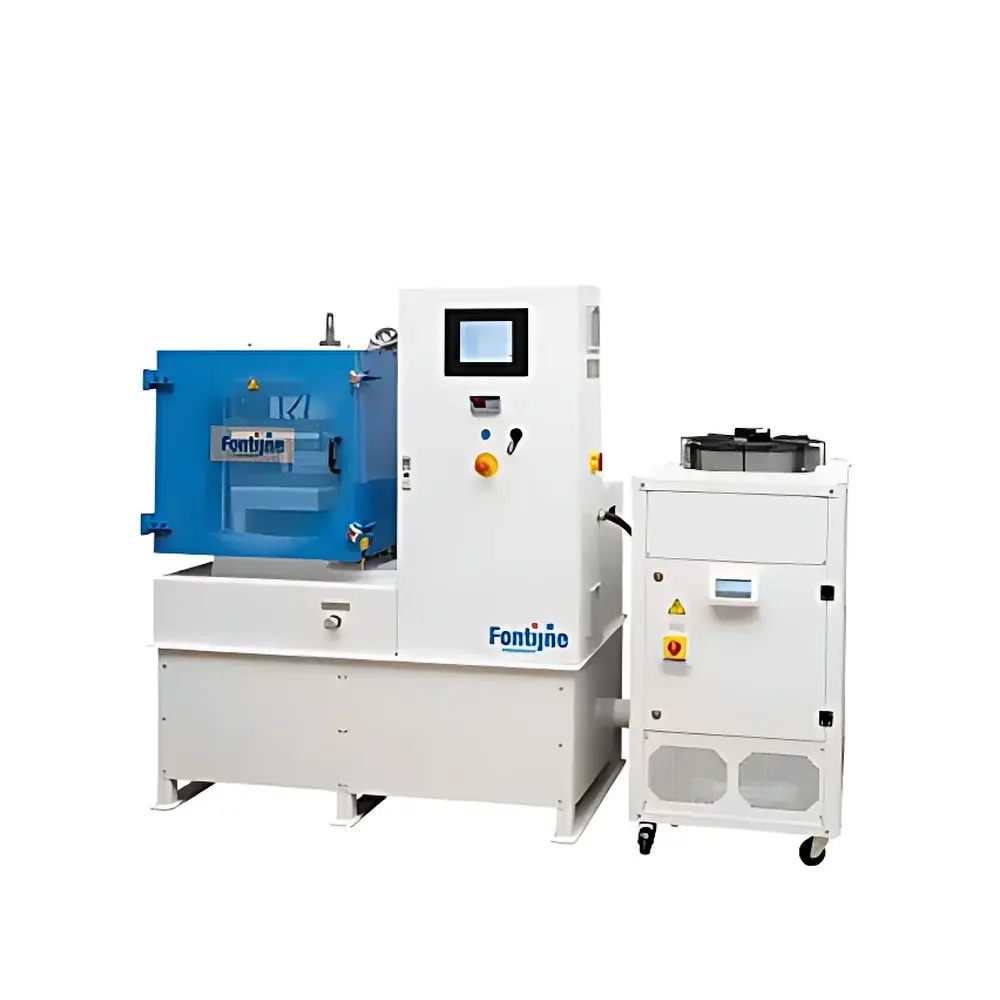
Fortelab LabPro Series Hydraulic Hot Press /平板硫化机
| Origin | Netherlands |
|---|---|
| Model | LabPro |
| Type | Fully Automatic Hydraulic Hot Press |
| Max Force | 50–3000 kN |
| Max Platen Size | up to 500 × 500 mm |
| Max Temperature | 700 °C |
| Platen Parallelism | < 5 µm/m |
| Control Interface | 8.4″ or 15″ Touchscreen (TP Control / Pro-View Control) |
| Compliance | ASTM D3182, ISO 527-2, ISO 6508-1, DIN 53505, USP <1059>, GLP/GMP-ready audit trail support |
Overview
The Fortelab LabPro Series Hydraulic Hot Press is a precision-engineered laboratory-scale hot press and vulcanizing press system designed for reproducible sample preparation of thermoplastic composites, polymer sheets, rubber compounds, ceramic green bodies, and metal powder compacts. Operating on the principle of controlled uniaxial compression under simultaneous thermal activation, the LabPro integrates hydraulic force generation, high-stability platen heating/cooling, and programmable multi-stage process control—enabling precise replication of industrial hot pressing and rubber vulcanization protocols in R&D and QC environments. Its dual-column rigid frame architecture ensures exceptional platen parallelism (< 5 µm/m), critical for uniform density distribution across heterogeneous or layered samples. The system supports both static and dynamic compression profiles, with real-time pressure feedback and closed-loop temperature regulation across the full operating range (ambient to 700 °C).
Key Features
- Dual-column monoblock frame with preloaded linear guides—optimized for long-term rigidity and minimal deflection under maximum load
- Fully hydraulic actuation with servo-controlled pressure hold: maintains setpoint within ±0.5% of full scale over extended dwell periods
- Heated platens with embedded cartridge heaters and calibrated Pt100 sensors—achieving ±1.0 °C uniformity across active surface area
- Optional vacuum chamber integration (30–40 mbar) for degassing prior to consolidation of porous or moisture-sensitive materials
- Modular platen configuration: interchangeable stainless steel, Inconel, or graphite-faced platens; customizable dimensions up to 500 × 500 mm
- Integrated cooling circuit interface (compatible with external chillers or condensers) for rapid quenching or controlled ramp-down cycles
- Two control platforms: TP Control (8.4″ touchscreen, fixed-rate heating/pressing) and Pro-View Control (15″ touchscreen, variable-speed pressing via VFD, PID-tuned multi-zone thermal profiling)
- Full data logging: time-stamped pressure, temperature, displacement, and cycle stage metadata stored internally and exportable via USB or Ethernet
Sample Compatibility & Compliance
The LabPro accommodates a broad spectrum of sample geometries and material classes—including elastomeric compounds (NR, SBR, EPDM), thermoset pre-pregs, PTFE tapes, battery electrode coatings, ferrite powders, and pharmaceutical tablet blends. Its design conforms to mechanical and thermal testing standards including ASTM D3182 (rubber compounding), ISO 527-2 (tensile testing specimen preparation), ISO 6508-1 (Rockwell hardness calibration blocks), and DIN 53505 (rubber hardness). All control firmware implements audit-trail functionality compliant with FDA 21 CFR Part 11 requirements, supporting electronic signatures, user-level access tiers (Operator/Engineer/Administrator), and tamper-proof method archiving. Optional GLP/GMP validation packages include IQ/OQ documentation templates and traceable calibration certificates.
Software & Data Management
Both TP Control and Pro-View Control firmware provide intuitive graphical workflow programming: users define sequential steps—preheat, evacuate (if equipped), close, compress, hold, cool, vent, and open—with independent setpoints for temperature ramp rate (°C/min), target pressure (kN or MPa), dwell duration (s), and cooling profile slope. Each method stores associated metadata (operator ID, timestamp, ambient conditions) and links to raw sensor logs. Export formats include CSV (for LIMS integration) and PDF reports with embedded trend plots. Remote monitoring is supported via Ethernet TCP/IP; optional OPC UA gateway enables seamless connection to MES or SCADA systems. Firmware updates are delivered via signed firmware images with SHA-256 verification.
Applications
- Preparation of standardized test specimens for tensile, flexural, and impact testing per ASTM D638, ISO 178, and ISO 180
- Vulcanization of rubber formulations under controlled time-temperature-pressure (TTP) profiles for cure kinetics analysis
- Consolidation of laminated composites (e.g., CFRP prepreg stacks) without void formation
- Green body densification of ceramic powders prior to sintering
- Electrode fabrication for Li-ion battery R&D: slurry-coated foils pressed to defined porosity and thickness
- Pharmaceutical solid dosage form development: excipient compatibility studies and tablet hardness optimization
- Calibration standard manufacturing: production of certified reference materials for hardness testers and compression testers
FAQ
What safety certifications does the LabPro series carry?
All LabPro models are CE-marked per Machinery Directive 2006/42/EC and EN 61000-6-2/-6-4 for electromagnetic compatibility. Optional ATEX-certified variants are available for use in classified hazardous areas.
Can the LabPro be integrated into an automated lab workflow?
Yes—via Ethernet-based Modbus TCP or optional OPC UA server, enabling synchronization with robotic sample handlers, environmental chambers, or central LIMS databases.
Is vacuum capability standard or optional?
Vacuum chamber integration (30–40 mbar ultimate pressure) is an optional module, configurable with electric or pneumatic evacuation pumps and integrated pressure transducers.
What maintenance intervals are recommended for hydraulic and thermal subsystems?
Hydraulic oil replacement every 24 months; heater cartridge calibration annually; platen surface flatness verification every 12 months using optical interferometry per ISO 10360-2.
Does Fortelab provide application support for method development?
Yes—Fortelab’s Applications Engineering team offers remote and on-site method optimization services, including TTP parameter mapping, thermal gradient modeling, and failure mode analysis for brittle or delaminating samples.



