
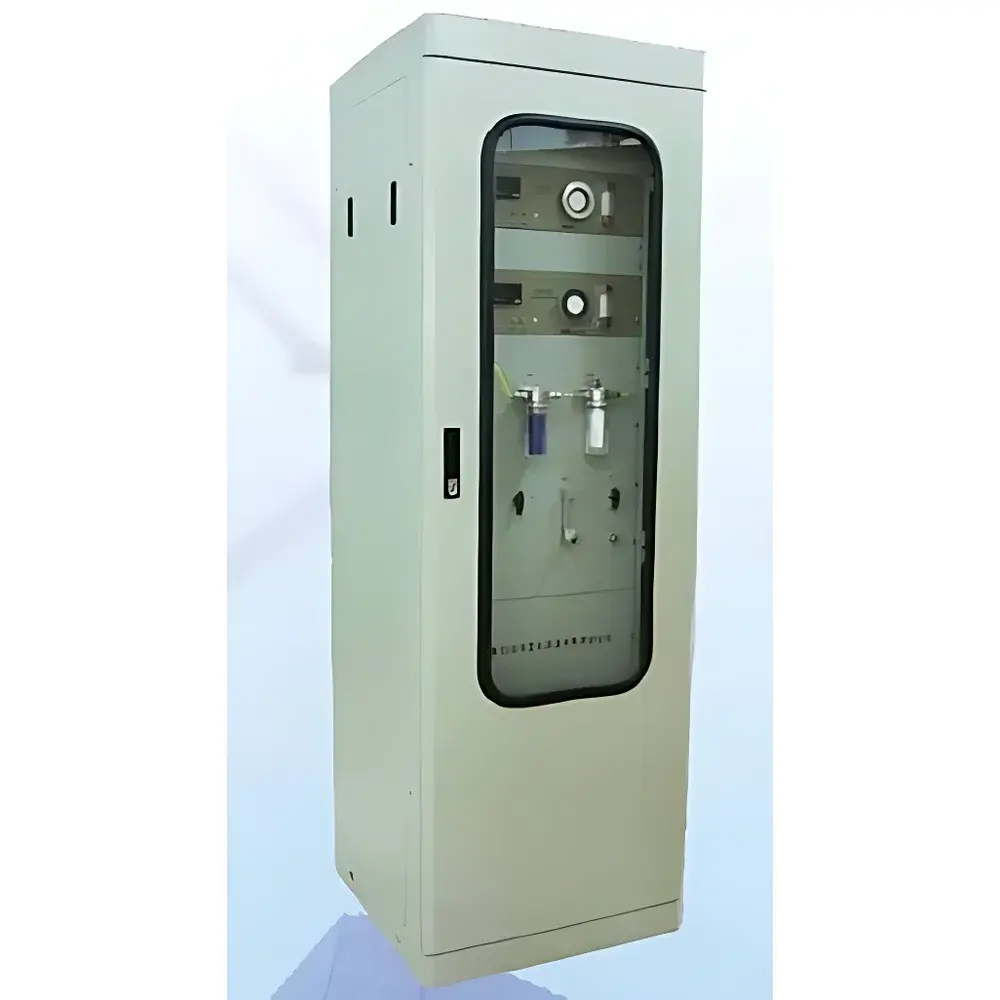
FS7000 Flue Gas Continuous Emission Monitoring System (CEMS)
| Origin | Beijing, China |
|---|---|
| Manufacturer Type | Authorized Distributor |
| Model | FS7000 |
| Pricing | Upon Request |
Overview
The FS7000 Flue Gas Continuous Emission Monitoring System (CEMS) is an integrated, industrial-grade online analytical platform engineered for real-time, regulatory-compliant measurement of gaseous pollutants and process parameters in high-temperature, high-humidity, high-dust flue gas streams. Designed in accordance with ISO 14064, EN 15267, and EPA Method 3A/7E/10, the system employs a direct-heated extractive sampling architecture to ensure representative, dry-base quantification of key combustion byproducts—including CO, CO₂, NOx, SO₂, CH₄, and C₂H₂—alongside O₂ concentration, flue gas temperature, static pressure, volumetric flow rate, and moisture content. Its core analytical methodology combines non-dispersive infrared (NDIR) spectroscopy with electrochemical and paramagnetic detection technologies, enabling simultaneous multi-component analysis without cross-interference. The system operates on a true dry-gas basis: all sample conditioning occurs above the dew point to prevent condensation-induced bias, acid deposition, or sensor fouling—critical for long-term stability in coal-fired power plants, waste incinerators, cement kilns, and steel reheating furnaces.
Key Features
- Heated extractive sampling from probe tip (180 °C) through insulated, trace-heated sample line (140–160 °C), eliminating water condensation and maintaining sample integrity
- Multi-stage particulate filtration: upstream SiC ceramic filter (2 µm) + downstream ultra-fine metal sintered filter (0.1 µm), achieving total particulate retention <0.5 µm
- Dual-layer and triple-layer NDIR detectors with single-beam, non-dispersive optical design—enhancing spectral selectivity for SO₂, NOx, and hydrocarbons
- Patented SO₃ scrubber integrated upstream of SO₂ channel, preserving SO₂ measurement accuracy while extending system service life in corrosive sulfur-rich environments
- Thermally stable NOx converter calibrated using certified NO standard gas, ensuring stoichiometric conversion efficiency >95% across operating temperature range
- Automatic zero calibration using ambient air (O₂ channel) and span calibration via programmable multi-point gas standards
- Robust mechanical construction: 316L stainless steel probe housing, Inconel sample line fittings, and high-temp ceramic insulation rated for continuous exposure up to 1000 °C
- Integrated PLC-controlled pulse back-purge system for dynamic filter cleaning—adjustable cycle timing based on real-time differential pressure monitoring
Sample Compatibility & Compliance
The FS7000 accommodates demanding flue gas conditions: inlet temperature up to 1000 °C, dust loading ≤20 g/Nm³, moisture saturation (90–100% RH), and static pressure ranging from −3 kPa to +20 kPa. All wetted materials comply with ASTM A240 and NACE MR0175 for sour gas resistance. The system meets EU Directive 2010/75/EU (IED), China’s HJ 75–2017 and HJ 76–2017 technical specifications for CEMS, and supports audit-ready data logging per GLP/GMP and US EPA 40 CFR Part 60 Appendix B requirements. Optional integration with Modbus TCP/IP, Profibus DP, or OPC UA enables seamless connection to DCS/SCADA systems and central environmental data management platforms.
Software & Data Management
The embedded control unit features a menu-driven, password-protected interface with a high-contrast LCD display supporting dual-unit output (ppm, % vol, mg/m³ @ standard conditions). All measurements are timestamped and stored locally with ≥30 days of raw data retention. Software functions include automatic diagnostic logging, fault code reporting (e.g., low flow, high dew point, filter clog warning), remote maintenance access via secure HTTPS, and configurable alarm thresholds with relay outputs. Data export complies with HJ 212–2017 communication protocol and supports CSV/Excel formatting for regulatory reporting. Audit trails record all user actions—including calibration events, parameter changes, and alarm acknowledgments—in alignment with FDA 21 CFR Part 11 electronic record requirements.
Applications
The FS7000 serves as a primary compliance tool for continuous emission monitoring at stationary sources subject to national and regional air quality regulations. It provides real-time feedback for boiler combustion optimization (via O₂ and CO control), desulfurization (FGD) system performance evaluation (pre-/post-scrubber SO₂ differentials), selective catalytic reduction (SCR) efficiency tracking (NOx reduction ratio), and carbon management initiatives (CO₂ mass flow calculation). Additional use cases include thermal oxidizer verification, municipal solid waste incineration stack monitoring, and clinker cooler exhaust characterization in cement manufacturing—all under harsh, variable-load operational profiles.
FAQ
What is the T90 response time for gaseous analytes?
T90 ≤ 10 seconds for all NDIR-measured components (CO, CO₂, NOx, SO₂, CH₄, C₂H₂) under nominal flow and temperature conditions.
How often does the system require calibration?
Zero calibration is performed automatically using ambient air every 24 hours; span calibration is recommended weekly using certified multi-gas standards traceable to NIST or equivalent national metrology institutes.
Does the FS7000 support wet-basis or dry-basis reporting?
The system performs dry-base measurement by default, with optional integrated moisture sensing (capacitive hygrometer) enabling real-time wet-to-dry correction per ISO 14789 and EPA Method 4.
Can the system operate in explosive atmospheres?
Standard configuration is non-certified for hazardous areas; ATEX/IECEx Zone 2 or Class I Div 2 variants are available upon request with explosion-proof enclosures and intrinsically safe signal interfaces.
Is remote firmware update supported?
Yes—secure over-the-air (OTA) updates are enabled via encrypted SSH tunnel, with rollback capability and version-controlled change logs retained for regulatory review.
Related Products







