
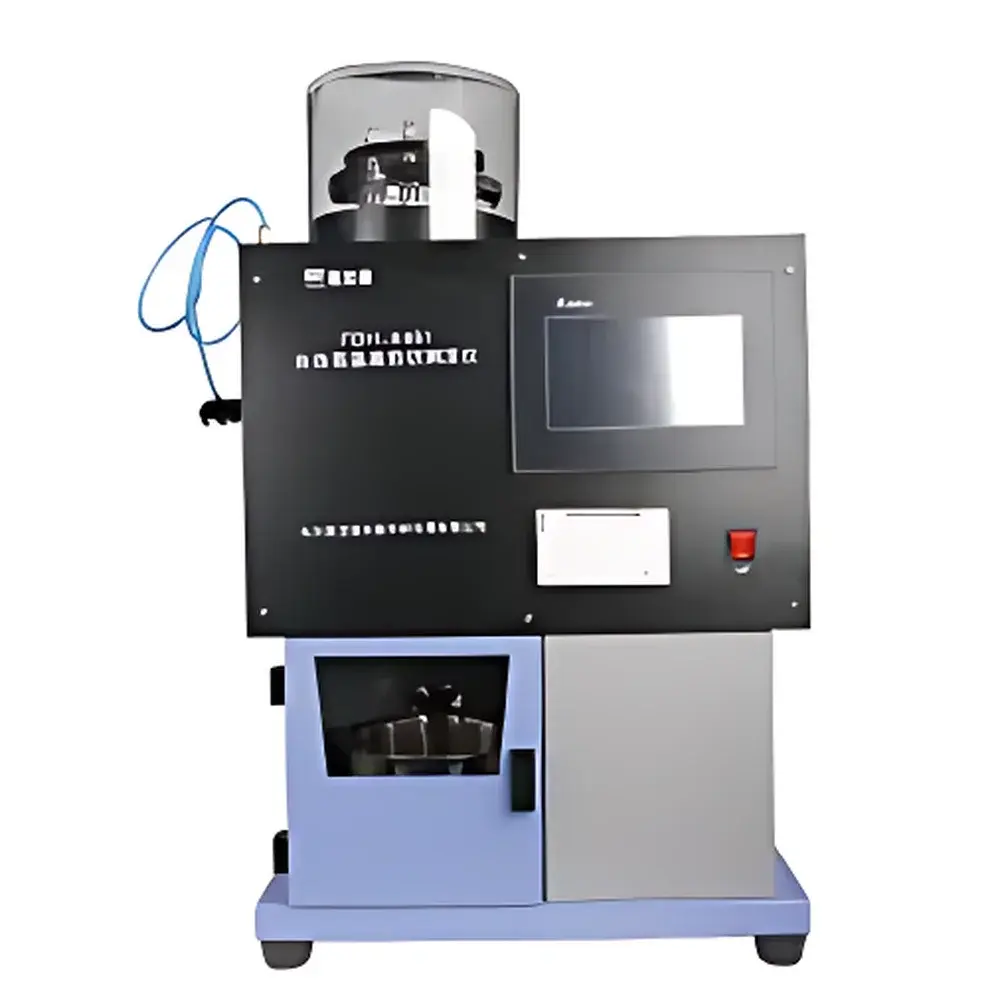

Fuland FDH-8461 Automated High-Temperature High-Shear (HTHS) Viscometer
| Brand | Fuland (CSFriend) |
|---|---|
| Model | FDH-8461 |
| Application | HTHS viscosity measurement of lubricating oils |
| Standard Compliance | ASTM D5481, SH/T 0703 |
| Temperature Range | Ambient to 150 °C |
| HTHS Viscosity Range | 0.5–8 mPa·s at 150 °C |
| Pressure Control Range | 3.5–35 kgf/cm² |
| Sample Volume | 10 mL |
| Pressure Display | Digital pressure gauge |
| Time Measurement | Digital timer |
| Control Method | Integrated microprocessor-based PID temperature & pressure regulation |
| Power Supply | AC 220 V, 50 Hz |
| Safety | FTC thermal cut-off circuit |
| Sample Handling | Individual stopcock valve per capillary cell |
Overview
The Fuland FDH-8461 Automated High-Temperature High-Shear (HTHS) Viscometer is a precision laboratory instrument engineered for the standardized determination of apparent dynamic viscosity of engine oils and other lubricants under simulated high-shear, high-temperature service conditions. Based on the capillary flow principle under controlled nitrogen or CO₂ pressurization, the system measures the time required for a fixed volume of sample (10 mL) to pass through a calibrated capillary tube at precisely maintained temperatures up to 150 °C and regulated pressures ranging from 3.5 to 35 kgf/cm². This enables calculation of apparent shear rates exceeding 10⁶ s⁻¹—conditions representative of critical engine components such as bearings, piston rings, and valve trains during operation. The instrument directly supports compliance with ASTM D5481 (Standard Test Method for Measuring Apparent Viscosity at High Temperature and High Shear Rate by Multicell Capillary Viscometer) and its Chinese counterpart SH/T 0703, making it indispensable for OEM formulation labs, lubricant quality control departments, and third-party testing facilities engaged in API licensing, ACEA certification, or OEM specification validation.
Key Features
- Automated pressure- and temperature-controlled capillary viscometry with integrated PID regulation for ±0.1 °C thermal stability and ±0.2 kgf/cm² pressure repeatability.
- Dual digital readouts: real-time display of applied pressure (kgf/cm²) and efflux time (s), enabling immediate verification of test validity prior to software processing.
- Modular capillary cell assembly with individual brass stopcock valves per cell—designed to meet ASTM D5481’s requirement for independent sample isolation and sequential testing without cross-contamination.
- Fuland proprietary HTHS calculation software with embedded calibration curves for each certified capillary cell; auto-applies correction factors for pressure, temperature, and capillary geometry per ISO/IEC 17025 traceability protocols.
- FTC (Fail-safe Thermal Cut-off) circuit protection: automatically interrupts power if chamber temperature exceeds 155 °C, preventing thermal degradation of samples and safeguarding operator safety.
- Critical fluid-path components—including pressure regulators, solenoid valves, and capillary manifolds—sourced from U.S.-based CN Technologies, ensuring long-term dimensional stability and corrosion resistance against aggressive hydrocarbon matrices.
Sample Compatibility & Compliance
The FDH-8461 is validated for use with mineral, synthetic, and semi-synthetic engine oils—including SAE 0W-20, 5W-30, 10W-40, and heavy-duty diesel formulations—as well as greases (after solvent dilution) and transmission fluids meeting OEM specifications (e.g., GM Dexron, Ford Mercon, JASO M345). All test procedures adhere strictly to ASTM D5481’s procedural requirements: pre-equilibration at 150 °C for ≥15 minutes, pressure application within ±1% of target value, and efflux time recording with 0.01-second resolution. Instrument calibration is traceable to NIST-certified reference oils (e.g., NIST SRM 1971, 1972), and full audit logs—including operator ID, timestamp, raw pressure/time data, and final viscosity result—are generated in accordance with GLP and FDA 21 CFR Part 11 electronic record requirements when paired with optional secure network configuration.
Software & Data Management
The Fuland HTHS Analysis Suite provides guided workflow execution—from sample loading prompts and parameter validation checks to automated viscosity computation using the ASTM D5481-defined equation: ηapp = K × P / t, where K is the cell-specific constant (determined via calibration with reference oils), P is applied pressure (kgf/cm²), and t is efflux time (s). Raw data files (.csv and .xlsx) include metadata headers compliant with LIMS integration standards (ASTM E1578, ISO 15197). Optional database modules support trend analysis across batches, statistical process control (SPC) charting (X̄/R charts), and deviation alerts against internal specification limits. All software updates are delivered via encrypted firmware packages with SHA-256 checksum verification.
Applications
- Formulation development of low-viscosity, fuel-efficient engine oils meeting ILSAC GF-6 and API SP categories.
- Quality assurance of finished lubricants prior to release—ensuring consistency in HTHS viscosity across production lots.
- Root-cause analysis of viscosity breakdown due to mechanical shear stress, oxidation, or additive depletion.
- Supporting OEM approval submissions requiring ASTM D5481-compliant data packages for field trials and warranty validation.
- Research into shear-thinning behavior of polymer-thickened oils and nanoparticle-enhanced lubricants.
FAQ
What is the minimum sample volume required per test?
10 mL of conditioned sample is required per capillary cell test. Duplicate measurements are recommended for statistical confidence.
Does the instrument support multi-cell parallel testing?
No—the FDH-8461 uses a single-capillary design with manual cell exchange; however, its modular stopcock valves allow rapid sequential testing of up to four samples without recalibration.
How is calibration traceability maintained?
Each capillary cell is supplied with a NIST-traceable calibration certificate. Users must re-validate annually using certified reference oils per ASTM D5481 Section 8.3.
Is the pressure source integrated or external?
The system includes an internal oil-free diaphragm compressor and precision pressure regulator; no external gas cylinders are required for routine operation.
Can the FDH-8461 be integrated into a centralized lab network?
Yes—via Ethernet port and OPC UA protocol support, enabling remote monitoring, data export to enterprise LIMS, and synchronized time-stamping across distributed instruments.




