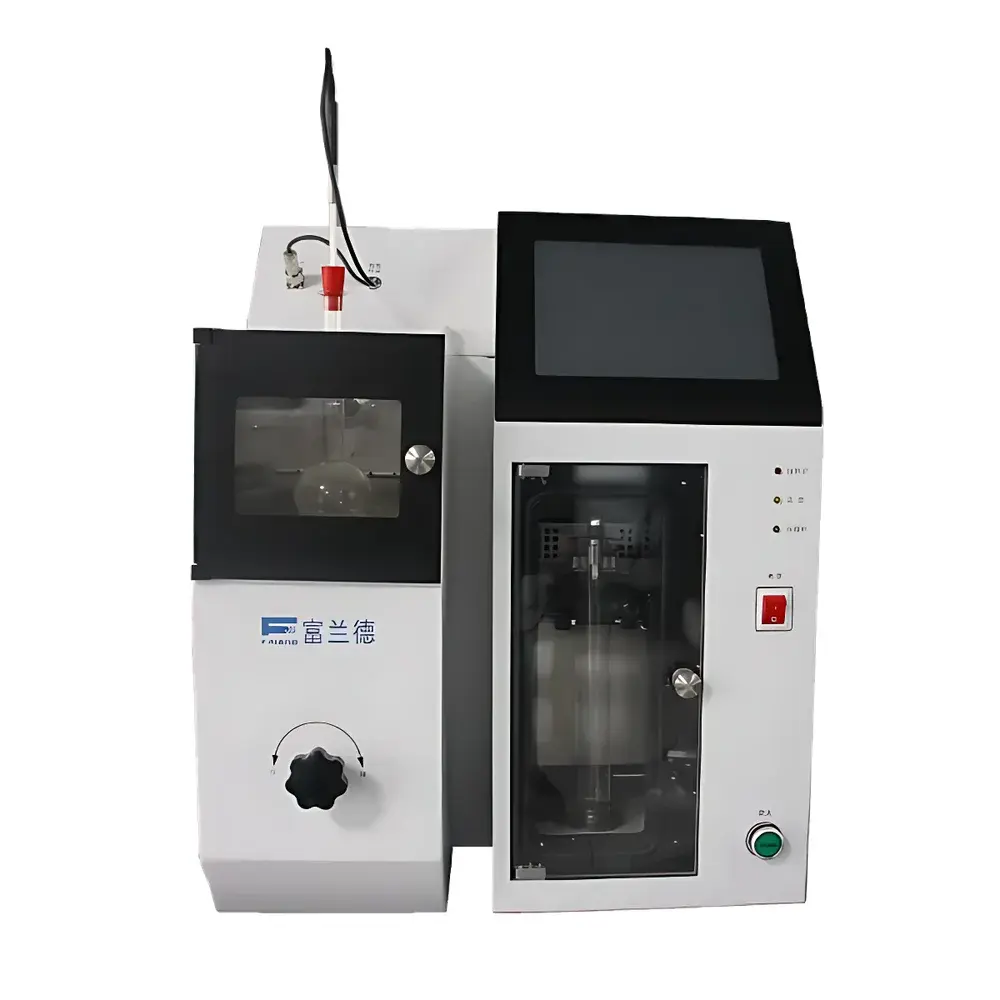
Fulande FDR-4571 Fully Automated Distillation Analyzer for Petroleum Products
| Brand | Fulande (csfriend) |
|---|---|
| Model | FDR-4571 |
| Origin | Hunan, China |
| Display | LCD screen |
| Distillation Rate | 4–5 mL/min |
| Cold Bath Temperature Range | −10 to +70 °C |
| Heating Temperature Range | Ambient to +350 °C |
| Temperature Resolution | 0.1 °C |
| Volume Detection Range | 0–100 mL |
| Volume Resolution | 0.1 mL |
| Temperature Sensor | Imported German probe |
| Power Supply | AC 220 V, 50 Hz |
| Total Power Consumption | 1.5 kW |
| Operating Environment | 0–60 °C, ≤80% RH |
Overview
The Fulande FDR-4571 Fully Automated Distillation Analyzer is engineered for precise, repeatable determination of boiling point distributions in petroleum products—including gasoline, diesel, jet fuel, naphtha, and light distillates—according to standardized test methods such as ASTM D86, ASTM D1078, ISO 3405, and GB/T 6536. It implements a microprocessor-controlled, single-stage atmospheric distillation process with real-time monitoring of vapor temperature, recovered volume, and heating power. The system employs a dual-sensor architecture: a high-stability German platinum resistance thermometer (Pt100 class A) for vapor-phase temperature measurement at the distillation head, and an optical infrared meniscus detection system (XEC, USA) for non-contact, high-resolution volumetric tracking of distillate collection in the graduated cylinder. This configuration eliminates mechanical wear, parallax error, and operator dependency—ensuring compliance with GLP and regulatory data integrity requirements.
Key Features
- Integrated LCD interface with full Chinese operating system and multi-mode programmable operation—including manual override, method-driven auto-run, and stepwise parameter adjustment.
- Patented one-touch calibration protocol for rapid validation of volume and temperature channels—reducing setup time and eliminating iterative manual tracking adjustments required by legacy systems.
- High-precision HP-derived linear motion tracking mechanism with sub-milliliter positional control (±0.1 mL resolution), ensuring consistent condensate delivery alignment without rail wear or backlash.
- Intelligent thermal management: independent PID-controlled cold bath (−10 to +70 °C) and heated distillation flask zone (ambient to +350 °C), each with real-time feedback loops and over-temperature cutoff.
- Embedded anti-bumping logic: dynamic vapor pressure estimation and adaptive heating power modulation suppress sudden ebullition, minimizing superheat-induced fraction skewing and improving repeatability across volatile samples.
- Onboard data storage supports ≥1,000 test records with timestamped metadata (operator ID, method name, ambient conditions), exportable via USB to CSV or PDF report formats.
Sample Compatibility & Compliance
The FDR-4571 accommodates standard ASTM D86 glassware assemblies (125 mL flask, 600 mm condenser, 100 mL graduated cylinder) and accepts sample volumes from 10 to 100 mL. It is validated for use with hydrocarbon mixtures ranging from C4–C12 (light ends) through mid-distillates (C10–C20). All thermal and volumetric measurements traceably align with NIST-traceable reference standards. The analyzer meets electromagnetic compatibility (EMC) requirements per IEC 61326-1 and safety specifications under IEC 61010-1. Its operational firmware includes audit trail logging (user actions, parameter changes, calibration events), supporting FDA 21 CFR Part 11 readiness when deployed in regulated QC environments.
Software & Data Management
The embedded control software provides method file creation, editing, and versioning—enabling laboratories to define custom distillation protocols (e.g., variable ramp rates, hold steps, endpoint criteria). Each method stores target temperature/volume breakpoints, alarm thresholds, and reporting templates. Data output includes raw time-series logs (vapor temp vs. volume), summary tables (IBP, EP, 10/50/90% points), and graphical overlays compliant with ASTM D86 Annex A1. Export options include USB mass storage and optional RS-232/Modbus RTU for integration into LIMS or SCADA platforms. No proprietary drivers or cloud dependencies are required—ensuring long-term maintainability and network-isolated deployment.
Applications
- Refinery quality assurance: verification of gasoline volatility (RVP correlation), diesel cetane improver blending, and kerosene flash point compliance.
- Fuel certification labs: execution of statutory distillation tests for EN 590, ASTM D975, and JIS K 2204.
- Research & development: characterization of biofuel blends (e.g., ethanol-gasoline, FAME-diesel) and evaluation of fractionation behavior under controlled thermal gradients.
- Contract testing facilities: high-throughput batch analysis with automated pass/fail flagging against specification limits (e.g., ASTM D86 T10 < 70 °C for unleaded gasoline).
FAQ
Does the FDR-4571 support ASTM D86 Method A and Method B?
Yes—the instrument’s firmware includes preconfigured templates for both Method A (manual distillation rate control) and Method B (automated rate regulation), with configurable ramp profiles and endpoint logic.
Can the system be integrated with a laboratory information management system (LIMS)?
Yes—via ASCII-based serial communication (RS-232) or USB CDC virtual COM port; structured data packets conform to ASTM E1382-compliant syntax for seamless ingestion.
Is third-party calibration verification supported?
Yes—calibration certificates for temperature and volume sensors can be generated using built-in diagnostic routines and external NIST-traceable references (e.g., dry-block calibrators, certified volumetric standards).
What maintenance intervals are recommended for the infrared volume sensor?
No scheduled maintenance is required; the XEC optical system is sealed and self-diagnosing. Annual functional verification using a certified 10 mL syringe is advised per ISO/IEC 17025 internal audit protocols.