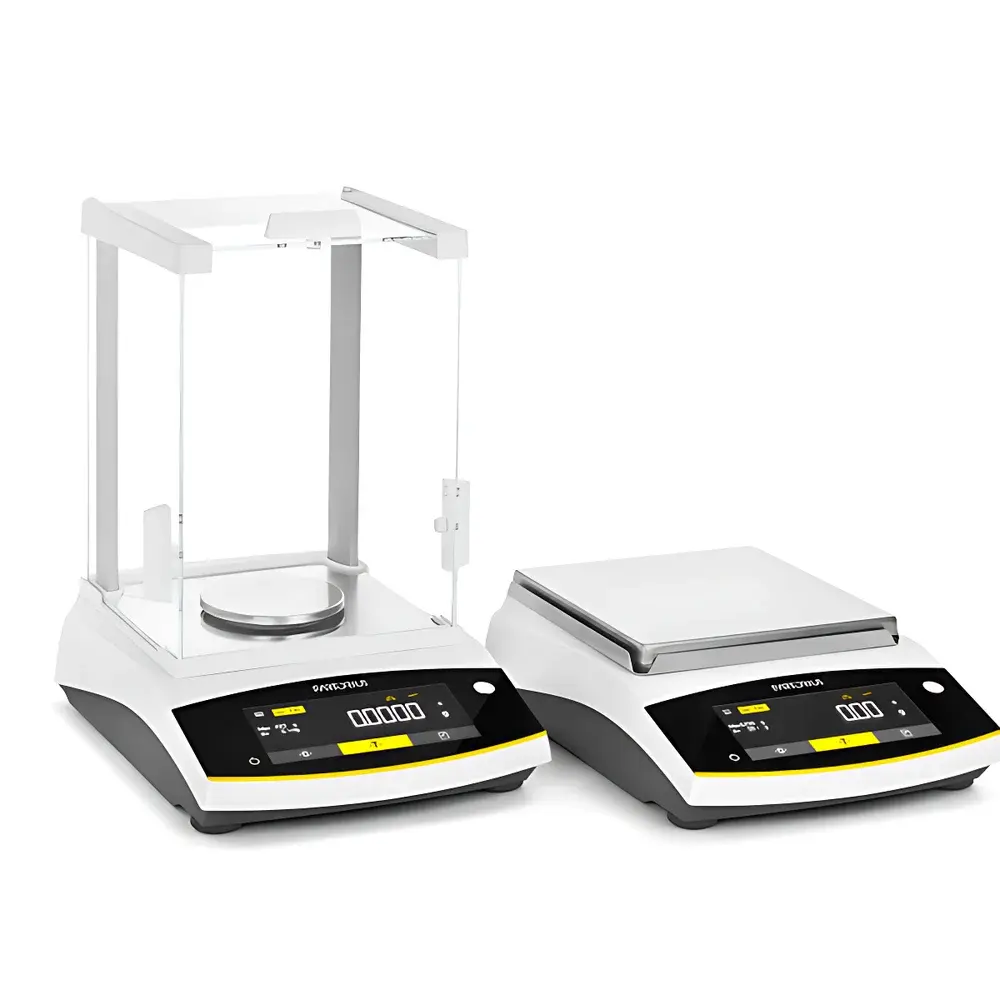
Sartorius Entris® II BCE2202i-1CCN Precision Balance
| Brand | Sartorius |
|---|---|
| Origin | Shanghai, China |
| Model | BCE2202i-1CCN |
| Type | Precision Balance |
| Maximum Capacity | 2200 g |
| Readability | 10 mg |
| Repeatability | ≤ ±10 mg |
| Calibration | Internal (isoCAL®) |
| Pan Dimensions | Rectangular |
| Connectivity | USB-C, RS232 (9-pin), GLP/GMP-compliant data output |
| Applications | Weighing, Counting, Percentage, Density, Statistics, Animal Weighing, Checkweighing, Formulation, Peak Hold, Unit Conversion, Below-balance weighing |
| Compliance | ISO/IEC 17025, USP <41>, ASTM E898, GLP/GMP audit trail ready |
| Display | LED-backlit touchscreen interface |
| Language Support | 8 built-in languages |
| Enclosure | Fully removable draft shield with anti-static coated glass |
| Construction | PBT polymer housing, stainless steel pan, tempered glass components |
| Environmental Protection | IP42-rated enclosure |
| Operating Temperature Range | 10–30 °C |
| Relative Humidity | 20–80% RH (non-condensing) |
Overview
The Sartorius Entris® II BCE2202i-1CCN is a high-performance precision balance engineered for routine laboratory and quality control environments where reproducibility, regulatory compliance, and operational efficiency are critical. Designed and validated in accordance with Sartorius’ global quality standards—rooted in over 150 years of German metrological expertise—the BCE2202i-1CCN delivers consistent 10 mg readability across its full 2200 g capacity range. Its core measurement principle relies on electromagnetic force compensation (EMFC) technology, utilizing Sartorius’ proprietary monolithic sensor architecture to ensure minimal thermal drift, rapid stabilization (<2 s typical), and long-term linearity. Unlike strain-gauge-based systems, the EMFC transducer provides inherent immunity to mechanical hysteresis and load-point sensitivity, making it especially suitable for applications demanding traceable accuracy under variable ambient conditions. The balance operates within a certified environmental envelope (10–30 °C, 20–80% RH non-condensing) and meets fundamental requirements for ISO/IEC 17025-accredited laboratories.
Key Features
- isoCAL® fully automated internal calibration and adjustment—triggered by time intervals or temperature deviations (±1.5 °C), ensuring continuous traceability without manual intervention
- Robust mechanical architecture: stainless steel weighing pan, chemically resistant PBT polymer housing, and anti-static coated tempered glass draft shield—designed for durability and ease of decontamination
- Modular draft shield system: fully removable front/side sliding doors and top-mounted access for large containers or below-balance weighing via integrated lower hook
- Intuitive LED-backlit touchscreen interface with haptic feedback—supports eight pre-installed languages (English, German, French, Italian, Spanish, Portuguese, Russian, Polish)
- GLP/GMP-ready data management: automatic timestamping, user ID logging, and audit-trail-capable output compliant with FDA 21 CFR Part 11 when paired with compatible software
- Dynamic application suite: 12 built-in functions including parts counting, percentage weighing, density determination (with optional kit), statistical analysis (mean, SD, CV), animal weighing with stabilization filter, and checkweighing with configurable tolerance bands
- Dual connectivity architecture: native USB-C port for direct PC communication and legacy 9-pin RS232 interface—ensuring backward compatibility with LIMS and ERP systems
Sample Compatibility & Compliance
The BCE2202i-1CCN accommodates a broad range of sample types—from powders and granules to irregular solids and small vessels—thanks to its spacious weighing chamber (W × D × H: 180 × 190 × 230 mm) and rectangular pan geometry (180 × 190 mm). Its anti-static glass components mitigate electrostatic interference during low-mass or dry-powder measurements, while the IP42-rated enclosure protects internal mechanisms from dust ingress and incidental splashes. Regulatory alignment includes adherence to USP for balance performance verification, ASTM E898 for laboratory balance specifications, and ISO 9001–certified manufacturing processes. All calibration events—including isoCAL® cycles—are recorded internally with date/time stamps, operator ID (if password-protected), and deviation metrics, satisfying GLP documentation requirements for audit readiness.
Software & Data Management
Data output is structured to support both standalone operation and integration into regulated workflows. Each measurement event can be exported via RS232 or USB-C in ASCII format, with customizable delimiters and field sequencing. Built-in GLP report templates include balance ID, calibration status, ambient conditions (if external sensors are connected), and full traceability metadata. When used with Sartorius LabX® Lite (optional), the BCE2202i-1CCN supports electronic signature capture, role-based access control, and automated report generation aligned with 21 CFR Part 11 Annex 11 expectations. All configuration changes—including unit selection, application parameters, and user permissions—are logged in an immutable internal audit trail accessible via service mode.
Applications
This balance serves as a primary weighing instrument across pharmaceutical QC labs (raw material verification, batch release testing), chemical R&D (reagent dispensing, formulation development), food safety testing (moisture content prep, additive dosing), and academic teaching labs (stoichiometry experiments, density lab exercises). Its 2200 g capacity and 10 mg resolution make it ideal for volumetric flask filling, tablet weight variation checks per USP , and multi-component blending protocols requiring net/gross/tare tracking. The density determination mode—when used with Sartorius’ optional density kit—enables solid and liquid density calculations per ISO 1183 and ASTM D792 without external software dependencies.
FAQ
What does “isoCAL®” mean, and how frequently does it activate?
isoCAL® is Sartorius’ patented internal calibration system that automatically initiates calibration and adjustment based on preset time intervals (e.g., every 4 hours) or temperature fluctuations exceeding ±1.5 °C—ensuring continuous metrological integrity without user input.
Is the BCE2202i-1CCN suitable for GMP-regulated environments?
Yes—when operated with password protection enabled, audit trail activated, and isoCAL® logs retained, it fulfills core GMP documentation requirements for analytical instrumentation as defined in EU Annex 11 and FDA guidance on computerized systems.
Can I connect this balance directly to Excel or LIMS without additional hardware?
Yes—via USB-C or RS232, the balance outputs ASCII-formatted data compatible with Microsoft Excel’s “Get External Data” function or standard LIMS import modules; no intermediary drivers or converters are required.
Does the balance support below-balance weighing for density or magnetic susceptibility measurements?
Yes—the integrated lower hook allows suspension of samples or pycnometers, enabling density determination and other specialized weighing modes using the built-in application suite.
How is cleaning and maintenance performed in compliance with ISO 17025?
The draft shield, pan, and housing surfaces are wipe-clean compatible with 70% ethanol or isopropanol; no disassembly is required. Routine verification per ISO/IEC 17025 Clause 6.4.10 should include daily repeatability checks and periodic linearity testing using certified weights traceable to NIST or PTB.