
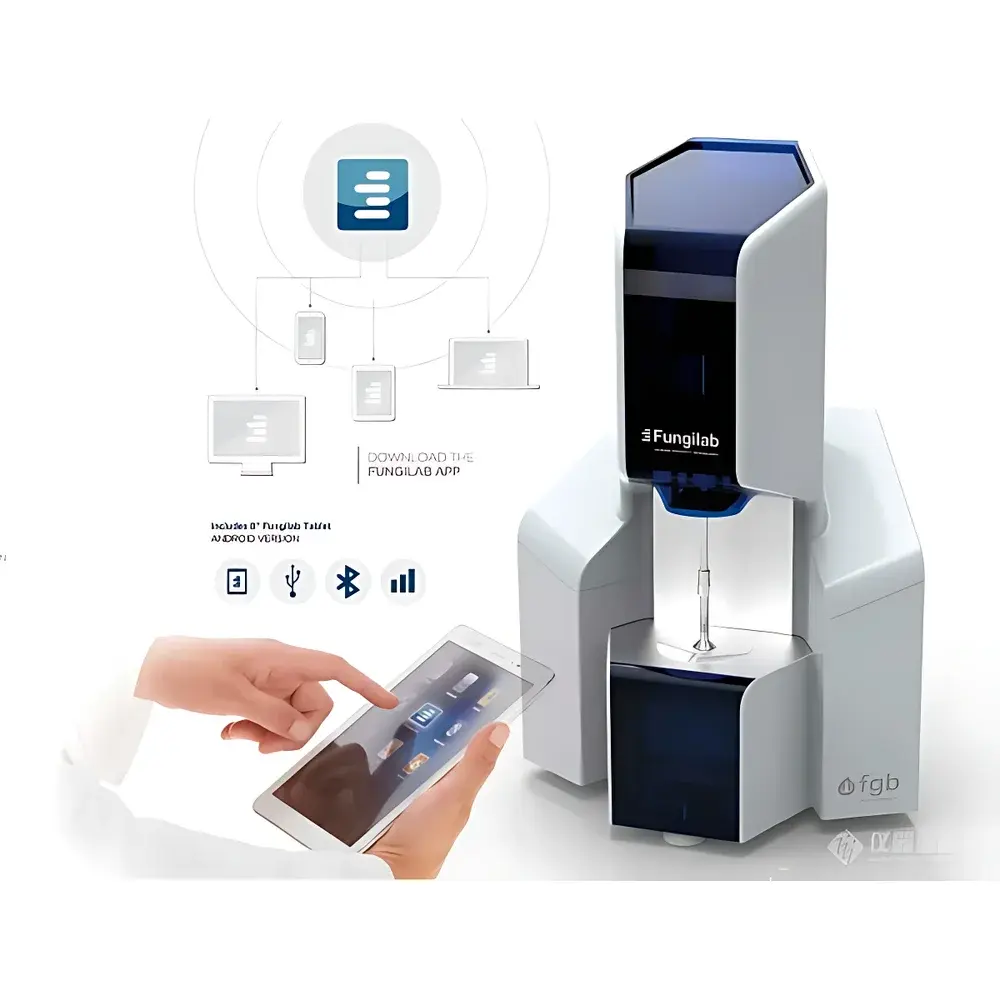
Fungilab V-cone&Plate Cone-and-Plate Viscometer
| Origin | Spain |
|---|---|
| Manufacturer Type | Authorized Distributor |
| Origin Category | Imported |
| Model | V-cone&Plate |
| Instrument Type | Rotational Viscometer |
| Viscosity Range | 0.2–270,000 mPa·s (dependent on cone/plate rotor selection) |
| Rotational Speed | 5–1000 rpm |
| Torque Range | 0.1–5.75 mN·m |
| Repeatability | ±0.2% |
| Accuracy | ±1% of full scale |
| Temperature Control | 5–80 °C (Peltier), optional 25–300 °C (electric heater) |
| Temp. Resolution | 0.1 °C |
| Temp. Accuracy | ±0.3 °C |
| Sample Volume | <1 mL |
| Compliance Standards | ASTM D4287, ISO 2884, ISO 3219, BS 3900 |
Overview
The Fungilab V-cone&Plate is a precision-engineered cone-and-plate rotational viscometer designed for high-fidelity rheological characterization of structured and non-Newtonian fluids under controlled shear conditions. Based on the fundamental principle of Couette flow between a precisely angled conical rotor and a flat, thermostatted plate, the instrument delivers uniform shear rate distribution across the entire sample gap—enabling accurate determination of dynamic viscosity, shear stress, and shear rate relationships. Unlike coaxial cylinder geometries, the cone-and-plate configuration eliminates end effects and ensures defined, calculable shear geometry—critical for quality control and R&D applications where reproducibility and compliance with international test standards are mandatory. The system is optimized for laboratories requiring traceable, low-volume measurements (<1 mL), including formulation development, QC release testing, and regulatory documentation in pharmaceutical, cosmetic, food, and advanced materials sectors.
Key Features
- Motorized auto-lift mechanism for precise, repeatable gap setting and sample loading
- Integrated 8-inch Android-based touchscreen tablet with pre-installed Fungilab ViscoLab software—no external PC required
- Multi-step programmable measurement protocols with TTT (Torque Threshold Termination) and TTS (Time Threshold Termination) logic
- Real-time graphical display of viscosity vs. time, shear stress vs. shear rate, and flow curves
- User-configurable speed range from 5 to 1000 rpm in discrete or continuous increments
- Onboard viscosity and temperature calibration routines (traceable to factory reference standards)
- Automatic range calculation: system computes maximum measurable viscosity based on selected rotor and speed combination
- Multi-language UI support—including English, Spanish, French, German, Chinese, and Portuguese—with configurable units (cP, mPa·s, Pa·s, cSt, mm²/s, %FS, °C/°F)
- Dual connectivity: USB 2.0, Ethernet (TCP/IP), and Bluetooth 4.2 for remote monitoring and data synchronization
- Acoustic alert system with configurable thresholds for torque overload, temperature deviation, or protocol completion
Sample Compatibility & Compliance
The V-cone&Plate supports a broad spectrum of Newtonian and non-Newtonian samples—from low-viscosity solvents to highly structured pastes and thermosetting resins. Its minimal sample requirement (<1 mL) makes it ideal for expensive, hazardous, or scarce materials. Standard rotors include STC32 (20 mm, 3°), STC12 (20 mm, 1°), STC05 (20 mm, 0.5°), STC34 (40 mm, 3°), STC14 (40 mm, 1°), STC05 (40 mm, 0.5°), and STC45 (24 mm, 0.45°), each certified for traceable calibration and compliant with ISO 3219:1993 (rotational viscometers—geometric specifications). All stainless-steel (AISI 316) rotors are autoclavable and chemically resistant. The instrument meets ASTM D4287 (high-shear viscosity of printing inks), ISO 2884 (paints and varnishes), and BS 3900 (coating materials), supporting GLP/GMP-aligned workflows with full audit trail capability for instrument settings, calibration history, and raw measurement metadata.
Software & Data Management
ViscoLab software—preloaded on the integrated tablet—provides full control over measurement parameters, real-time visualization, and post-processing analytics. All experimental data—including timestamps, environmental conditions, rotor ID, shear history, and calculated rheological parameters—are stored in a secure SQLite database with user-accessible query functions. Reports export directly to PDF (print-ready, with header/footer customization) and CSV (comma-separated values for statistical analysis in MATLAB, Python, or JMP). The software supports 21 CFR Part 11-compliant user authentication (role-based access), electronic signatures, and immutable audit logs for critical QC/QA environments. Optional cloud sync enables centralized data archiving and cross-site method sharing via secure HTTPS endpoints.
Applications
- Coatings & Inks: Rheology profiling of UV-curable resins, lithographic inks, and water-based acrylic dispersions per ISO 2884
- Pharmaceuticals: Viscosity verification of gels, ointments, and suspensions per USP , including yield stress estimation
- Foods & Confectionery: Texture analysis of chocolate masses, starch gels, and fruit purées under shear-thinning conditions
- Adhesives & Sealants: Characterization of thixotropic recovery, creep compliance, and structural breakdown at defined shear rates
- Polymer Processing: Melt viscosity screening of thermoplastics, epoxy formulations, and vinyl ester resins prior to extrusion or casting
- Personal Care: Stability assessment of emulsions, surfactant micellar systems, and hydrogel networks using oscillatory and steady-state protocols
FAQ
What is the minimum sample volume required for accurate measurement?
Less than 1 mL—typically 0.02–0.9 mL depending on rotor geometry.
Does the system support temperature-controlled measurements?
Yes: Peltier-cooled plate (5–80 °C) is standard; electrically heated plate (up to 300 °C) is available as an option.
Can I perform yield stress estimation with this instrument?
Yes—via controlled shear ramp tests or Herschel-Bulkley model fitting using exported shear stress vs. shear rate data.
Is calibration traceable to national standards?
Factory calibration uses NIST-traceable silicon oils and certified torque standards; users may perform field recalibration with supplied reference fluids.
How is data integrity ensured in regulated environments?
ViscoLab implements role-based access control, electronic signatures, and immutable audit trails compliant with FDA 21 CFR Part 11 and EU Annex 11 requirements.



