
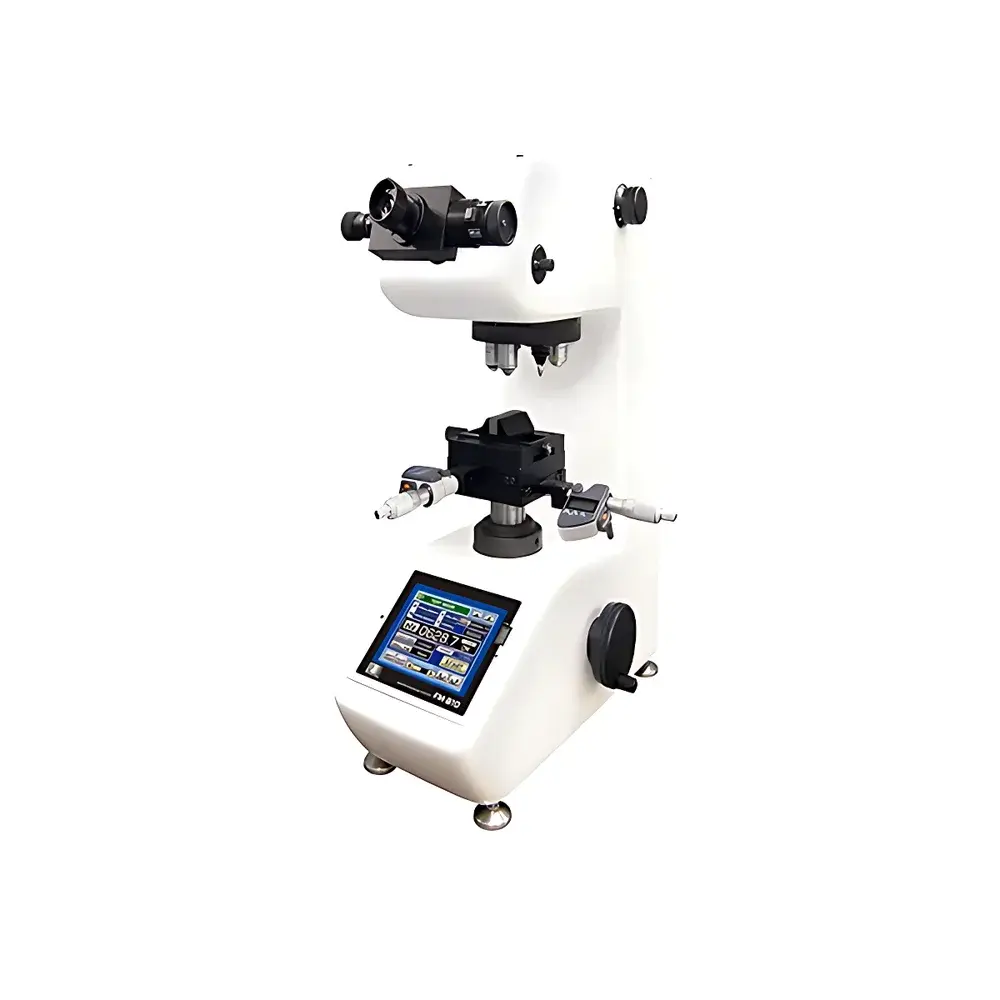
Future-Tech FM-310 Micro-Vickers Hardness Tester
| Brand | Future-Tech |
|---|---|
| Origin | Japan |
| Model | FM-310 |
| Hardness Tester Type | Micro-Vickers |
| Test Load Range | 1 g to 1000 g (selectable combinations) |
| Maximum Test Load | 1000 g |
| Specimen Height Clearance | 95 mm (H) × 115 mm (D) |
| Compliance | JIS B 7734, JIS B 7735, ASTM E384, ISO 6507-2 |
| Optical System | Dual-standard objective lenses (10× & 50×), expandable up to four objectives (5×, 20×, 40×, 100×) |
| Measurement Method | Manual or optional digital X-Y stage with encoder-based coordinate input |
| Indentation Evaluation | Manual measurement via eyepiece micrometer or optional AR-assisted automatic indentation recognition (1.3 MP CMOS camera + FT-ZERO software) |
| Display Interface | 7-inch full-color LCD touchscreen (FM-810 control unit) |
| Load Application | Fully automated loading–holding–unloading sequence at 60 µm/sec |
| Hold Time Range | 5–99 s |
| Focus Mechanism | Manual coarse/fine focusing |
| Turret Operation | Motorized auto-turret (FM-310/FM-810) |
| Hardness Scales Supported | HV, HK, HBW, HBS, KC fracture toughness |
| Hardness Conversion | Built-in SAE J417b and ASTM E140 lookup tables |
| Surface Correction Functions | Cylindrical and spherical surface compensation |
| Data Output | USB and RS-232C interfaces |
| Power Supply | AC 100–115 V / 240 V, 50/60 Hz |
| Dimensions (W×D×H) | 186 × 450 × 504 mm |
| Weight | ~40 kg (including tool case) |
Overview
The Future-Tech FM-310 Micro-Vickers Hardness Tester is a precision-engineered instrument designed for quantitative microhardness evaluation of metallic, ceramic, and thin-film materials in research laboratories, quality control departments, and failure analysis facilities. Based on the Vickers indentation principle—where a diamond pyramid indenter (136° apex angle) is applied under controlled static load to produce a geometrically reproducible impression—the FM-310 delivers traceable, high-repeatability hardness values across the 1 g to 1000 g test load range. Its optical-mechanical architecture integrates Japanese manufacturing rigor with metrological best practices, ensuring long-term stability and minimal operator-induced variability. The system complies with international standards including ISO 6507-2, ASTM E384, and JIS B 7734, making it suitable for GLP-compliant reporting and regulatory submissions where hardness data forms part of material qualification dossiers.
Key Features
- Precision Load Control: Fully automated electromechanical loading mechanism with programmable hold time (5–99 s) and consistent indentation velocity (60 µm/sec), minimizing creep effects and enhancing inter-laboratory reproducibility.
- Modular Optical Platform: Standard dual-objective configuration (10× and 50×), expandable to four objectives (5×, 20×, 40×, 100×) for optimized resolution across diverse specimen topographies and indentation sizes.
- Motorized Turret & Auto-Focus Ready Architecture: Integrated motorized turret enables seamless switching between Vickers and Knoop indenters; mechanical design accommodates future upgrades to motorized Z-axis focus and automated XY-stage positioning.
- 7-Inch Touchscreen Control Unit (FM-810 interface): Intuitive graphical interface supporting real-time hardness calculation, D1/D2 diagonal measurement display, load force visualization, and customizable pass/fail thresholds (HI/OK/LOW).
- Surface Geometry Compensation: Onboard cylindrical and spherical surface correction algorithms adjust measured diagonal lengths based on specimen curvature—critical for hardness testing of wires, bearings, and coated components.
- Digital Measurement Integration: Optional digital micrometer interface accepts X-Y coordinate inputs from encoded stages, enabling spatial mapping of hardness gradients and correlation with microstructural features observed via SEM or optical microscopy.
Sample Compatibility & Compliance
The FM-310 accommodates specimens up to 95 mm in height and 115 mm in depth, accommodating standard metallographic mounts, heat-treated coupons, and small-dimension engineering parts. Its rigid cast-iron base and vibration-damped column ensure minimal deflection during loading—even at maximum 1000 g force—preserving indentation geometry fidelity. All calibration and verification procedures follow JIS B 7725 and ISO 6507-2 requirements. Hardness reference blocks are supplied with NIST-traceable certification, and periodic verification protocols align with ISO/IEC 17025-accredited laboratory practice. The instrument supports audit-ready documentation through timestamped test logs, operator ID tagging (when integrated with networked LIMS), and exportable CSV reports compliant with FDA 21 CFR Part 11 electronic record requirements when used with validated FT-ZERO software configurations.
Software & Data Management
While the FM-310 operates autonomously via its embedded FM-810 control unit, it serves as the hardware foundation for Future-Tech’s FT-ZERO hardness analysis suite. This Windows-based application enables batch processing of indentation images, statistical analysis (mean, SD, CPK), hardness profile plotting, and overlay with optical micrographs. Data export supports ASTM E140 and SAE J417b conversion matrices, facilitating cross-scale comparisons (e.g., HV ↔ HBW ↔ HK). The software architecture supports configurable user roles, electronic signatures, and full audit trails—including parameter changes, recalibrations, and result modifications—meeting GLP/GMP documentation integrity expectations. USB and RS-232C ports allow direct integration into centralized QA/QC databases or MES platforms without middleware dependency.
Applications
- Case depth profiling of carburized or nitrided steel components using step-load microhardness traverses.
- Thin-film and coating hardness validation (e.g., TiN, DLC, PVD layers) at loads down to 1 g.
- Fracture toughness estimation (KC) of brittle ceramics via crack-length measurement following Vickers indentation.
- Quality assurance of additive-manufactured metal parts, where localized hardness variations indicate thermal history inconsistencies.
- Research-grade hardness mapping of multiphase alloys (e.g., duplex stainless steels, aluminum composites) to correlate phase distribution with mechanical response.
- Calibration verification of Rockwell and Brinell testers using certified reference materials traceable to national metrology institutes.
FAQ
What hardness scales does the FM-310 support natively?
The FM-310 directly measures Vickers (HV) and Knoop (HK) hardness. With optional software and calibration, it calculates HBW, HBS, and KC fracture toughness values per ASTM E384 Annex A3.
Is the FM-310 compatible with automated stage systems?
Yes—the FM-310 chassis includes standardized mounting interfaces and electrical connectors for third-party or Future-Tech-supplied motorized XY stages and auto-focus modules. Full integration requires FM-810 firmware v2.4 or later.
Can hardness data be exported in machine-readable format?
All test results—including D1/D2 measurements, calculated hardness, load, dwell time, and operator notes—are exportable via USB to CSV or XML files. RS-232C supports real-time streaming to external SCADA or LIMS systems.
Does the system meet regulatory requirements for pharmaceutical or aerospace applications?
When deployed with validated FT-ZERO software, documented IQ/OQ protocols, and calibrated reference blocks, the FM-310 meets the evidentiary requirements of AS9100 Rev D, ISO 13485, and ICH Q5E for material characterization in regulated environments.
What optical magnification options are available beyond the standard 10× and 50× objectives?
Users may install up to two additional objectives from the 5×, 20×, 40×, or 100× series—enabling field-of-view optimization for large-area surveys or sub-micron indentation resolution, respectively.
Related Products



