
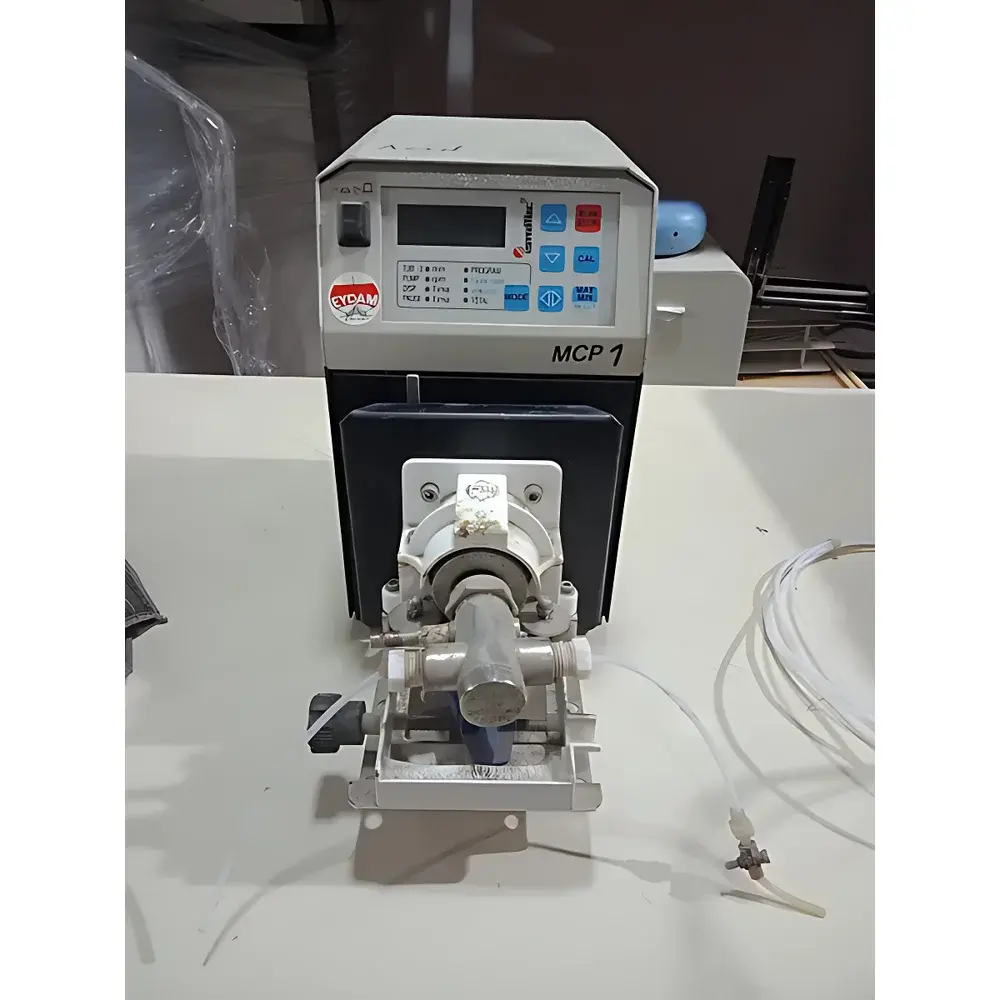
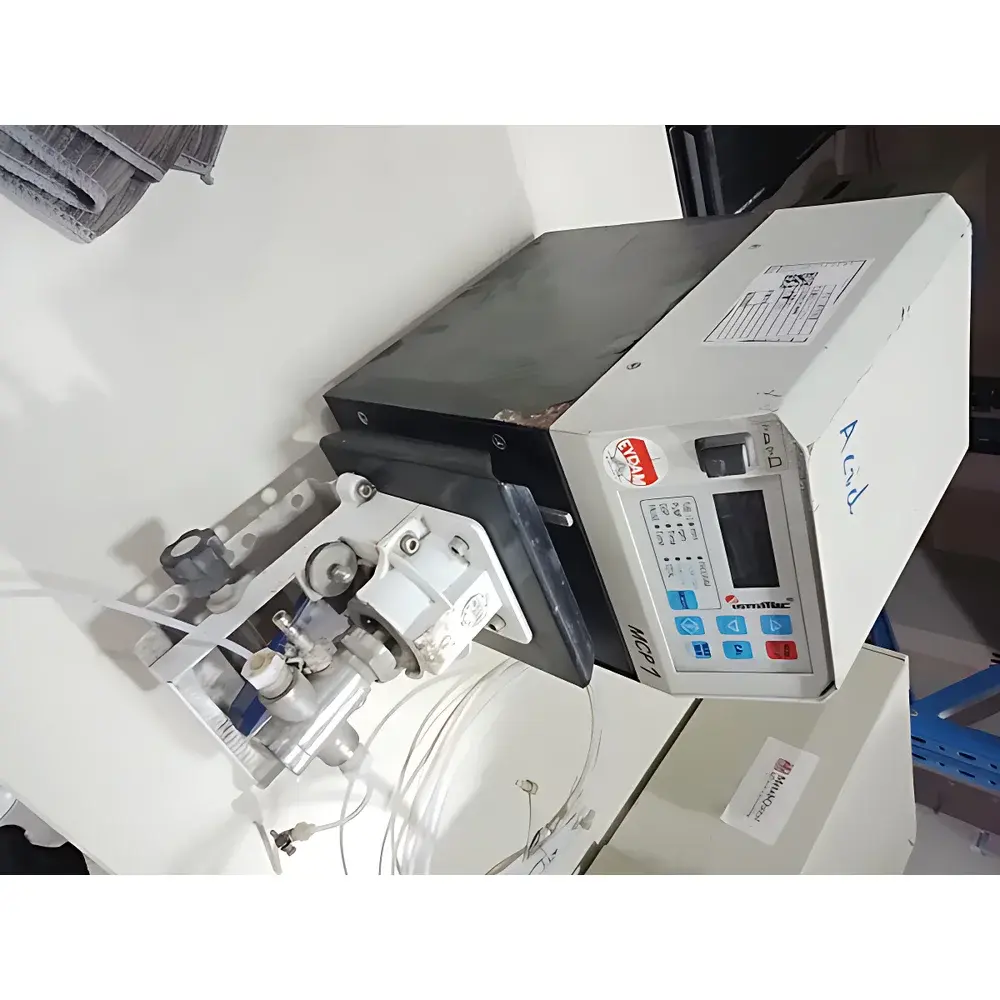
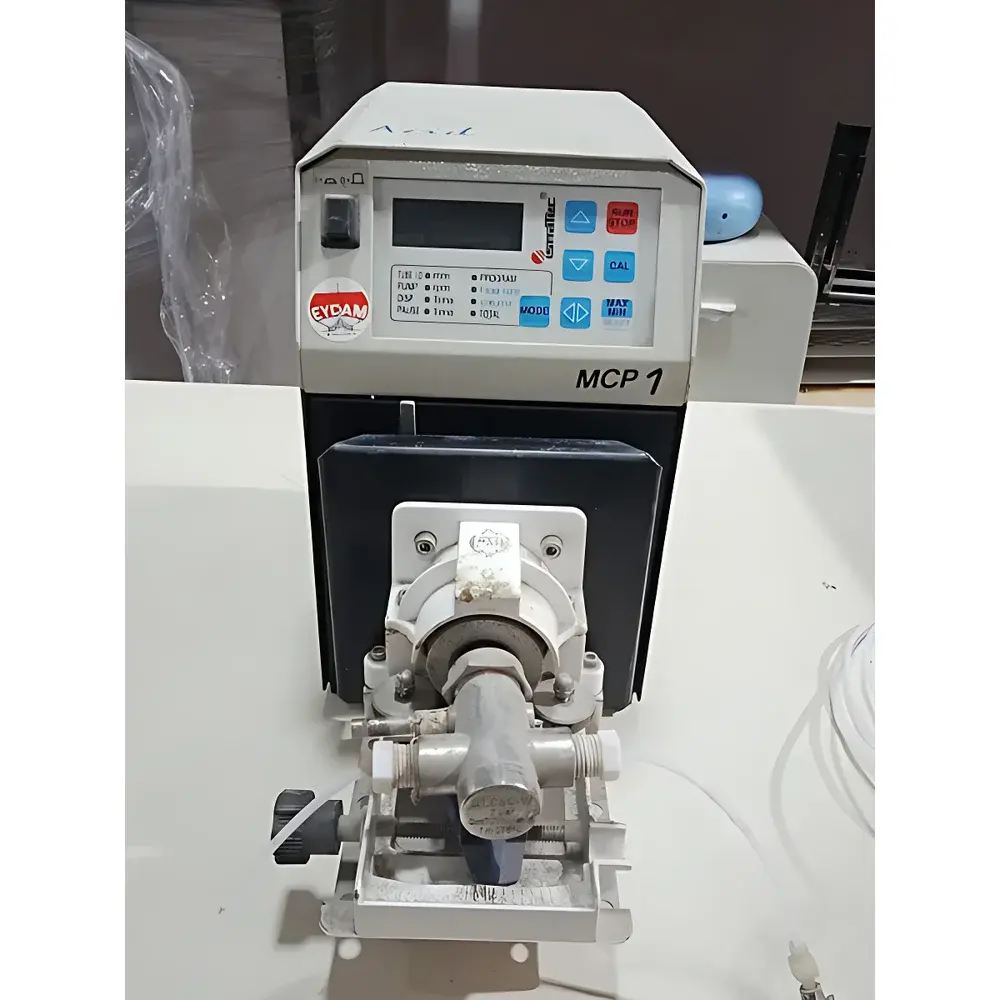
MCP1 Peristaltic Pump
| Origin | Shanghai |
|---|---|
| Manufacturer Type | Distributor |
| Origin Category | Domestic (China) |
| Model | MCP1 |
| Price | USD 85 |
| Plate Capacity | 10 |
| Pipetting Accuracy | ±2% at 10 µL |
| Pipetting Volume Range | 10–10,000 µL |
| Sample Throughput | 5 samples per run |
| Dimensions (W×D×H) | 70 × 80 × 90 mm |
Overview
The MCP1 Peristaltic Pump is a compact, benchtop liquid handling instrument engineered for precise, contamination-free fluid transfer in analytical laboratories, bioprocessing workflows, and quality control environments. Operating on the principle of peristalsis—where rotating rollers compress a flexible tubing segment to create discrete, volumetric “pillows” of fluid—the MCP1 delivers repeatable flow rates without exposing the fluid path to valves, seals, or wetted metal components. This isolation-based architecture ensures full compatibility with shear-sensitive biomolecules (e.g., proteins, cell suspensions), aggressive solvents, abrasive slurries, and oxygen-sensitive reagents. Designed for integration into modular liquid handling workstations or standalone operation, the MCP1 supports continuous or pulsed delivery modes, enabling reliable dosing, recirculation, filtration feed, or inline dilution applications under ambient or controlled environmental conditions.
Key Features
- True fluid isolation: Only the tubing contacts the sample—no valves, diaphragms, or mechanical seals introduce contamination or degradation risk.
- Reversible bidirectional operation: Identical flow rate performance in forward and reverse directions, supporting backflushing, priming, and recirculation protocols.
- Dry-run capability: Sustained operation without fluid present causes no damage to pump head or drive mechanism—critical for system start-up, purge cycles, or intermittent flow control.
- High vacuum generation: Capable of achieving up to 98% vacuum (≈740 mbar absolute), enabling effective self-priming from open reservoirs or elevated vessels.
- Low-shear transport: Ideal for fragile biological suspensions, emulsions, and polymer solutions where laminar, non-turbulent displacement preserves structural integrity.
- Modular service design: Only the tubing requires periodic replacement—no alignment tools, calibration routines, or certified technicians needed for routine maintenance.
Sample Compatibility & Compliance
The MCP1 accommodates a broad spectrum of fluid types—including aqueous buffers, organic solvents (e.g., IPA, acetone), corrosive acids/bases (with compatible tubing), viscous glycerol solutions, and heterogeneous mixtures containing suspended solids up to 40% of the tubing’s internal diameter. Tubing material selection (e.g., PharMed® BPT, Tygon® LFL, silicone) determines chemical resistance, UV stability, and compliance with USP Class VI, FDA 21 CFR Part 11 (when paired with audit-trail-enabled controllers), and ISO 8573-1 for clean air–assisted pneumatic integration. The pump meets general laboratory safety standards (IEC 61010-1) and supports GLP/GMP-aligned workflows when operated with documented tubing change logs and flow verification records.
Software & Data Management
While the base MCP1 operates via manual speed adjustment (0–60 rpm range, calibrated via external flow meter), optional RS-485 or USB-C interface modules enable integration with LabVIEW™, Python-controlled automation platforms, or LIMS systems. Firmware supports programmable ramp profiles, pulse-width modulation for timed dispensing, and real-time RPM feedback. Audit trails—including operator ID, timestamp, tubing batch number, and calibration verification date—can be exported as CSV or embedded in electronic lab notebooks (ELN) to satisfy regulatory traceability requirements under 21 CFR Part 11 and Annex 11.
Applications
- Continuous feeding of HPLC or IC mobile phases with minimal pulsation
- In-line dilution and buffer exchange in protein purification skids
- Cell culture media perfusion in bioreactor auxiliary loops
- Waste aspiration in automated ELISA or microplate washers
- Controlled reagent addition during titration or kinetic assays
- Slurry transport in environmental sediment analysis or mining QA/QC labs
FAQ
What tubing sizes are supported by the MCP1 pump head?
The standard pump head accepts tubing with inner diameters of 0.5 mm to 3.2 mm (1/16″ to 1/8″), compatible with common peristaltic tubing families including Norprene®, Viton®, and C-Flex®.
Can the MCP1 be used in sterile or aseptic processes?
Yes—when paired with gamma-sterilizable tubing (e.g., C-Flex® SR or Pharmed® BPT) and installed within ISO Class 5 laminar flow hoods or closed-loop manifolds, it meets aseptic transfer requirements for cell therapy and vaccine manufacturing.
Is flow rate calibration required before each use?
Calibration is not mandatory for qualitative applications; however, quantitative workflows demand initial gravimetric or volumetric verification using certified reference standards traceable to NIST or equivalent national metrology institutes.
How often should tubing be replaced?
Replacement interval depends on operating speed, duty cycle, and fluid chemistry—typically every 100–500 hours for silicone tubing at ≤30 rpm with aqueous solutions; consult tubing manufacturer’s fatigue life data for accelerated conditions.
Does the MCP1 support multi-channel parallel operation?
No—the MCP1 is a single-channel unit; however, multiple units can be synchronized via external TTL triggers or master-slave RS-485 daisy-chaining for coordinated multi-stream delivery.



