
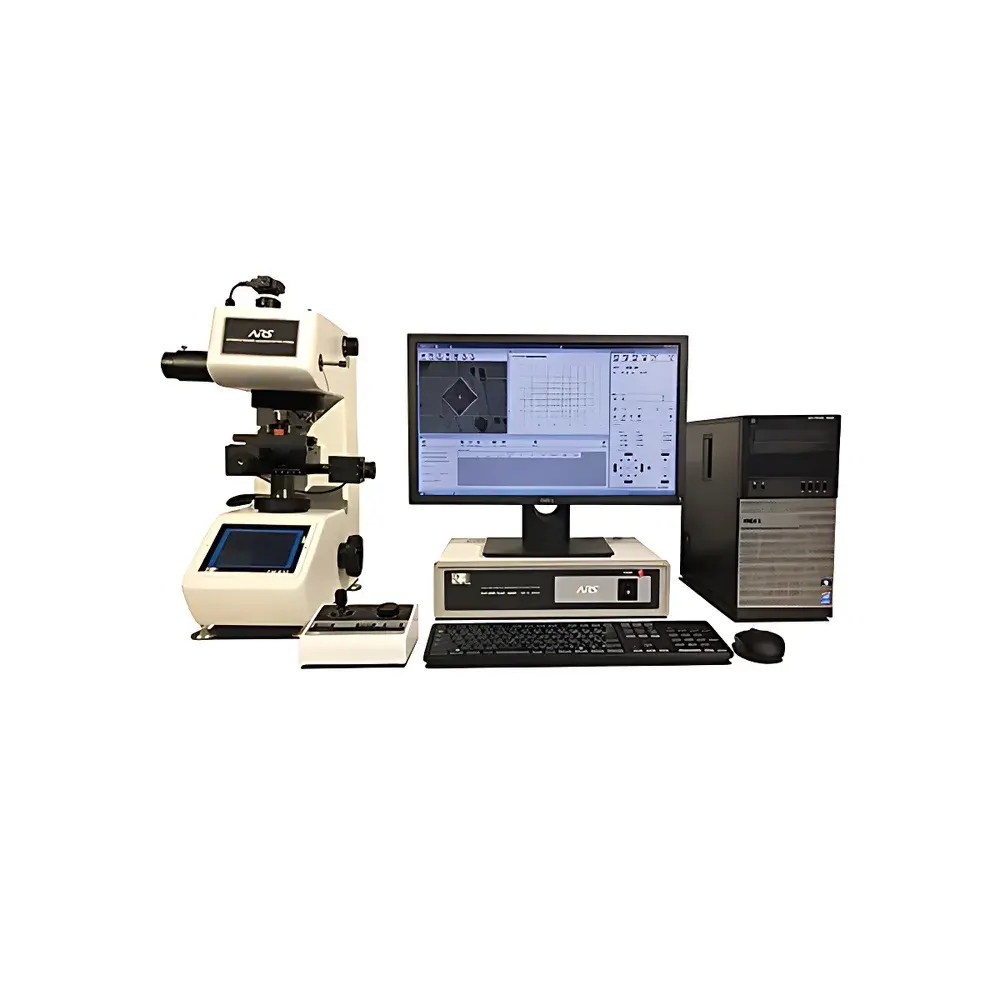
Future-Tech FM310-ARSF Fully Automated Vickers Hardness Tester
| Brand | Future-Tech |
|---|---|
| Origin | Japan |
| Model | FM310-ARSF |
| Instrument Type | Vickers Hardness Tester |
| Test Force Range | 1 g to 2000 g (selectable combinations) |
| Maximum Test Load | 2000 g |
| Testing Space | 95 mm (H) × 115 mm (D) |
| Minimum Indentation Size | 16 µm (diagonal) |
| Measurement Resolution | 0.1 µm |
| Repeatability | ±0.5% at HV500 (≈500 gf) |
| Indentation Measurement Method | Shadow-image processing with automated optical recognition |
| Hardness Scales | HV (Vickers), HK (Knoop) |
| Auto XY Stage | FM/FV-series: 110 mm × 110 mm travel (X/Y ±50 mm), 1 µm step resolution |
| FLV-series | 150 mm × 150 mm travel (X/Y 180 mm × 110 mm), 1 µm step resolution |
| Camera | 1.3 MP CMOS sensor (1300 × 1024 pixels) |
| Software | FT-ZERO control and data analysis suite |
| Compliance | Designed for GLP/GMP-aligned workflows |
Overview
The Future-Tech FM310-ARSF is a fully automated, high-precision Vickers microhardness tester engineered for metrological-grade hardness evaluation in R&D laboratories, quality control environments, and materials certification facilities. Based on the standardized Vickers indentation principle—where a diamond pyramid indenter (136° apex angle) is applied under controlled static load onto a polished specimen surface—the system quantifies material resistance via optical measurement of the resulting diagonal impression. Unlike conventional manual or semi-automated systems, the FM310-ARSF integrates real-time image acquisition, shadow-based pattern recognition, and closed-loop stage positioning to eliminate operator-dependent variability. Its architecture supports unattended multi-point testing sequences—including gradient profiling, case-depth mapping, and statistical hardness distribution analysis—making it suitable for metallurgical validation (e.g., carburized, induction-hardened, or nitrided layers), thin-film characterization, and microstructural correlation studies.
Key Features
- Fully automated indentation measurement using proprietary shadow-image processing: robust against grain boundary contrast, surface scratches, oxidation, and polishing artifacts.
- Integrated auto-focus, auto-indentation, and auto-stage navigation (ARS-F configuration) enabling zero-touch operation from sample loading to report generation.
- Motorized XY stage with 1 µm positional resolution and programmable trajectory support—linear, serpentine, arc, circular, matrix, edge-following, and teach-mode paths.
- Real-time Z-axis tilt compensation: user-defined surface inclination angle triggers dynamic focus and load-axis alignment, ensuring consistent indentation geometry on non-planar specimens.
- 1.3 MP CMOS camera with optimized illumination optics delivers high-contrast, low-noise images for sub-16 µm diagonal indentations.
- Safety-integrated mechanical limiters prevent lens or indenter collision during autofocus or stage movement.
- FT-ZERO software platform provides traceable calibration logs, configurable pass/fail thresholds, and statistical summaries (mean, SD, min/max, Cpk, depth-of-hardness profiles).
Sample Compatibility & Compliance
The FM310-ARSF accommodates specimens up to 95 mm in height and 115 mm in depth, supporting standard metallographic mounts, cross-sectioned components, coated substrates, and heat-treated parts. Its optical path and load frame are designed for ISO 6507-1:2023 and ASTM E384-22 compliance in Vickers microhardness testing. When deployed with validated FT-ZERO software configurations, the system supports 21 CFR Part 11–compliant electronic records—including time-stamped audit trails, user authentication, and immutable result archiving—meeting GLP and GMP documentation requirements for regulated industries (aerospace, medical device manufacturing, automotive Tier-1 suppliers). Calibration traceability is maintained to NIST-traceable reference blocks (e.g., certified Vickers hardness standards HV10–HV1000).
Software & Data Management
FT-ZERO serves as the unified interface for instrument control, image analysis, and reporting. It enables batch scripting of multi-location test plans, automatic image capture pre- and post-indentation, and reprocessing of stored images without physical retesting. Hardness values are exported in CSV, PDF, and native Excel formats—with embedded charts (hardness vs. depth, contour maps, scatter plots). Statistical outputs include effective case depth (ECD), hardened layer thickness, dispersion metrics (unbiased variance, coefficient of variation), and conformance flags based on user-defined specification limits. All measurement metadata—load, dwell time, indenter type, environmental timestamp, operator ID, and stage coordinates—is embedded in each data record for full traceability.
Applications
- Case depth analysis of carburized, nitrided, or induction-hardened steel components.
- Microhardness profiling across weld zones, heat-affected zones (HAZ), and dissimilar metal interfaces.
- Thin-film and coating adhesion assessment via cross-sectional hardness gradients.
- Quality assurance of sintered metals, powder metallurgy parts, and additive-manufactured alloys.
- Research into phase transformation kinetics, precipitation hardening, and thermal aging effects.
- Calibration verification and inter-laboratory round-robin studies requiring high inter-operator reproducibility.
FAQ
What hardness scales does the FM310-ARSF support?
HV (Vickers) and HK (Knoop) scales are natively supported, with automatic scale conversion and unit normalization (e.g., kgf/mm², GPa) within FT-ZERO.
Can the system measure on curved or inclined surfaces?
Yes—the ARS-F configuration includes programmable Z-axis tilt tracking, allowing accurate indentation placement and focus maintenance on angled or cylindrical specimens.
Is the software compliant with regulatory data integrity standards?
FT-ZERO supports 21 CFR Part 11 functionality (electronic signatures, audit trail, role-based access) when installed in a validated computing environment per organizational SOPs.
What is the minimum measurable indentation size?
The system reliably resolves Vickers indentations with diagonal lengths ≥16 µm under standard lighting and surface preparation conditions.
Does the FM310-ARSF require external vibration isolation?
While not mandatory, installation on a granite slab or active/passive anti-vibration table is recommended for optimal repeatability at loads ≤10 gf.
Which sample stages are compatible with this model?
The FM310-ARSF supports both FM/FV-series (110 × 110 mm stage) and FLV-series (150 × 150 mm stage) configurations; ARS-F automation is available for all variants.



