
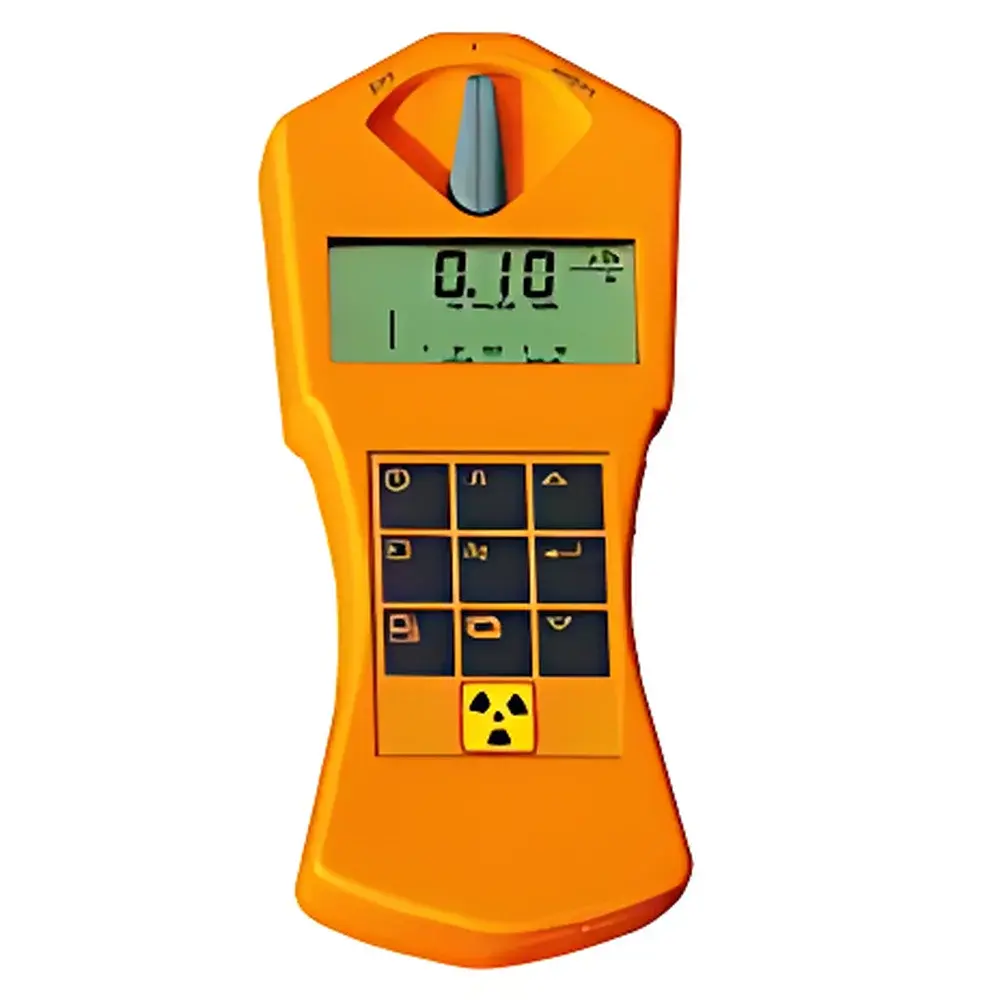
GammaScout 950 Portable Multi-Radiation Detector (α/β/γ/X-ray)
| Origin | USA |
|---|---|
| Manufacturer Type | Authorized Distributor |
| Origin Category | Imported |
| Model | 950 |
| Instrument Type | Radiation Dose Rate Meter |
| Measurement Range | 0.05–10,000 µSv/h |
| Sensitivity | 108 cps per µSv/h (⁶⁰Co), or 1000 cpm per mR/h |
| Detection Modes | γ only / β+γ / α+β+γ |
| Geiger-M� | ller Tube: 38 mm × 9 mm |
| Display | Backlit LCD with digital readout + bar graph + real-time clock/date/battery voltage |
| Alarm | Audible threshold alarm |
| Accuracy | ±1% |
| Data Storage | 2 KB internal memory |
| Interface | RS-232 serial port |
| Operating Temperature | −40 °C to +75 °C |
| Dimensions | 163 × 72 × 30 mm |
| Weight | ~220 g |
| Battery Life | 10 years (lithium primary cell) |
| Certifications | CE (EU), FCC Part 15 |
| Calibration Interval | Every 5 years |
| Warranty | 12 months |
Overview
The GammaScout 950 Portable Multi-Radiation Detector is a field-deployable, high-reliability radiation monitoring instrument engineered for precision dose rate measurement across alpha (α), beta (β), gamma (γ), and X-ray photon emissions. Based on a halogen-quenched Geiger-Müller tube (38 mm active length, 9 mm diameter) traceably calibrated against NIST-traceable ⁶⁰Co reference sources, the device operates on the principle of ionization-induced pulse counting in low-pressure gas fill. Its dual-range analog-to-digital conversion architecture enables linear response from 0.05 µSv/h up to 10,000 µSv/h — covering environmental background levels through emergency-response dose rates. Designed for operational continuity in extreme conditions (−40 °C to +75 °C), the 950 integrates a 10-year lithium primary power system, real-time clock with persistent date/time retention during standby, and ruggedized housing compliant with IP54-rated ingress protection (dust and splash resistant). It is not submersible and must be operated within its specified thermal and humidity envelope.
Key Features
- Tri-mode radiation selection switch (γ-only / β+γ / α+β+γ) enabling targeted detection without cross-interference from non-target emissions
- High-sensitivity GM tube certified by the U.S. Conference of Radiation Control Program Directors (CRCPD); each unit carries a unique NIST-traceable calibration certificate
- Backlit LCD with simultaneous display of instantaneous dose rate, time-weighted average over user-defined intervals (1 min to 24 h), battery voltage, and elapsed real-time clock
- Configurable audible alarm with adjustable threshold (0.1–1000 µSv/h) and latching behavior for incident documentation
- Onboard 2 KB non-volatile memory supporting time-stamped logging at programmable intervals (1 s to 1 h); data export via RS-232 to Windows-compatible GammaScout Analysis Suite
- Ergonomic form factor (163 × 72 × 30 mm; ~220 g) with sealed membrane keypad (10 tactile keys) and shock-absorbing polymer casing rated for drop resistance per MIL-STD-810G Method 516.6
- Five-year recalibration interval supported by documented metrological stability under ISO/IEC 17025-accredited service protocols
Sample Compatibility & Compliance
The GammaScout 950 is validated for direct surface scanning of solid, liquid, and airborne radionuclide sources where emission energies exceed the GM tube’s effective detection thresholds: ≥3 MeV for α-particles (with thin-window configuration), ≥0.1 MeV for β⁻, ≥0.03 MeV for γ/X-rays. It meets IEC 60846-1:2014 requirements for portable dose rate meters used in occupational and environmental monitoring. Device firmware and hardware architecture comply with EU Directive 2014/30/EU (EMC) and 2014/53/EU (Radio Equipment Directive), bearing CE marking under harmonized standards EN 61000-6-2 and EN 61000-6-3. While not FDA-cleared as a medical device, it satisfies ANSI N42.33-2022 criteria for survey instruments employed in radiological emergency response, nuclear facility perimeter surveillance, and regulatory compliance audits aligned with 10 CFR Part 20 and EPA Method 901.0.
Software & Data Management
The included GammaScout Analysis Suite (v5.x) provides GLP-compliant data handling for Windows OS environments. The software supports automated import of time-series dose rate logs, spectral histogram generation, trend analysis with linear regression, and customizable report export in PDF, CSV, and XML formats. Audit trail functionality records all user-initiated actions (e.g., parameter changes, calibration resets, data deletions) with timestamp, operator ID, and reason code — satisfying 21 CFR Part 11 electronic record integrity requirements when deployed in regulated pharmaceutical or nuclear medicine settings. Raw pulse count data is preserved alongside dose-equivalent conversions using energy-dependent fluence-to-dose coefficients per ICRP Publication 74. No cloud connectivity or remote telemetry is embedded; all data remains under local administrative control.
Applications
- Environmental screening for radon progeny (²¹⁸Po, ²¹⁴Po) and terrestrial gamma emitters (⁴⁰K, ²³²Th, ²³⁸U series) in residential basements and construction materials
- In-field verification of NORM/TENORM contamination in oilfield equipment, pipeline scale, and refinery sludge per API RP 1004
- Verification of shielding integrity around diagnostic X-ray rooms (50–150 kVp) and industrial radiography sources (e.g., ¹⁹²Ir, ⁶⁰Co)
- Post-incident triage in radiological dispersal device (RDD) scenarios, including rapid source localization via directional count-rate gradient mapping
- Long-term ambient monitoring at decommissioned uranium mining sites, landfill leachate collection points, and groundwater abstraction wells
- Quality assurance screening of consumer goods (ceramics, granite countertops, antique glassware) for elevated ²²⁶Ra or ⁴⁰K activity
- Personnel dosimetry support in veterinary radiology suites and university research labs handling unsealed β-emitters (e.g., ³H, ¹⁴C, ³²P)
FAQ
What radiation types does the GammaScout 950 detect, and what are its energy response limitations?
The instrument detects α (≥3 MeV, requires optional thin-window probe), β (≥0.1 MeV), γ, and X-ray photons (≥0.03 MeV) using a halogen-quenched GM tube. Energy dependence follows IEC 60846-1 Class II specifications; readings below 60 keV require correction factors applied post-measurement.
Is the device suitable for continuous unattended monitoring?
Yes — with programmable logging intervals and 10-year battery life, it supports autonomous deployment for up to 12 months at 1-min sampling resolution. External power options (USB-C adapter) are available for permanent installations.
How often must the instrument be recalibrated, and who performs traceable calibration?
Recalibration is recommended every 5 years by an ISO/IEC 17025-accredited laboratory using NIST-traceable ¹³⁷Cs and ⁶⁰Co reference fields. Certificate includes uncertainty budget per GUM (JCGM 100:2018).
Does the GammaScout 950 meet requirements for use in FDA-regulated pharmaceutical manufacturing?
While not a Class II medical device, its metrological performance, audit trail software, and documentation package satisfy Annex 11 and USP analytical instrument qualification (AIQ) criteria for environmental radiation monitoring in cleanroom and warehouse settings.
Can the device distinguish between natural background and anthropogenic radionuclides?
No — it measures total dose rate without spectral discrimination. Isotopic identification requires complementary gamma spectroscopy (e.g., NaI or HPGe systems). However, temporal pattern analysis (e.g., diurnal radon variation vs. constant Cs-137 signal) aids qualitative source attribution.







