
Gamry QCM-I Mini Quartz Crystal Microbalance
| Brand | Gamry |
|---|---|
| Origin | USA |
| Model | QCM-I Mini |
| Operating Temperature Range | 15–60 °C (±0.02 °C) |
Overview
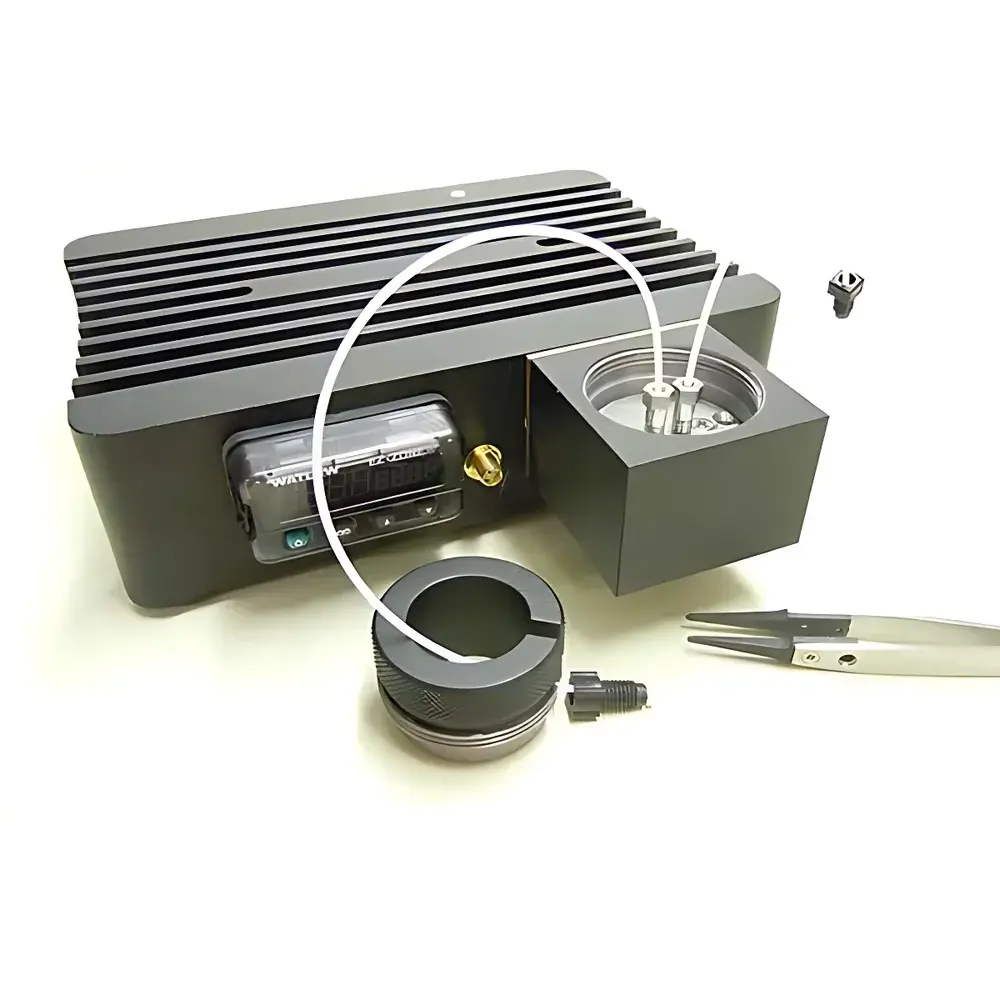
The Gamry QCM-I Mini is a compact, dual-channel quartz crystal microbalance system engineered for high-resolution, real-time monitoring of interfacial mass changes and viscoelastic properties at solid–liquid interfaces. It operates on the fundamental principle of piezoelectric resonance: when a thin AT-cut quartz crystal is excited electrically, it oscillates at a characteristic fundamental resonant frequency (f0) and higher odd harmonics (3rd, 5th, …, up to 13th). Adsorption or desorption of material onto the crystal surface alters both the resonant frequency (Δf) and energy dissipation (ΔD), enabling quantitative analysis of mass loading—including hydrodynamically coupled solvent—and mechanical rigidity of the adlayer. Unlike gravimetric-only QCM systems, the QCM-I Mini simultaneously acquires both frequency shift and dissipation factor across multiple harmonics, supporting robust modeling of soft, hydrated films—such as proteins, polymers, lipids, and nanoparticles—under dynamic flow or static conditions.
Key Features
- Dual independent measurement channels—one with integrated Peltier-based temperature control (15–60 °C, stability ±0.02 °C)—enabling comparative studies or reference-compensated measurements;
- High-harmonic capability: full impedance analysis up to the 13th overtone for 5 MHz crystals, delivering enhanced sensitivity to film thickness, hydration, and structural relaxation;
- Two operational modes: (1) Resonance Scan, acquiring full conductance spectra (up to 80 MHz span) to determine f0 and full width at half maximum (FWHM); and (2) QCM-t mode, providing continuous, time-resolved tracking of f and D at user-selected harmonics;
- USB-connected architecture with dedicated Windows® 10 host (Microsoft Surface Pro included), ensuring deterministic timing, low-latency data acquisition, and seamless integration with laboratory IT infrastructure;
- Modular sensor interface compatible with standard 14-mm-diameter QCM crystals and flow cells, including the supplied QSH-104 flow-through holder optimized for biosensing applications;
- Engineered for reproducibility: temperature-stabilized electronics, calibrated impedance measurement circuitry, and harmonic-phase coherence algorithms minimize drift and cross-talk between channels.
Sample Compatibility & Compliance
The QCM-I Mini supports a broad range of sample types and experimental configurations. It is routinely deployed in studies involving protein adsorption/desorption kinetics, polymer brush swelling, lipid bilayer formation, nanoparticle deposition, electrochemical interface evolution, and corrosion inhibitor film stability. The system accommodates aqueous, organic, and mixed-solvent environments via interchangeable flow cells or static cuvettes. All hardware and firmware comply with IEC 61000-6-3 (EMC emissions) and IEC 61010-1 (safety for laboratory equipment). While not certified for GMP manufacturing, its software architecture supports GLP-aligned workflows: BioSensing 3.xx provides full audit trail logging (user actions, parameter changes, calibration events), electronic signatures, and exportable timestamped datasets compliant with FDA 21 CFR Part 11 requirements for regulated research environments.
Software & Data Management
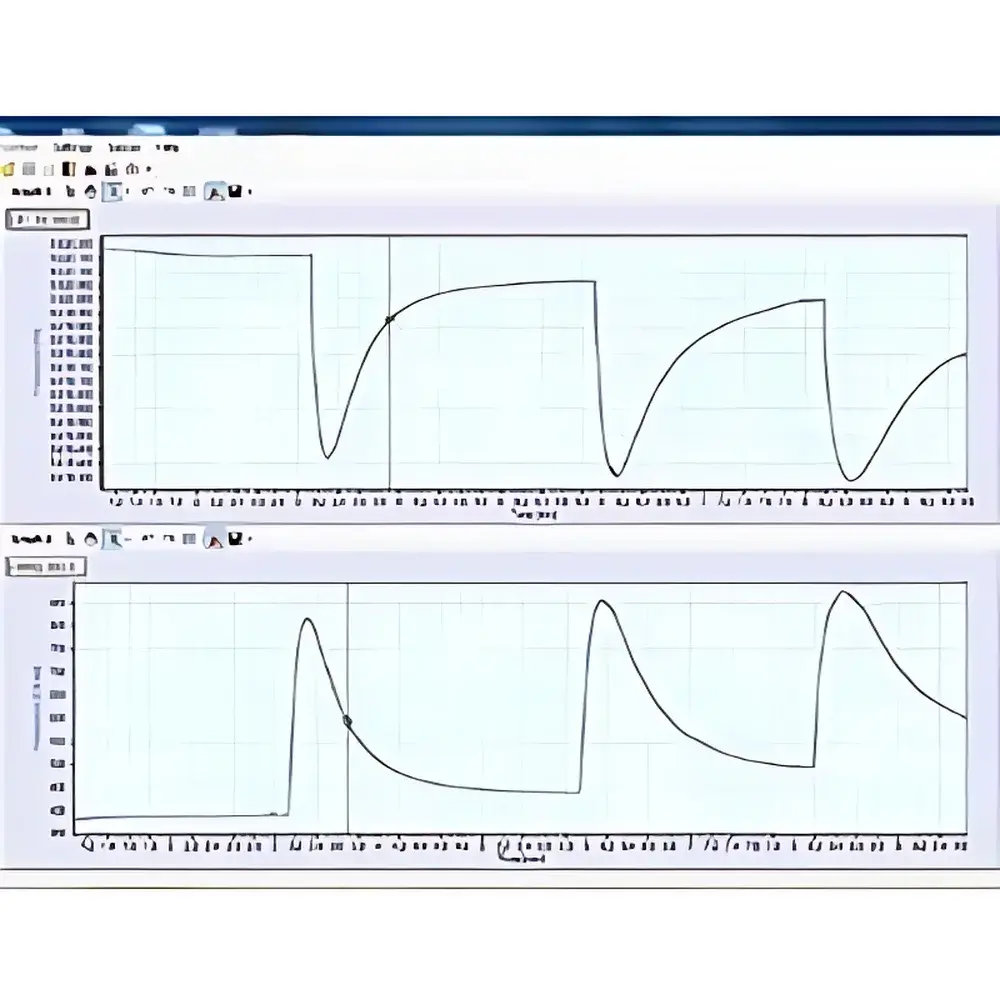
BioSensing 3.xx software serves as the unified control, acquisition, and analysis platform. It offers intuitive experiment setup, real-time visualization of f(t) and D(t) curves per harmonic, automated baseline subtraction, and harmonic-by-harmonic fitting using the Sauerbrey equation (for rigid films) or Voigt-based viscoelastic models (for soft, hydrated layers). Raw impedance spectra are stored in HDF5 format, preserving phase, magnitude, and metadata for post-acquisition reprocessing. Export options include CSV, MATLAB (.mat), and Excel-compatible formats. The software supports batch processing of multi-harmonic datasets and integrates with third-party tools (e.g., Python via provided API hooks) for custom modeling or machine learning pipelines. License management enforces single-user concurrency, with optional network license upgrades available for core facility deployment.
Applications
- Protein–Surface Interactions: Quantify binding affinity, conformational change, and layer rigidity during antibody–antigen or enzyme–substrate association under physiological buffer flow;
- Polymer Thin Films: Monitor swelling kinetics of pH- or temperature-responsive hydrogels, distinguishing water uptake from chain rearrangement via D/f trajectory analysis;
- Biosensor Development: Characterize immobilization efficiency and stability of DNA aptamers or peptide ligands on gold-coated crystals prior to target challenge;
- Electrochemical QCM (EQCM): Correlate charge transfer (from potentiostat) with mass change (from QCM-I Mini) during electrodeposition, passivation, or redox-switching of conducting polymers;
- Nanoparticle Adhesion: Assess colloidal stability and surface coverage of functionalized AuNPs or liposomes on biorecognition surfaces under shear;
- Corrosion Science: Track in situ formation and breakdown of protective inhibitor films on metal electrodes in aggressive electrolytes.
FAQ
What is the minimum detectable mass change per unit area?
The theoretical resolution is ~0.1 ng/cm² for the 5 MHz fundamental mode under optimal signal-to-noise conditions; actual sensitivity depends on crystal quality, liquid damping, and harmonic order used.
Can the QCM-I Mini be synchronized with an external potentiostat?
Yes—via TTL trigger input and analog voltage output ports, enabling precise temporal alignment with electrochemical perturbations such as cyclic voltammetry or chronoamperometry.
Is third-party crystal compatibility supported?
The system accepts any 14-mm-diameter, AT-cut quartz crystal with gold electrodes and standard BNC or SMB connectors; Gamry recommends crystals with Q > 10,000 in air for optimal performance.
Does the software support real-time harmonic fitting during data acquisition?
Yes—BioSensing 3.xx performs on-the-fly calculation of f and D for all enabled harmonics, updating plots and trend logs with sub-second latency.
How is temperature uniformity maintained across the crystal surface?
The thermostatted channel uses a precision Peltier element with dual-stage feedback control and a thermistor embedded within the sensor mount, ensuring axial temperature homogeneity better than ±0.03 °C over the active electrode area.
Related Products



