
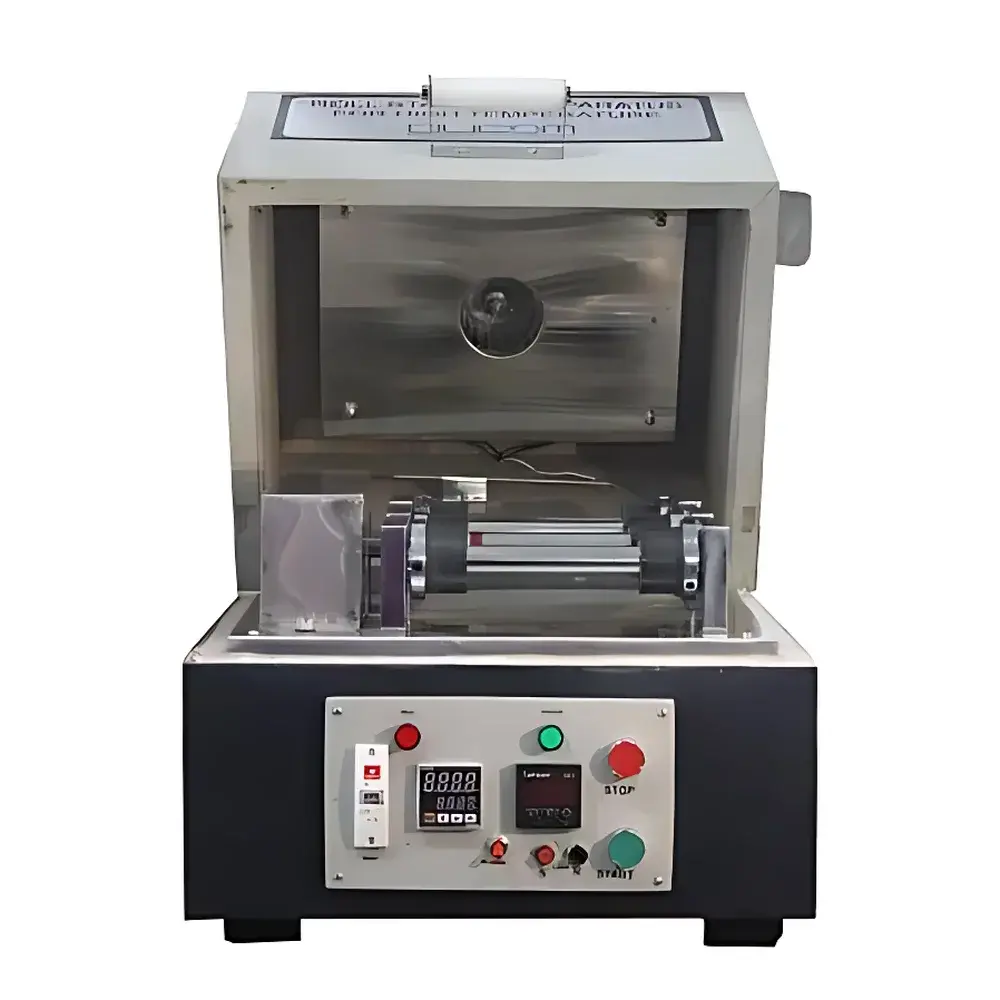
Ducom ASTM D1831 Rolling Stability Consistency Tester
| Brand | Ducom |
|---|---|
| Origin | USA |
| Model | ASTM D1831 |
| Test Method | Open-Cup |
| Operation Mode | Automatic |
| Applicable Standards | ASTM D1831, ASTM D7342 |
| Repeatability | ±0.1°C |
| Ignition Method | Automated temperature-controlled testing |
| Temperature Range | Up to 200°C |
| Rotational Speed | Up to 300 rpm |
| Timer Range | 1 minute to 100 hours |
| Temperature Control Accuracy | ±1°C |
Overview
The Ducom ASTM D1831 Rolling Stability Consistency Tester is a precision-engineered instrument designed to evaluate the mechanical shear stability and consistency retention of lubricating greases under elevated temperature and dynamic rolling conditions. Based on the fundamental principle of simulating real-world bearing kinematics—where a weighted roller rotates within a grease-filled cylindrical chamber—the instrument subjects grease samples to controlled mechanical stress while maintaining precise thermal regulation. Unlike static consistency measurement methods (e.g., ASTM D217 cone penetration), this tester quantifies structural degradation resulting from prolonged rolling action, making it indispensable for formulating high-performance greases used in automotive wheel bearings, industrial gearboxes, and wind turbine applications. The device operates in strict compliance with two key international standards: ASTM D1831 (“Standard Test Method for Rolling Stability of Lubricating Grease”) and ASTM D7342 (“Standard Test Method for Long-Term Working Stability of Lubricating Grease in the Presence of Water”). Its open-cup configuration enables direct observation of grease migration, oil separation, and structural collapse during extended thermal-mechanical exposure.
Key Features
- Robust benchtop architecture with integrated electronic controller and intuitive interface for parameter setup and real-time monitoring
- Closed-loop temperature control system ensuring ±1°C accuracy across the full operating range (ambient to 200°C)
- Motor-driven horizontal rotation assembly supporting programmable speeds up to 300 rpm with stable torque delivery
- Custom-designed test cylinder featuring uniform internal grease coating geometry and precision-machined roller assembly
- Automated safety interlock that immediately halts rotation and heating upon removal of the upper chamber cover
- Programmable timer spanning 1 minute to 100 hours, enabling both short-term screening and long-duration stability profiling
- Thermally insulated test chamber with optimized heat distribution to minimize axial and radial thermal gradients
Sample Compatibility & Compliance
The tester accommodates standard ASTM-compliant grease specimens (typically 15–20 g) applied uniformly to the inner wall of the stainless-steel test cylinder. It supports evaluation of lithium-, calcium-, polyurea-, and complex soap-based greases, as well as emerging formulations containing nanomaterials or bio-based thickeners. All operational protocols align with Good Laboratory Practice (GLP) requirements, and data acquisition workflows are compatible with audit-trail-enabled environments governed by FDA 21 CFR Part 11. The instrument’s adherence to ASTM D1831 and D7342 ensures regulatory acceptability in global OEM qualification programs, third-party certification labs (e.g., TÜV, SGS), and ISO/IEC 17025-accredited testing facilities.
Software & Data Management
While the base model features embedded microcontroller logic for standalone operation, optional PC-based software enables automated logging of temperature profiles, rotational speed history, and test duration metadata. Raw data exports are provided in CSV format for integration into LIMS platforms or statistical process control (SPC) systems. The software supports user-defined test templates, multi-step ramp-and-hold sequences, and configurable alarm thresholds for out-of-specification deviations—facilitating traceable, repeatable execution across shifts and laboratories.
Applications
- Quantifying grease consistency loss after standardized rolling cycles (e.g., 10,000–100,000 revolutions)
- Evaluating the impact of thickener type, base oil viscosity, and additive packages on shear resistance
- Assessing water-induced structural breakdown per ASTM D7342 for marine and off-road equipment greases
- Supporting ASTM D4950 classification (GC-LB, LB, GA, etc.) through correlation with field performance data
- Validating shelf-life predictions and thermal aging behavior under accelerated conditions
- Providing input for tribological modeling of grease film persistence in elastohydrodynamic (EHD) contacts
FAQ
What distinguishes the Ducom ASTM D1831 tester from conventional penetration testers?
Unlike static cone penetration instruments (ASTM D217), this device applies dynamic mechanical shear under controlled temperature—directly simulating bearing roll-slip conditions that drive real-world grease softening.
Can the instrument be used for non-grease materials such as pastes or semi-solids?
No—it is specifically engineered and validated for NLGI-grade lubricating greases; deviation from ASTM-specified sample geometry and rheological behavior compromises result validity.
Is calibration traceable to NIST or other national metrology institutes?
Yes—temperature sensors are supplied with individual calibration certificates traceable to NIST standards; rotational speed verification is performed using certified optical tachometers.
How is repeatability of ±0.1°C achieved across extended test durations?
Through dual-stage PID control, redundant PT100 sensors, and active thermal mass stabilization within the insulated chamber housing.
Does the system support remote monitoring or network connectivity?
The standard configuration does not include Ethernet or Wi-Fi; however, optional RS-232/USB interfaces enable connection to local PCs for supervised data capture and script-based automation.




