
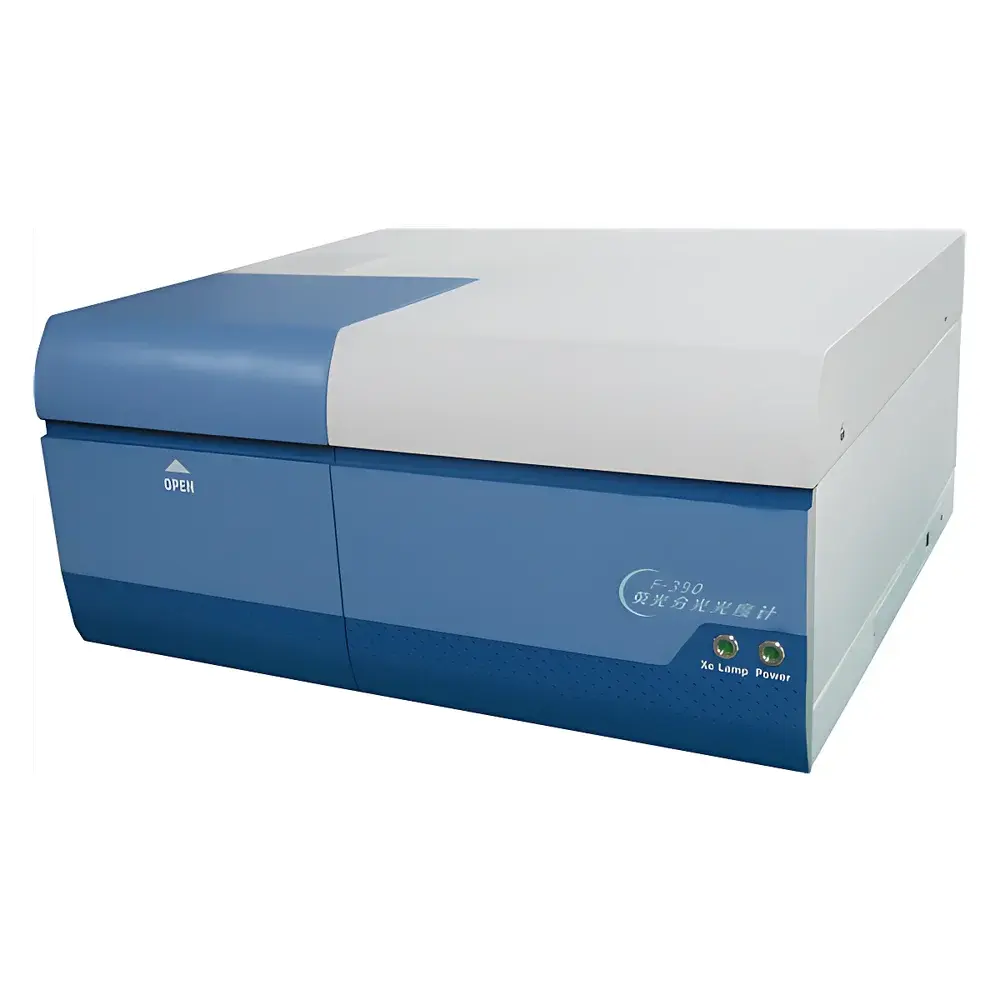
Gangdong F-390 Molecular Fluorescence Spectrometer
| Brand | Gangdong |
|---|---|
| Origin | Tianjin, China |
| Manufacturer Type | Direct Manufacturer |
| Instrument Type | Steady-State & Time-Resolved Fluorescence Spectrometer |
| Wavelength Range (Excitation/Emission) | 200–900 nm |
| Spectral Bandwidth (EX/EM) | 1.0–20.0 nm (adjustable in 5 steps) |
| Resolution | ≤1.0 nm |
| Wavelength Accuracy | ±1.0 nm |
| Wavelength Repeatability | ≤0.5 nm |
| Sensitivity (S/N) | >300:1 (water Raman peak, P-P) |
| Light Source | 150 W ozone-free xenon lamp |
| Monochromators | Holographic concave grating (1200 L/mm) for both excitation and emission |
| Scan Speed | Up to 60,000 nm/min |
| Minimum Sample Volume | 0.5 mL (in 10 mm cuvette) |
| Data Acquisition Interval | 0.2–1.0 nm |
| Response Time | 4 ms–8 s (8-step adjustable) |
| Dimensions | 670 × 540 × 320 mm |
| Weight | ~48 kg |
| Interface | USB 2.0 |
| Operating Systems | Windows XP / 7 / 10 |
Overview
The Gangdong F-390 Molecular Fluorescence Spectrometer is a high-performance, dual-monochromator fluorescence instrument engineered for quantitative and qualitative analysis of fluorescent and phosphorescent species in solution, solid, and thin-film states. Based on the principle of photoluminescence spectroscopy, it measures the intensity and spectral distribution of light emitted by analytes following excitation with monochromatic UV–Vis radiation. Its optical architecture employs two independently controlled holographic concave gratings (1200 L/mm), enabling high spectral purity, low stray light (<0.01%), and precise wavelength isolation—critical for resolving overlapping emission bands and minimizing Raman/elastic scattering interference. Designed for both steady-state and time-resolved measurements, the F-390 supports phosphorescence decay analysis down to 1 ms lifetimes, making it suitable for applications requiring discrimination between short-lived fluorescence and long-lived triplet-state emissions.
Key Features
- Dual Holographic Grating Optics: Excitation and emission monochromators utilize custom-fabricated, high-efficiency holographic concave gratings (1200 L/mm), delivering resolution ≤1.0 nm and stray light suppression optimized for low-background phosphorescence and trace-level detection.
- Phosphorescence-Specific Chopper System: A synchronized, multi-CPU-controlled mechanical chopper enables gated detection with precise delay and integration timing—eliminating Rayleigh and Raman scatter during phosphorescence acquisition without reliance on pulsed lasers.
- High-Speed 3D Fluorescence Scanning: Capable of full excitation–emission matrix (EEM) acquisition at up to 60,000 nm/min, with data point intervals as fine as 0.2 nm; supports rapid fluorophore identification, quenching studies, and multivariate calibration development.
- Synchronous Fluorescence Scanning: Implements constant-wavelength difference (Δλ) and constant-energy (Δν) modes to narrow spectral bandwidths, suppress scattering artifacts, and enhance selectivity in multi-analyte systems such as polycyclic aromatic hydrocarbons (PAHs) or protein–ligand complexes.
- Optimized Sample Handling: Horizontal slit geometry improves photon throughput for both excitation and emission paths; combined with a 0.5 mL minimum sample volume requirement (10 mm quartz cuvette), it reduces reagent consumption while maintaining S/N >300:1 (water Raman peak, peak-to-peak).
- Integrated Ozone Management: Equipped with a long-life, ozone-free 150 W xenon lamp and internal catalytic ozone decomposition—ensuring operator safety and eliminating the need for external exhaust ducting in standard laboratory environments.
- Hardware-Level Light Protection: Motorized excitation shutter limits sample photodegradation; emission-side gated photomultiplier tube (PMT) control prevents detector saturation and extends PMT operational lifetime under high-intensity conditions.
Sample Compatibility & Compliance
The F-390 accommodates liquid samples (aqueous/organic solvents), powders, films, gels, and temperature-controlled specimens via optional accessories—including solid-sample holders, an 8-position automated cuvette changer, magnetic-stirring thermostatic cells (±0.1 °C), and polarization modules. It complies with key international standards governing analytical instrumentation: ISO/IEC 17025 requirements for testing laboratories, ASTM E131–22 for terminology in molecular spectroscopy, and USP for fluorescence spectrophotometric assay validation. Software includes audit trail functionality (user login, parameter changes, data export logs) aligned with FDA 21 CFR Part 11 expectations for regulated environments. Optional IQ/OQ/PQ documentation packages support GMP/GLP-compliant installation and operation verification.
Software & Data Management
The proprietary Gangdong FluoroStation software provides a modular, Windows-native interface supporting method development, real-time spectral visualization, kinetic modeling, and multivariate analysis (e.g., PARAFAC). Key capabilities include dual background subtraction (solvent + blank reference), automatic peak deconvolution, concentration calculation via built-in calibration curves, and export to CSV, TXT, or JCAMP-DX formats for third-party chemometric tools. The system implements role-based access control (three-tier user permissions: operator, supervisor, administrator), timestamped electronic signatures, and immutable raw-data archiving—meeting traceability requirements for pharmaceutical QC, environmental monitoring, and academic publication workflows.
Applications
- Quantitative determination of vitamins (B2, B12), amino acids (tryptophan, tyrosine), and polycyclic aromatic hydrocarbons (PAHs) in food and environmental matrices per AOAC and EPA methods.
- Protein conformational analysis via intrinsic tryptophan fluorescence, including denaturation kinetics, ligand-binding affinity (Kd), and Förster resonance energy transfer (FRET) efficiency calculations.
- Characterization of quantum dots, conjugated polymers, and metal–organic frameworks (MOFs) through excitation–emission mapping, lifetime decay fitting, and quantum yield estimation (with integrating sphere accessory).
- Pharmaceutical stability studies: photodegradation profiling of APIs under ICH Q1B conditions; impurity identification via synchronous scanning of degradation products.
- Water quality assessment: detection of dissolved organic matter (DOM), humic substances, and microcystin toxins using EEM-PARAFAC modeling.
FAQ
What is the minimum detectable concentration for quinine sulfate in 0.1 M H2SO4?
The F-390 achieves a limit of detection (LOD) of ≤0.1 ng/mL under standard 10 mm pathlength conditions, based on water Raman S/N calibration and typical instrumental parameters (EX 250 nm, EM 450 nm, 5 nm slits, 1 s response).
Does the instrument support time-resolved fluorescence decay measurements?
Yes—the chopper-gated detection architecture supports phosphorescence lifetime quantification from 1 ms to several seconds. For sub-millisecond decays, external pulsed excitation sources and TCSPC modules are required (not included).
Can the software generate GLP-compliant reports with electronic signatures?
Yes—audit trail logging, user authentication, and electronic signature capture are enabled by default; report templates comply with ISO/IEC 17025 and USP analytical instrument qualification guidelines.
Is the xenon lamp user-replaceable, and what is its rated lifetime?
The ozone-free 150 W xenon lamp is field-replaceable with alignment-free installation; rated lifetime is ≥1,000 hours at full power, extendable to >2,000 hours with pulse-width modulation under software control.
Which accessories are certified for use in regulated pharmaceutical testing?
The thermostatic magnetic stirrer cell (±0.1 °C), 8-position autosampler, and polarization kit have documented IQ/OQ protocols available upon request and are validated for use in USP and EP 2.2.25 compliant assays.






