
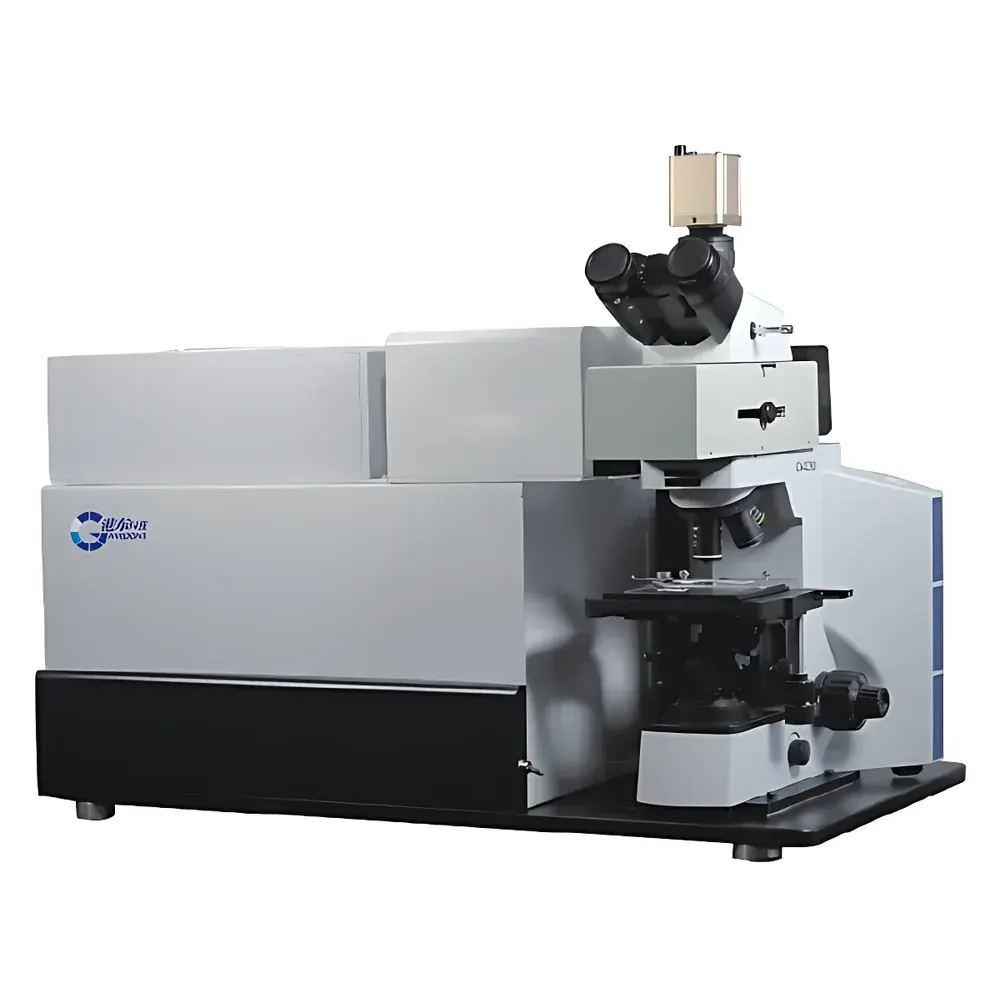
Gangdong LRS-4S Micro-Raman Spectrometer
| Brand | Gangdong |
|---|---|
| Origin | Tianjin, China |
| Manufacturer Type | Direct Manufacturer |
| Instrument Type | Confocal Micro-Raman Spectrometer |
| Spectral Range | 50–7000 cm⁻¹ |
| Spectral Resolution | ≤1 cm⁻¹ |
| Spatial Resolution | X/Y-axis: 0.01 µm |
| Z-axis | 0.002 µm |
| Minimum Wavenumber | 20 cm⁻¹ |
| Spectral Repeatability | ≤0.2 nm |
| Monochromator Focal Length | 300 mm |
| Grating Density | 1200 grooves/mm |
| Wavelength Range | 200–800 nm |
| Slit Width | 0–2 mm continuously adjustable |
| Wavelength Accuracy | ≤0.2 nm |
| Laser Excitation Wavelength | 532 nm |
| Laser Output Power | 100 mW |
| Microscope Objective | Infinity-corrected semi-apochromatic fluorescence objectives (10×, 50×, 100×) |
| Eyepiece | PL10×/22 mm wide-field plan eyepiece with optional micrometer scale |
| Stage Travel | 76 mm × 50 mm (0.1 mm resolution) |
| CCD Camera | 16 MP ultra-high-definition imaging sensor |
Overview
The Gangdong LRS-4S Micro-Raman Spectrometer is a confocal, modular Raman spectroscopy platform engineered for precision molecular fingerprinting at the microscale. It operates on the principle of inelastic light scattering—where monochromatic laser photons (532 nm, 100 mW) interact with vibrational modes of chemical bonds, generating wavelength-shifted Raman signals. The system integrates a high-throughput Czerny–Turner monochromator (300 mm focal length, 1200 grooves/mm grating) with continuously variable slit control (0–2 mm), enabling rigorous trade-off management between spectral resolution (≤1 cm⁻¹) and signal-to-noise ratio. Its extended low-wavenumber capability (down to 20 cm⁻¹) supports detection of lattice modes, intermolecular vibrations, and phonon-related features in 2D materials, pharmaceutical polymorphs, and catalysts. Designed for robustness and reproducibility, the LRS-4S delivers ≤0.2 nm wavelength repeatability—critical for long-term spectral alignment in quantitative batch analysis and time-resolved studies.
Key Features
- Confocal optical architecture with axial (Z-axis) spatial resolution of 0.002 µm and lateral (X/Y) resolution of 0.01 µm—enabling depth-resolved chemical mapping of multilayer thin films and heterogeneous particulates.
- Integrated infinity-corrected microscope with semi-apochromatic fluorescence objectives (10×, 50×, 100×), high-eye-point wide-field eyepieces (PL10×/22 mm), and a five-position objective turret with precise internal centering.
- Motorized or manual XYZ stage (76 × 50 mm travel, 0.1 mm positioning accuracy) with height-adjustable stage bracket and ceramic-coated upper platform for thermal and mechanical stability.
- Adaptive Köhler illumination using a single high-brightness 5 W LED (100–240 V AC input), offering uniform, glare-free brightfield contrast without halogen heat load or bulb replacement cycles.
- 16-megapixel ultra-high-definition CMOS camera for real-time sample visualization, automated focus confirmation, and precise ROI selection prior to spectral acquisition.
- Software-controlled polarization module for acquiring vectorial Raman data—supporting symmetry analysis of crystalline domains and anisotropic nanostructures.
Sample Compatibility & Compliance
The LRS-4S accommodates solid, powder, thin-film, and micro-particulate samples up to 2 µm in lateral dimension, with no requirement for conductive coating or vacuum environment. Its open-stage design allows direct integration with environmental cells (temperature-controlled, gas-purged) and electrochemical stages (with appropriate optical access). The instrument meets core requirements for GLP-compliant laboratories: full audit trail logging, user-access-level permissions, and timestamped metadata embedding (laser power, slit width, grating position, objective ID, exposure time). While not pre-certified to ISO/IEC 17025 or ASTM E1840, its traceable wavelength calibration (using NIST-traceable neon/argon emission lines) and documented repeatability (≤0.2 nm) support validation protocols aligned with USP , ISO 8573-9, and ICH Q5E guidelines for spectroscopic identity testing.
Software & Data Management
The bundled acquisition and analysis suite provides native support for multi-dimensional hyperspectral cube generation (x, y, λ), peak deconvolution (Gaussian–Lorentzian fitting), baseline correction (asymmetric least squares), and principal component analysis (PCA). All spectra are saved in vendor-neutral .spa or .txt formats compliant with ASTM E1421 and JCAMP-DX v5.0 standards. Data export includes full parameter metadata (e.g., laser power drift compensation status, grating efficiency curve application flag), facilitating cross-platform interoperability with third-party tools such as MATLAB, Python (SciPy/NumPy), and Thermo Fisher OMNIC. The software enforces 21 CFR Part 11–compatible electronic signatures, role-based access control, and immutable raw-data archiving—ensuring regulatory readiness for QC/QA workflows in pharmaceutical, materials, and environmental labs.
Applications
- Identification and polymorphic screening of active pharmaceutical ingredients (APIs) and excipients via characteristic Raman band assignment (e.g., C=O stretch at 1700 cm⁻¹, ring breathing modes at 600–800 cm⁻¹).
- Depth-profiling of stress distribution in semiconductor heterostructures and SiC/GaN epitaxial layers using confocal Z-scan mode.
- Microplastic identification in environmental water/filtrate samples—differentiating PET (1720 cm⁻¹), PP (1450 cm⁻¹), and PE (1415 cm⁻¹) with sub-10 µm spatial resolution.
- In situ monitoring of catalytic reactions on supported metal nanoparticles under ambient or controlled-atmosphere conditions.
- Carbon nanomaterial characterization—including D/G band intensity ratios (ID/IG), G′-band shape analysis, and strain mapping in graphene monolayers.
FAQ
What laser safety class does the LRS-4S comply with?
The integrated 532 nm, 100 mW laser source conforms to IEC 60825-1:2014 Class 3B requirements. Full compliance documentation—including beam divergence, M² factor, and interlock circuit schematics—is provided with the system.
Can the LRS-4S be upgraded for time-resolved measurements?
Yes—via optional TCSPC (time-correlated single-photon counting) module integration and pulsed laser coupling (e.g., 532 nm picosecond diode laser), subject to optical path reconfiguration and detector replacement.
Is external calibration with certified reference standards supported?
Yes—the software accepts user-defined calibration files (.csv) containing known Raman shift positions and intensities. NIST SRM 2241 (silicon) and SRM 2242 (polystyrene) are routinely used for daily performance verification.
Does the system support automated mapping with stage synchronization?
Yes—programmable raster scanning (up to 512 × 512 points per map) with synchronized spectral acquisition, dwell time control (1–10,000 ms), and real-time preview stitching.
What maintenance intervals are recommended for optical alignment and laser power calibration?
Optical alignment verification is advised quarterly; laser power calibration (using NIST-traceable thermopile sensor) is recommended before each high-precision quantitative study or after 200 hours of cumulative operation.






