
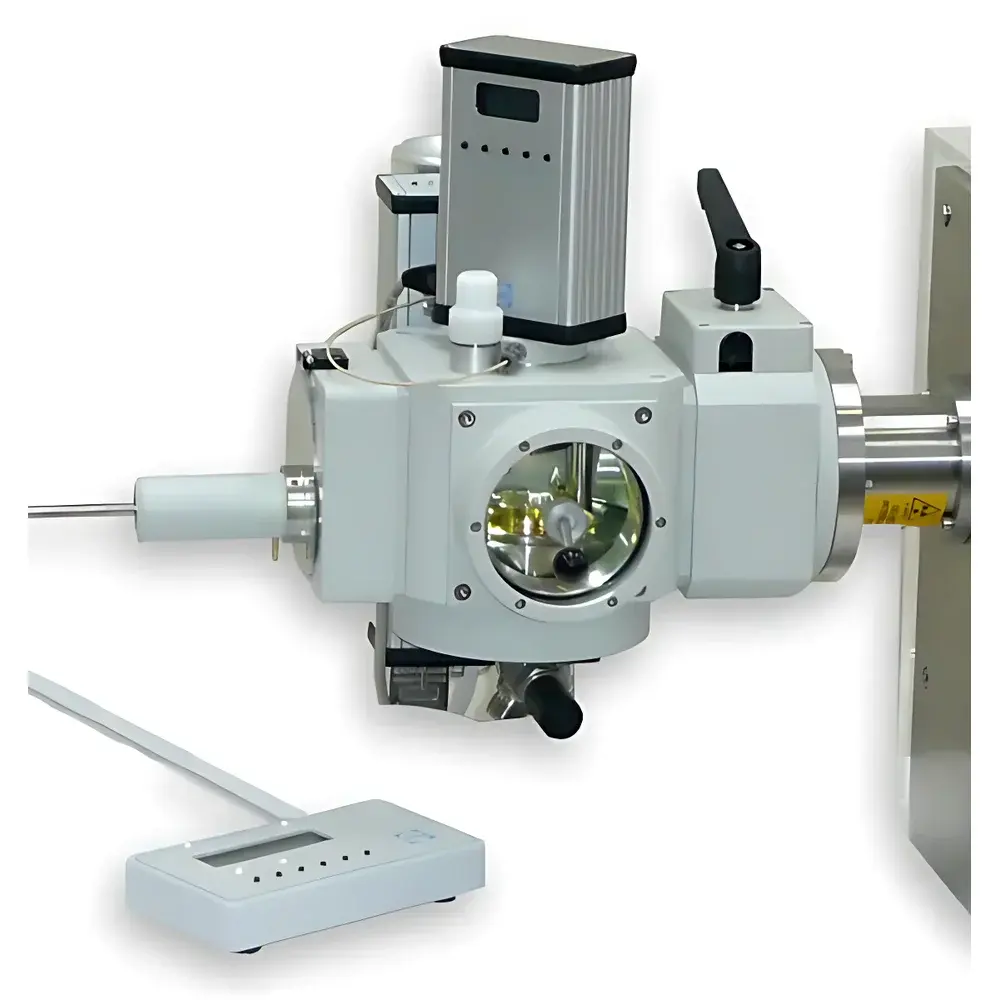
Gatan ALTO 1000 Cryo-Transfer System
| Brand | Gatan |
|---|---|
| Origin | USA |
| Model | ALTO 1000 |
| Sample Temperature Range | −210 °C (LN₂ slush) to +50 °C |
| SEM Cold Stage Operating Range | −185 °C to +50 °C |
| Cold Stage Stability | ±1 °C |
| Pre-chamber Base Pressure | <1×10⁻³ mbar |
| Integrated LN₂ Slush Station | Yes (ALTO 1000D/E) |
| Vacuum Transfer Device (VTD) | Yes (ALTO 1000D/E) |
| Cryo-Fracture Knife | Standard |
| Sputter Coater | Optional (ALTO 1000E, magnetron-based, multi-metal compatible) |
| Control Interface | Dedicated compact keypad with real-time parameter display |
| Interlock System | Full electro-mechanical interlocking with SEM communication |
Overview
The Gatan ALTO 1000 Cryo-Transfer System is a purpose-engineered solution for cryogenic sample preparation and transfer in scanning electron microscopy (SEM), designed to preserve the native ultrastructure of hydrated, beam-sensitive, or thermally labile specimens. It operates on the principle of rapid vitrification—using liquid nitrogen slush (−210 °C) to achieve high-fidelity amorphous ice formation—followed by controlled cryo-fracture, sublimation, and optional low-temperature sputter coating under high vacuum. This workflow enables high-resolution imaging of biological tissues, soft materials, polymers, emulsions, and geological samples without chemical fixation, dehydration, or drying artifacts. The ALTO 1000 integrates directly with both high-vacuum and variable-pressure SEMs—including dual-beam FIB-SEM platforms—via a dedicated pre-chamber that maintains thermal isolation and contamination control throughout the entire transfer sequence.
Key Features
- Modular architecture supporting two primary configurations: ALTO 1000D (cryo-fracture + slush freezing + VTD) and ALTO 1000E (adds integrated magnetron sputter coater for Pt, Au, Cr, and C deposition)
- Integrated LN₂ slush generation station coupled to a mechanical pump—producing stable −210 °C environments for ultra-rapid specimen vitrification and minimized ice crystal nucleation
- Dedicated pre-chamber with independent roughing pump, achieving base pressures better than 1×10⁻³ mbar; equipped with high-brightness white LED illumination and large-diameter spherical valve for unobstructed visual monitoring during transfer
- Compact vacuum transfer device (VTD) with oversized optical viewport ensures real-time alignment and contamination-free movement from pre-chamber to SEM cold stage
- Cryo-stage cooled by overcooled nitrogen gas, operating from −185 °C to +50 °C with thermal stability of ±1 °C; anti-contamination shield configurable to ≤−190 °C
- Intuitive palm-sized keypad controller with live readouts of temperature, pressure, valve status, and coating parameters; supports synchronized operation with SEM interlock protocols
- Full electro-mechanical safety interlocks—including SEM chamber gate validation, VTD position sensing, and emergency thermal cutoff—to ensure operator and instrument protection under all operational states
Sample Compatibility & Compliance
The ALTO 1000 accommodates standard 10 mm aluminum stubs secured with cryo-adhesive, with optional sample holders featuring embedded pins or clamping mechanisms for irregular or bulky specimens (e.g., whole insect specimens, plant stems, or rock fragments). Its workflow conforms to established cryo-SEM best practices outlined in ASTM E2374–22 (“Standard Guide for Cryo-Scanning Electron Microscopy”) and supports GLP-compliant documentation when paired with Gatan’s DigitalMicrograph® acquisition software. While not FDA 21 CFR Part 11–certified out-of-the-box, the system’s deterministic control logic, audit-trail-capable parameter logging (via optional software integration), and hardware interlocks provide foundational traceability for regulated environments in pharmaceutical development, food science, and medical device characterization.
Software & Data Management
The ALTO 1000 operates autonomously via its embedded microcontroller but is fully compatible with Gatan’s DigitalMicrograph® platform for synchronized acquisition, annotation, and metadata tagging. Temperature setpoints, sublimation duration, sputter time/current, and valve sequencing can be saved as repeatable methods—enabling reproducible workflows across user shifts and laboratories. When interfaced with SEM automation suites (e.g., Thermo Fisher SmartSEM or Zeiss Atlas 5), the ALTO 1000 transmits status signals (e.g., “stage at target temp”, “VTD docked”, “coating complete”) to trigger downstream imaging or analysis steps. All operational logs—including timestamps, thermal profiles, and interlock events—are exportable as CSV or XML for integration into LIMS or ELN systems.
Applications
The ALTO 1000 serves critical roles across disciplines requiring structural fidelity under native-state conditions: in life sciences, it enables visualization of freeze-fractured plasma membranes, intracellular organelles, and extracellular matrices in mammalian kidney tissue or pollen grains; in food science, it reveals phase-separated domains in ice cream, foam architecture in beer head, and crystalline fat networks in dairy spreads; in petroleum geology, it characterizes pore geometry and bitumen distribution in oil shale and mudstone; in materials R&D, it supports failure analysis of low-k dielectrics, cryo-FIB milling of battery SEI layers, and morphology mapping of thermosensitive polymer blends. Its compatibility with FIB-SEM further extends utility to site-specific lamella preparation for cryo-electron tomography correlative workflows.
FAQ
What vacuum level does the ALTO 1000 pre-chamber achieve?
The pre-chamber reaches a base pressure better than 1×10⁻³ mbar using its dedicated mechanical pump.
Is the ALTO 1000 compatible with environmental SEM (ESEM) or low-vacuum SEM modes?
Yes—the pre-chamber isolates the cryo-sample from the SEM column environment; compatibility is maintained through appropriate differential pumping and valve coordination per instrument vendor specifications.
Can the ALTO 1000 be retrofitted to an existing SEM?
Yes—Gatan provides custom flange kits and interface engineering support for integration with major SEM platforms (Thermo Fisher, Zeiss, JEOL, Hitachi) including field-emission and dual-beam systems.
What is the typical liquid nitrogen consumption rate?
The integrated Dewar holds 6 L of LN₂ and supports up to 3 hours of continuous cold-stage operation at −185 °C.
Does the system support automated sublimation control?
Yes—sublimation time and temperature ramp profiles are programmable via the keypad controller and executed with closed-loop thermal feedback.



