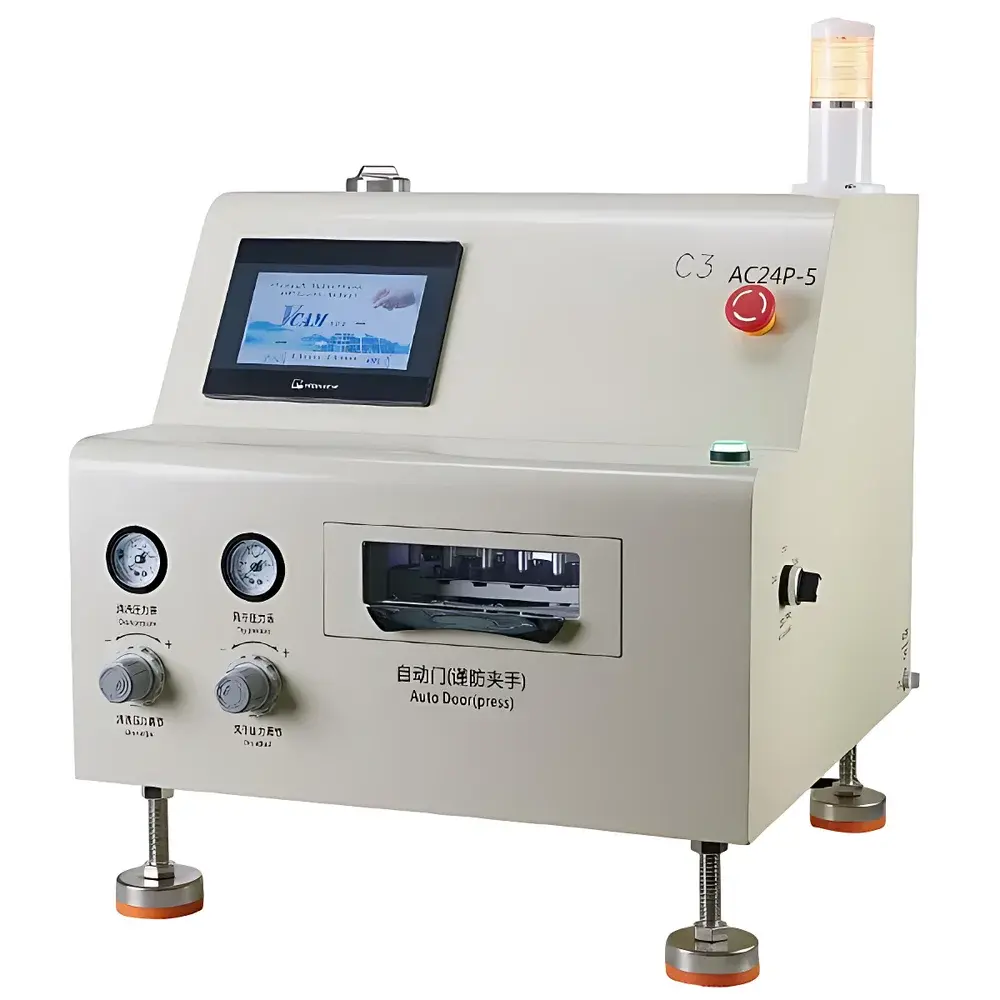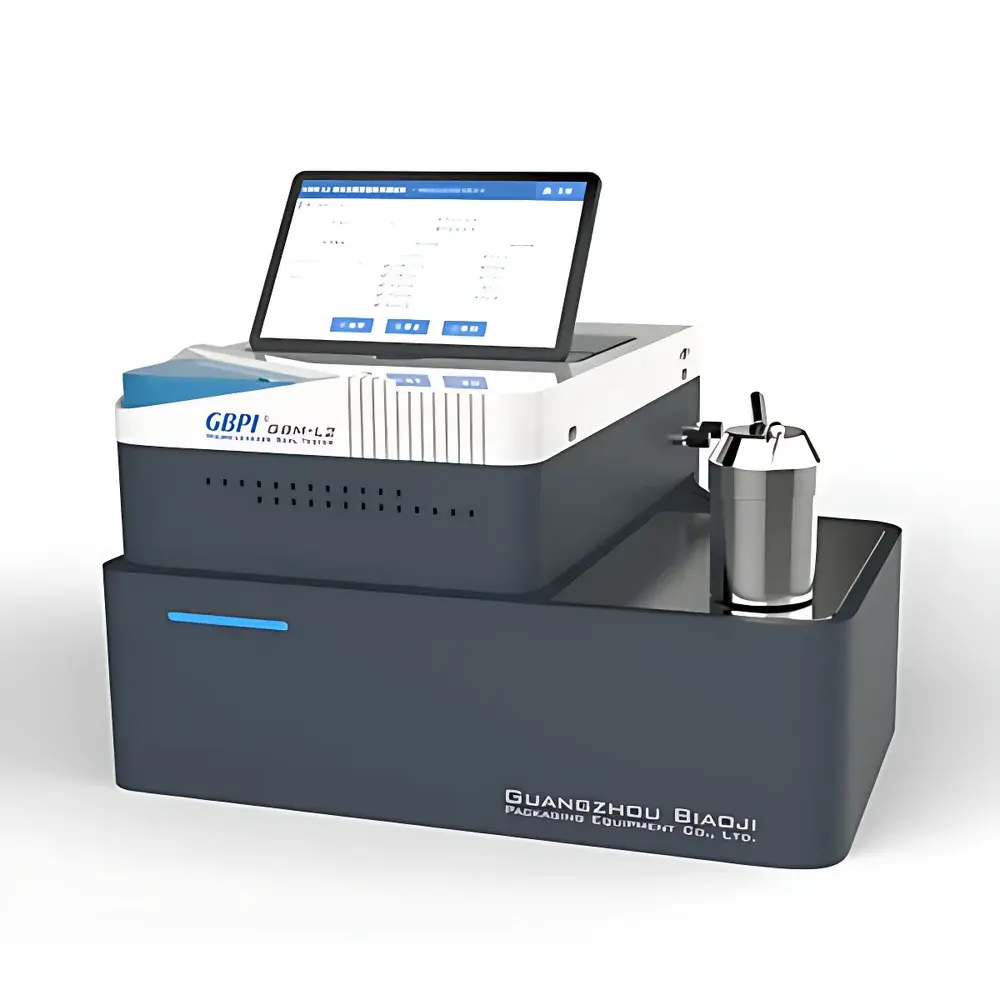
GBPI AUTO GBM-L2 Dual-Pressure Micro-Leak Tester
| Brand | GBPI (Guangzhou Biaoji) |
|---|---|
| Origin | Guangdong, China |
| Manufacturer Type | Direct Manufacturer |
| Region Classification | Domestic (China) |
| Model | GBM-L2A |
| Price | USD 42,000 (approx.) |
| Absolute Pressure Range | 0–300 kPa |
| Differential Pressure Range | −2 to +2 kPa |
| Detection Sensitivity | 1–3 µm |
| Equilibration/Test Duration | 1–3600 s |
| Vacuum Purge Time | 1–3600 s |
| Set Flow Rate | 0–3 mL/min |
| Sensor Configuration | Dual-sensor (absolute + differential pressure) / Dual-loop testing system |
| Test Chamber | Custom-engineered per sample geometry |
| Compliance Standards | ASTM F2338-09(2013), YY/T 0681.18–2020, USP <1207.2>, ASTM F2095 |
Overview
The GBPI AUTO GBM-L2 Dual-Pressure Micro-Leak Tester is a fully automated, GMP-compliant integrity verification system engineered for deterministic detection of micron-scale leaks in sterile pharmaceutical primary packaging. It implements two complementary, physics-based leak detection modalities—vacuum decay and pressure decay—within a single instrument platform. Unlike single-mode systems, the GBM-L2’s dual-pressure architecture enables reliable assessment of both evacuated (e.g., lyophilized vials) and non-evacuated (e.g., pre-filled syringes, IV bags) containers without method revalidation or hardware modification. The system operates on gas dynamics principles: during vacuum decay mode, the test chamber is evacuated, inducing outgassing through any defect; during pressure decay mode, controlled pressurization drives gas ingress into the package interior. Real-time monitoring of absolute and differential pressure transients—via traceable, high-stability sensors with 0.1% full-scale accuracy—enables quantitative correlation between pressure drift rate and equivalent leak orifice diameter.
Key Features
- Dual-sensor, dual-loop architecture integrating high-precision absolute pressure sensors (0–300 kPa range) and differential pressure sensors (±2 kPa range) for simultaneous transient signal capture and cross-validated decision logic.
- Sub-micron sensitivity validated to 1 µm equivalent leak orifice for rigid containers (e.g., glass vials, ampoules), with repeatability ≤0.8% RSD under controlled environmental conditions (20–30°C, ≤80% RH, non-condensing).
- Imported high-efficiency vacuum system: 3 L/s dry scroll pump with ultimate vacuum <1 Pa, acoustic noise ≤50 dB(A), integrated oil-level monitoring and service indicators.
- Certified mass flow controller (UK-sourced): programmable flow range 0–3 mL/min, resolution 0.001 mL/min—enabling precise artificial leak generation for method suitability, limit-of-detection (LOD) verification, and PQ protocol execution.
- 11-inch industrial-grade capacitive touchscreen HMI with intuitive workflow navigation, real-time pressure curve visualization, and embedded audit trail compliant with FDA 21 CFR Part 11 and EU Annex 11 requirements.
- Modular test chamber design: fully customizable cavity geometry—including nested fixtures—for multi-format compatibility (e.g., 2R–30R vials, 1–5 mL syringes, HDPE bottles, flexible IV bags) without cross-contamination risk or mechanical stress on samples.
Sample Compatibility & Compliance
The GBM-L2 supports regulatory-grade integrity testing across Class I–III medical device and pharmaceutical packaging formats. Validated use cases include freeze-dried powder vials (where residual vacuum confounds conventional vacuum decay), nitrogen-purged ampoules, silicone-coated pre-filled syringes, blow-fill-seal (BFS) ophthalmic dropper bottles, and multi-layer co-extruded IV bags. All test methods are aligned with compendial standards: ASTM F2338-09(2013) for vacuum decay, ASTM F2095 for pressure decay, USP for deterministic non-destructive testing (NDT), and YY/T 0681.18–2020 for Chinese pharmacopoeial compliance. System qualification includes IQ/OQ documentation templates, sensor calibration certificates traceable to NIM (National Institute of Metrology, China), and full GMP validation support packages for GLP/GMP environments.
Software & Data Management
Embedded firmware features role-based access control (RBAC) with three-tier user permissions (Operator, Supervisor, Administrator), electronic signatures, and immutable audit trails recording all parameter changes, test executions, result approvals, and calibration events. Raw pressure-time datasets are stored in CSV and PDF formats with embedded metadata (timestamp, operator ID, chamber ID, environmental log). Data export complies with ALCOA+ principles (Attributable, Legible, Contemporaneous, Original, Accurate, Complete, Consistent, Enduring, Available) and integrates with LIMS via configurable OPC UA or Modbus TCP protocols. Software update history and version-controlled firmware binaries are retained for full lifecycle traceability.
Applications
- Final container closure integrity testing (CCIT) of lyophilized products prior to release, eliminating false-negative outcomes caused by internal vacuum masking leakage signals.
- Stability study support: periodic CCIT at accelerated and real-time storage conditions to assess seal degradation kinetics.
- Process validation: correlation of sealing parameters (crimp force, stopper insertion depth) with leak probability distributions using statistical process control (SPC) tools.
- Root cause analysis of packaging failures: differentiation between gross leaks (>10 µm), micro-leaks (1–10 µm), and hermeticity loss due to material creep or particulate-induced channeling.
- Regulatory submission support: generation of complete validation reports including method sensitivity mapping, robustness evaluation, and uncertainty budgeting per ISO/IEC 17025 guidelines.
FAQ
Does the GBM-L2 require external compressed air or nitrogen supply?
No—the system is self-contained and uses only ambient air for pressure decay mode; vacuum decay mode requires no auxiliary gas source.
Can the same test chamber be used for both vials and pre-filled syringes?
Yes, via optional nested fixture kits that maintain consistent headspace volume and mechanical alignment across multiple container formats.
Is sensor recalibration required between tests?
No—sensors are factory-calibrated with annual recalibration recommended; built-in zero-drift compensation ensures stability over extended operation cycles.
How does the system handle flexible packaging like IV bags?
Chamber design incorporates adaptive clamping and volume compensation algorithms to minimize elastic deformation artifacts during pressure transients.
What documentation is provided for GMP validation?
IQ/OQ protocols, URS summary, risk assessment (FMEA), calibration certificates, and raw data traceability logs are included as standard deliverables.