
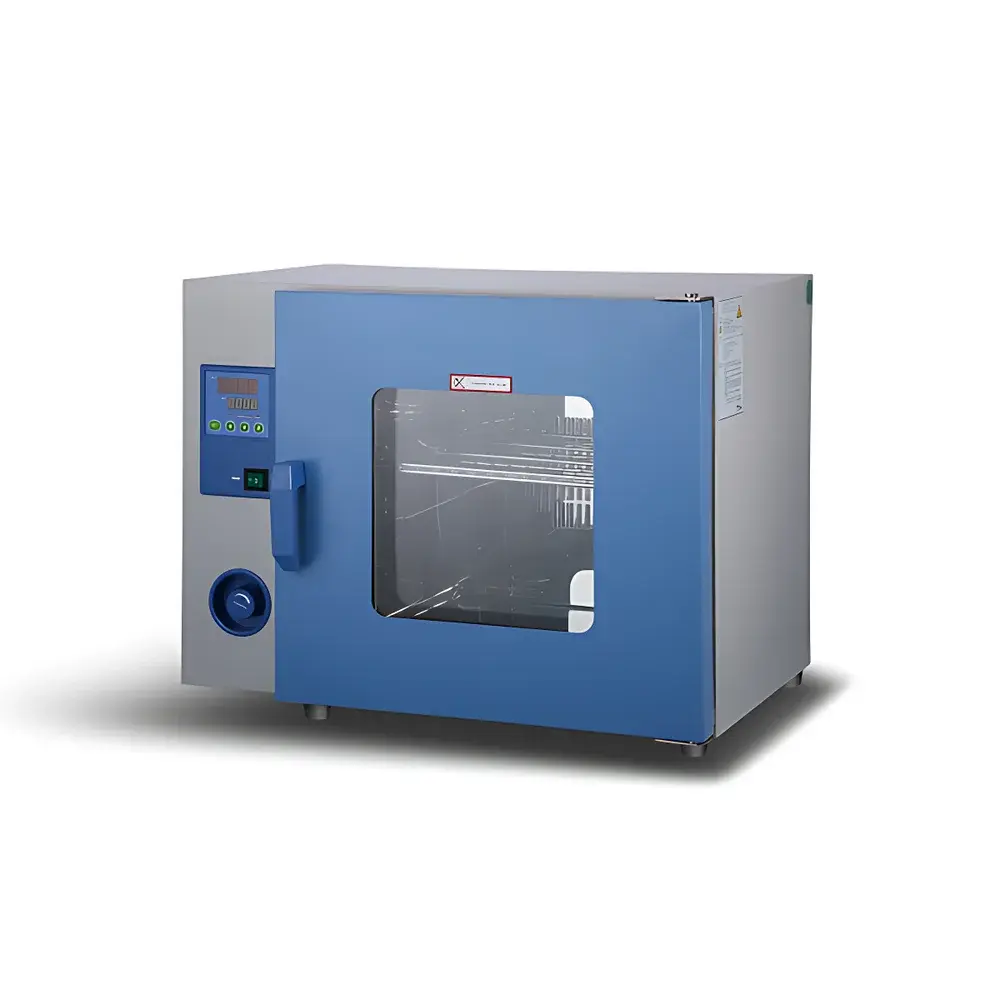
GBPI DHG-9023A Precision Forced-Air Drying Oven
| Brand | GBPI |
|---|---|
| Origin | Guangdong, China |
| Manufacturer Type | Direct Manufacturer |
| Instrument Category | Domestic |
| Model | DHG-9023A-aa |
| Temperature Range | Ambient +10°C to 300°C |
| Temperature Uniformity | ≤±3°C |
| Temperature Fluctuation | ≤±0.5°C |
| Internal Dimensions (D×W×H) | 300 mm × 300 mm × 275 mm |
| External Dimensions (D×W×H) | 625 mm × 500 mm × 490 mm |
| Inner Chamber Material | SUS304 Brushed Stainless Steel |
| Heating Method | Nickel-Chromium Alloy Wire with Centrifugal Forced-Air Circulation |
| Power Rating | 1000 W |
| Supply Voltage/Frequency | 220 V, 50 Hz |
| Net Weight | 31.5 kg |
| Safety Protections | Over-Temperature Cut-Off, Fan Overheat Protection |
| Shelf Load Capacity | 5 kg |
| Sensor | Pt100 Platinum Resistance Thermometer |
| Display | LED Digital |
| Insulation | Super Glass Wool |
| Outer Casing | Cold-Rolled Steel with Anti-Rust Coating and Powder Finish |
Overview
The GBPI DHG-9023A Precision Forced-Air Drying Oven is an ISO-compliant, laboratory-grade convection drying system engineered for thermal stability, repeatability, and operational safety in regulated environments. It operates on the principle of forced-air convection—where a centrifugal blower circulates heated air uniformly across the chamber—to ensure consistent heat transfer and minimize thermal gradients during drying, baking, sterilization, or moisture removal procedures. Designed to meet the functional requirements of QC/QA laboratories, R&D facilities, and academic institutions, the DHG-9023A supports critical workflows including residual solvent evaporation, polymer curing, sample pre-conditioning prior to gravimetric analysis, and low-temperature sterilization of non-heat-sensitive labware. Its temperature control architecture—built around a Pt100 sensor and microprocessor-based PID controller—delivers stable setpoint maintenance within ±0.5°C fluctuation and ≤±3°C uniformity across the full working volume (300 × 300 × 275 mm), satisfying routine compliance needs aligned with ASTM E145, ISO 17025, and GLP documentation standards.
Key Features
- Stainless steel inner chamber fabricated from SUS304 brushed stainless steel with argon arc welding—resistant to corrosion, oxidation, and repeated thermal cycling
- High-efficiency nickel-chromium heating elements integrated with precision airflow management via a centrifugal fan system
- Digital LED display with microcomputer temperature controller featuring adjustable timer function (up to 999 minutes) and real-time deviation indication
- Multi-layer thermal insulation using super glass wool (≥80 mm thickness) to reduce surface temperature rise and energy consumption
- Dual-stage safety protection: independent over-temperature cut-off circuit and fan overheat monitoring to prevent uncontrolled thermal runaway
- Ergonomic design with reinforced double-layer door seal, smooth-opening hinges, and removable stainless steel shelves rated for 5 kg load per shelf
Sample Compatibility & Compliance
The DHG-9023A accommodates a wide range of solid and semi-solid samples—including powders, granules, films, coated substrates, and ceramic precursors—without risk of cross-contamination due to its seamless, non-porous interior finish. Its operating range (ambient +10°C to 300°C) covers standard protocols for moisture content determination (e.g., AOAC 950.46, USP <641>), polymer drying (ASTM D792), and pharmaceutical excipient conditioning. The unit complies with IEC 61010-1:2010 for electrical safety in laboratory equipment and carries CE marking under the Low Voltage Directive (2014/35/EU) and EMC Directive (2014/30/EU). All firmware and hardware configurations support audit-ready operation in GMP/GLP environments, with optional calibration certificate traceable to NIST or CNAS-accredited reference standards.
Software & Data Management
While the DHG-9023A operates as a standalone instrument with embedded digital control logic, it supports external data logging through optional RS485/Modbus RTU interface (available upon request). This enables integration into centralized laboratory information management systems (LIMS) or SCADA platforms for time-stamped temperature profiling, event logging (e.g., door open/close, alarm triggers), and electronic record retention compliant with FDA 21 CFR Part 11 requirements when paired with validated third-party software. GBPI provides factory calibration reports and offers annual recalibration services aligned with ISO/IEC 17025:2017 accreditation criteria.
Applications
- Moisture loss-on-drying (LOD) assays in food, pharma, and chemical raw material testing
- Pre-drying of filter papers, crucibles, and weighing boats prior to gravimetric analysis
- Baking of thin-film coatings, printed electronics substrates, and battery electrode layers
- Low-temperature sterilization of glassware, pipette tips, and reusable lab tools
- Accelerated aging studies of packaging materials and adhesives under controlled thermal stress
- Thermal conditioning of reference standards and calibration artifacts prior to metrological use
FAQ
What is the maximum safe operating temperature for continuous use?
The DHG-9023A is rated for sustained operation up to 300°C; however, prolonged use above 250°C may accelerate aging of gasket materials and insulation integrity—consult the user manual for duty-cycle recommendations.
Is the oven suitable for inert-atmosphere applications?
No—the DHG-9023A is not equipped with gas purge ports or pressure-rated seals; it is designed exclusively for ambient-air convection drying.
Can multiple shelves be installed simultaneously without compromising temperature uniformity?
Yes—up to three standard shelves (included) may be loaded while maintaining ≤±3°C uniformity across the working volume, provided proper spacing (≥50 mm clearance from walls and ceiling) is observed.
Does GBPI provide installation and qualification support?
Yes—IQ/OQ documentation templates and on-site installation qualification (IQ) assistance are available upon request; PQ validation must be performed by the end-user per internal SOPs.
How often should the Pt100 sensor be recalibrated?
Annual recalibration is recommended; GBPI offers certified recalibration services with uncertainty reporting per ISO/IEC 17025 guidelines.



