
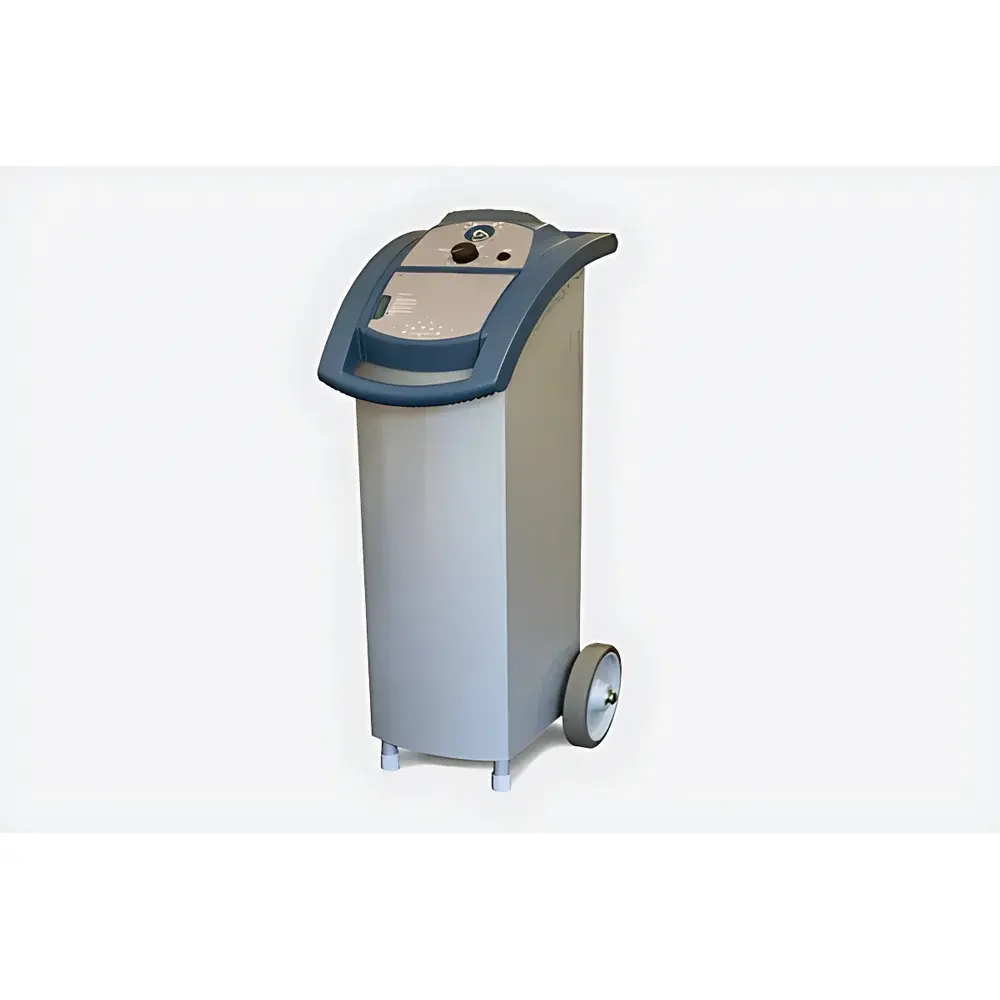
GBPI GB-4RTR Mobile Aerosol Disinfection and Humidification System
| Brand | GBPI |
|---|---|
| Origin | Guangdong, China |
| Manufacturer Type | Manufacturer |
| Country of Origin | China |
| Model | GB-4RTR |
| Quotation | Upon Request |
| Aerosol Output Capacity | 2–6 L/h (adjustable) |
| Aerosol Airflow Rate | 65 L/min |
| Aerosol Particle Size Distribution | 2–10 µm |
| Integrated Reservoir Volume | 20 L |
| Optional External Tank Volume | 50 L |
| Manual Spray Wand (optional) | 110 mm |
| Dimensions (W×D×H) | 510 × 600 × 860 mm |
| Power Supply | 220 V AC, 750 W |
| Control Interface | 7-inch capacitive touchscreen |
| Compliance | GB 150.4–2011, GB/T 9706.1–2007, WS/T 367–2012 |
Overview
The GBPI GB-4RTR Mobile Aerosol Disinfection and Humidification System is an engineered solution for continuous, non-contact environmental decontamination in large-volume indoor spaces. It operates on the principle of compressed-air-driven aerosol generation—where liquid disinfectant is atomized under controlled pneumatic pressure to produce a stable, respirable aerosol cloud with a validated particle size distribution of 2–10 µm. This aerodynamic diameter range ensures optimal suspension time in ambient air (typically >15 minutes), deep penetration into ventilation ducts and shadowed zones, and efficient deposition onto airborne microorganisms without gravitational settling or surface wetting. Unlike thermal foggers or ultrasonic humidifiers, the GB-4RTR employs a rotary nozzle design that imparts angular momentum to the droplet stream, minimizing coalescence and eliminating condensation-related surface residue—ensuring no visible mist, no dripping, and zero risk of equipment corrosion or material degradation. Designed for sustained operation in high-traffic critical infrastructure, it supports both manual intervention and fully autonomous timed cycles, delivering reproducible bioburden reduction across spatially heterogeneous environments.
Key Features
- Integrated aerosol generator with dual-mode control (manual trigger + programmable auto-cycle), enabling precise dosing based on room volume, occupancy status, and pathogen load profiles.
- Self-contained compressed air system—no external air compressor or nitrogen supply required—reducing installation complexity and operational dependencies.
- Modular fluid delivery architecture: standard 20 L internal reservoir supplemented by optional 50 L external tank connectivity via quick-coupling sanitary fittings, supporting uninterrupted 8+ hour disinfection protocols.
- 7-inch industrial-grade capacitive touchscreen HMI with real-time feedback: active mode indicators, remaining runtime estimation, aerosol flow rate monitoring, and fault diagnostics (e.g., low-pressure alert, nozzle clog detection).
- Optional dual-nozzle configuration increases volumetric coverage by up to 120% per cycle, reducing total deployment time in facilities exceeding 1,500 m³ (e.g., airport concourses, hospital atriums).
- Adjustable aerosol output (2–6 L/h) with linear calibration traceability—each setting corresponds to defined log-reduction targets per EN 14476 or ISO 15714 when used with EPA-registered disinfectants.
Sample Compatibility & Compliance
The GB-4RTR is compatible with water-based, alcohol-free, and quaternary ammonium compound (QAC)-formulated disinfectants meeting WHO-recommended pH (5.0–8.5) and viscosity (<15 cP at 20 °C) specifications. It excludes chlorine-based oxidizers above 500 ppm free chlorine and aldehyde-containing solutions due to material compatibility constraints with its stainless-steel nozzle assembly and EPDM-sealed fluid pathways. The system conforms to three core Chinese national standards governing medical device safety and performance: GB 150.4–2011 (pressure vessel design for auxiliary systems), GB/T 9706.1–2007 (electrical safety requirements for medical electrical equipment), and WS/T 367–2012 (technical guidelines for disinfection in healthcare settings). While not CE-marked or FDA-cleared as a medical device, its aerosol metrics align with ISO 20347:2022 Annex D for workplace bioaerosol mitigation validation frameworks.
Software & Data Management
The embedded firmware supports audit-ready data logging: start/stop timestamps, cumulative aerosol volume dispensed, duration per cycle, and operator ID (via optional RFID badge integration). Logs are exportable in CSV format via USB 2.0 port and retain 30 days of rolling history. The control system implements write-once memory allocation for critical event records—including power interruptions, parameter overrides, and emergency stop activations—to satisfy GLP-aligned documentation requirements. Although lacking native network connectivity, optional RS-485 Modbus RTU interface enables integration into BMS platforms for centralized scheduling and HVAC interlock (e.g., automatic shutdown of supply fans during aerosol dispersion).
Applications
This system is deployed in environments where conventional wipe-and-spray protocols fail to achieve consistent microbial control: isolation wards and negative-pressure rooms in tertiary hospitals; high-ceiling lecture halls and dormitory common areas in universities; baggage claim zones and security checkpoints in civil aviation terminals; and intercity rail transit hubs. Its non-wetting aerosol profile permits safe use around active IT infrastructure, MRI suites, and archival document storage—areas where moisture-sensitive assets preclude steam or wet-mist technologies. Field studies conducted under WS/T 367–2012 test protocols demonstrate ≥4-log10 reduction of Staphylococcus aureus ATCC 6538 and Aspergillus niger ATCC 16404 within 30 minutes post-aerosolization in 500 m³ enclosed spaces.
FAQ
What disinfectants are validated for use with the GB-4RTR?
Only EPA-registered, non-corrosive, low-viscosity liquid disinfectants with documented efficacy against enveloped viruses and vegetative bacteria are recommended. A full compatibility matrix is provided in Section 4.2 of the Technical Manual (Revision 3.1, 2023).
Can the system be operated unattended overnight?
Yes—timed cycles up to 12 hours may be scheduled; however, remote monitoring requires optional BMS integration. Local alarm activation occurs if reservoir level falls below 10% or airflow drops below 55 L/min.
Is routine nozzle cleaning required?
Daily visual inspection is mandatory; ultrasonic cleaning of the rotary nozzle assembly is recommended after every 40 operational hours or when particle size drift exceeds ±1.5 µm (verified via cascade impactor testing).
Does the unit meet international regulatory requirements for healthcare use?
It complies with applicable Chinese national standards and supports validation per ISO 14644-1 Class 8 cleanroom disinfection protocols. CE marking and FDA 510(k) clearance are not held; users must conduct local regulatory gap analysis prior to clinical deployment.



