
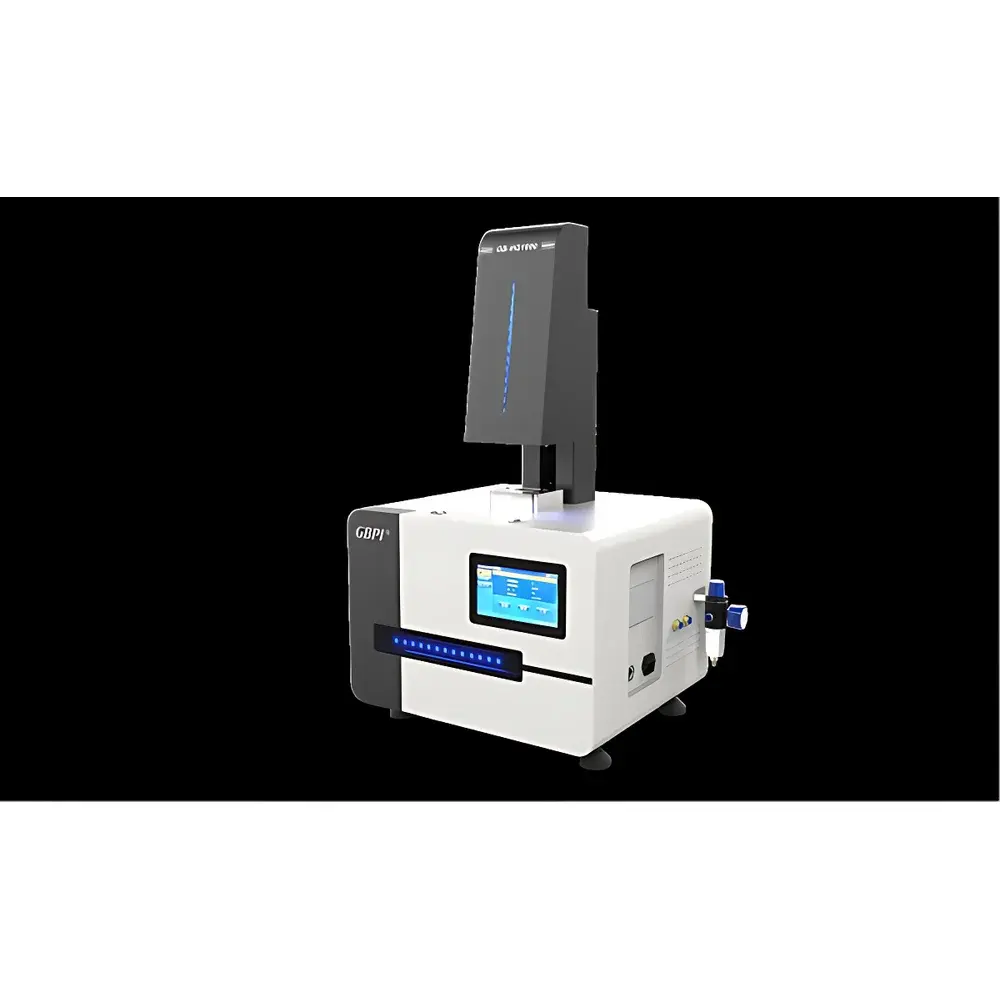
GBPI GB-HQ1000-1 Optical Particle-Based Exhalation Valve Integrity Tester
| Brand | GBPI |
|---|---|
| Origin | Guangdong, China |
| Manufacturer Type | Direct Manufacturer |
| Regional Classification | Domestic (China) |
| Model | GB-HQ1000-1 |
| Price Range | USD 70,000 – 140,000 |
| Instrument Type | Optical Particle Counter |
| Air Source | Compressed Air |
| Vacuum Pump Flow Rate | 2 L/min |
| Buffer Tank Volume | 5 L |
| Pressure Sensor Range | −1000 Pa to 0 Pa, Accuracy: ±1%, Resolution: 1 Pa |
| Flow Meter Range | 0–100 mL/min, Accuracy: ±1%, Resolution: 0.1 mL/min |
| Display | Integrated HD Touchscreen |
| Power Supply | 220 V, 50 Hz |
Overview
The GBPI GB-HQ1000-1 Optical Particle-Based Exhalation Valve Integrity Tester is a precision-engineered instrument designed for quantitative evaluation of the sealing integrity of exhalation valves integrated into medical and respirator-grade face masks. Unlike conventional pressure-decay or bubble-test methods, this system employs an optical particle counting principle combined with controlled differential pressure application to detect and quantify real-time leakage across the valve interface under physiologically relevant negative-pressure conditions. The device operates in accordance with the test methodology specified in GB 2626–2019 “Respiratory Protective Devices – Non-powered Air-purifying Particulate Respirators”, particularly Clause 6.7 (Exhalation Valve Leakage Test), and supports alignment with ISO 16900-3 and ASTM F2299 for comparative leakage assessment. Its architecture integrates calibrated vacuum generation, high-stability flow control, and real-time particle-based leakage quantification—enabling objective, repeatable, and traceable validation of valve performance during simulated exhalation cycles.
Key Features
- Integrated optical particle detection module synchronized with differential pressure control, enabling direct correlation between pressure differential and particulate egress rate.
- Dedicated sample holder fixture engineered for secure, reproducible mounting of flat-fold and cup-style masks with integrated exhalation valves—minimizing operator-induced variability.
- High-resolution capacitive pressure sensor (−1000 Pa to 0 Pa, ±1% full-scale accuracy, 1 Pa resolution) coupled with digital PID-controlled vacuum regulation for precise step-and-hold or ramped pressure profiles.
- Mass flow meter (0–100 mL/min, ±1% FS, 0.1 mL/min resolution) providing real-time volumetric leakage rate display and data logging at user-defined intervals.
- Onboard 7-inch HD capacitive touchscreen interface with intuitive workflow navigation, parameter configuration, and live graphical visualization of pressure vs. flow vs. time traces.
- Built-in thermal line printer for immediate hardcopy output of test reports—including date/time stamp, operator ID, sample ID, test parameters, and pass/fail status per GB 2626–2019 thresholds.
- Modular pneumatic design featuring a 5 L buffer tank to dampen pulsation, ensuring stable vacuum delivery during dynamic testing sequences.
Sample Compatibility & Compliance
The GB-HQ1000-1 accommodates standard medical/surgical masks and N95/N99/KN95 respirators equipped with one-way silicone or thermoplastic elastomer exhalation valves. Fixtures conform to the dimensional constraints defined in GB 2626–2019 Annex C and support both single-valve and dual-valve configurations. All measurement subsystems—including pressure transducers, mass flow sensors, and optical particle counters—are factory-calibrated against NIST-traceable standards. The instrument’s firmware implements audit-ready data handling protocols compliant with GLP principles; raw test logs include immutable timestamps, operator credentials, environmental metadata (ambient temperature/humidity if externally interfaced), and digital signatures. While not FDA 21 CFR Part 11-certified out-of-the-box, the system supports export of CSV/Excel-compatible datasets suitable for integration into validated laboratory information management systems (LIMS) used in pharmaceutical QC environments.
Software & Data Management
The embedded firmware provides local storage of ≥10,000 test records with searchable indexing by batch ID, date range, or operator. Export options include USB flash drive transfer and Ethernet-based FTP/SFTP upload to networked servers. Optional PC software (GBPI TestSuite v3.x) enables advanced statistical process control (SPC) analysis—calculating Cp/Cpk, trend charts, and outlier detection per ISO 22514 series. All exported data files retain native metadata structure and are compatible with common statistical packages (Minitab, JMP, Python pandas). Audit trail functionality logs all parameter changes, report generation events, and user logins—supporting internal quality audits and regulatory inspections under ISO 13485 and ICH Q5A frameworks.
Applications
- Quality assurance laboratories validating exhalation valve integrity prior to mask release in Class II/III medical device manufacturing.
- National metrology institutes performing inter-laboratory comparison studies on respirator leakage test methodologies.
- Regulatory testing bodies conducting conformity assessments against GB 2626–2019, EN 149:2001+A1:2009, and KN95 certification requirements.
- Research institutions investigating valve material fatigue, temperature-dependent seal degradation, or humidity-induced adhesion loss over accelerated aging cycles.
- Contract testing labs supporting OEMs in root-cause analysis of field-reported valve failure incidents through controlled parametric sweeps (e.g., pressure ramp rate, dwell time, cycle count).
FAQ
What pressure range does the GB-HQ1000-1 apply during exhalation valve testing?
The system applies a controlled negative pressure from −1000 Pa to 0 Pa relative to ambient, as required by GB 2626–2019 Section 6.7.2.
Is calibration documentation provided with the instrument?
Yes—each unit ships with a factory calibration certificate referencing NIST-traceable pressure and flow standards, valid for 12 months under normal operating conditions.
Can the tester be integrated into an automated production line?
While primarily designed for lab-based QA, optional digital I/O modules (RS-485, Modbus TCP) enable external PLC-triggered test initiation and pass/fail signal output.
Does the optical particle counter require periodic consumables or lamp replacement?
The LED-based light source has a rated lifetime exceeding 50,000 hours; no consumables are required during routine operation.
How is compliance with ISO/IEC 17025 demonstrated for test reports generated by this instrument?
Test reports include unique identifiers, uncertainty budgets derived from sensor specifications, and references to accredited calibration certificates—fulfilling clause 7.8.2 requirements when used within a certified laboratory’s scope of accreditation.



