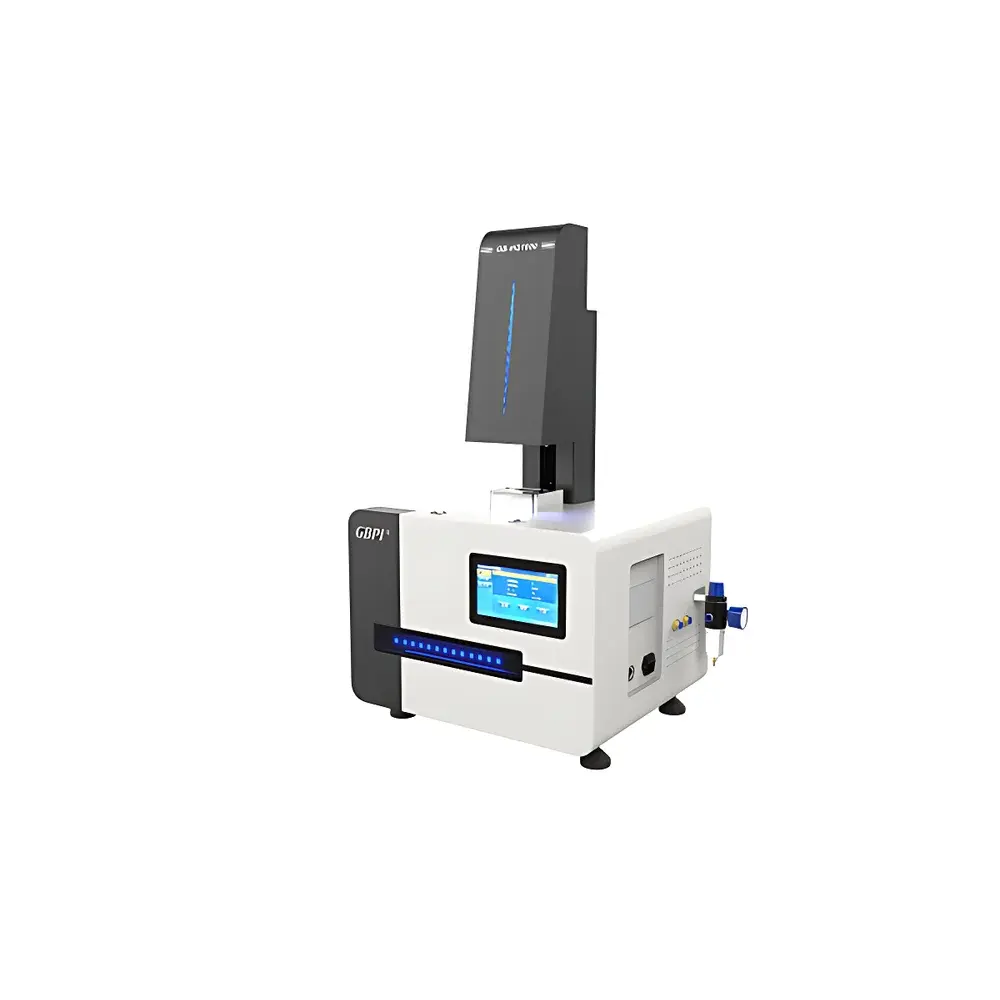
GBPI GB-HQ1000A Respiratory Valve Airtightness Tester for Face Masks
| Brand | GBPI |
|---|---|
| Model | GB-HQ1000A |
| Origin | Guangdong, China |
| Manufacturer Type | Direct Manufacturer |
| Regional Classification | Domestic (China) |
| Price Range | USD 14,000 – 42,000 |
| Air Source | Compressed Air |
| Vacuum Pump Flow Rate | 2 L/min |
| Buffer Tank Volume | 5 L |
| Pressure Sensor Range | −1000 Pa to 0 Pa |
| Pressure Sensor Accuracy | ±1% FS |
| Pressure Resolution | 1 Pa |
| Flow Meter Range | 0–100 mL/min |
| Flow Meter Accuracy | ±1% FS |
| Flow Resolution | 0.1 mL/min |
| Display | Integrated HD Touchscreen Interface |
| Power Supply | 220 V AC, 50 Hz |
| Sample Holder | Dedicated Mask Valve Fixture |
Overview
The GBPI GB-HQ1000A Respiratory Valve Airtightness Tester is an engineered solution designed specifically for quantitative assessment of air leakage through exhalation valves installed in particulate-filtering face masks—primarily N95, KN95, FFP2, and surgical respirators compliant with GB 2626–2019, EN 149:2001+A1:2009, and ISO 16900-1:2015. It operates on the principle of controlled negative pressure differential measurement: a calibrated vacuum is applied across the valve via a sealed test chamber, while high-fidelity sensors continuously monitor both the decay rate of chamber pressure and the corresponding volumetric flow rate of air ingress. This dual-parameter acquisition enables precise quantification of valve leakage under standardized static and dynamic pressure conditions, directly supporting conformity evaluation against regulatory pass/fail thresholds defined in national and international respiratory protection standards.
Key Features
- Dedicated mechanical fixture engineered for secure, repeatable clamping of diverse exhalation valve geometries—including round, oval, and recessed configurations—without deformation or seal interference.
- Integrated high-resolution capacitive pressure sensor (−1000 Pa to 0 Pa range, ±1% full-scale accuracy, 1 Pa resolution) and thermal mass-flow sensor (0–100 mL/min, ±1% FS, 0.1 mL/min resolution), both traceably calibrated per ISO/IEC 17025 requirements.
- Stable vacuum generation system featuring a low-pulsation diaphragm vacuum pump (2 L/min free-air displacement) coupled with a 5 L stainless-steel buffer tank to dampen pressure transients and ensure steady-state test conditions.
- Real-time digital display of differential pressure, leakage flow, elapsed time, and pass/fail status on a 7-inch industrial-grade capacitive touchscreen with glove-compatible interface and multilingual UI support (English, Chinese, Spanish).
- Built-in thermal line printer enabling immediate hardcopy output of test reports—including date/time stamp, operator ID, sample ID, measured values, and compliance verdict—formatted to meet internal QA documentation protocols.
- Manual and semi-automated test modes: users may preset target vacuum levels (e.g., −250 Pa or −500 Pa) and hold durations, or initiate fully automated sequences aligned with GB 2626–2019 Clause 6.5.2 for exhalation valve leakage testing.
Sample Compatibility & Compliance
The GB-HQ1000A accommodates flat-fold, cup-shaped, and contoured respirators equipped with integrated or snap-on exhalation valves. Its modular fixture design supports valves with outer diameters from 18 mm to 42 mm and flange thicknesses up to 3.5 mm. The instrument meets metrological and functional requirements outlined in GB 2626–2019 (Annex B), ISO 16900-1:2015 (Section 7.3), and ASTM F2299/F2299M–03(2020) for filter penetration and valve leakage characterization. All pressure and flow measurements are referenced to ambient temperature (23 ± 2 °C) and atmospheric pressure (101.3 kPa), with optional environmental monitoring integration for GLP-compliant laboratories.
Software & Data Management
Data logging occurs at 10 Hz during active testing, storing raw sensor outputs, timestamps, and operator inputs in encrypted binary files (.gbt). Optional USB export generates CSV-formatted datasets compatible with Excel, JMP, or Minitab for SPC analysis. Audit trail functionality records user login events, parameter changes, calibration history, and report generation actions—supporting FDA 21 CFR Part 11 readiness when deployed with network authentication and electronic signature modules. Firmware updates are delivered via secure HTTPS portal; no cloud dependency or third-party telemetry is implemented.
Applications
- Quality control release testing of exhalation valves during mask manufacturing (in-process and final inspection).
- Validation of valve integrity after accelerated aging (40 °C / 75% RH, 90 days) per ISO 10993-12.
- Comparative evaluation of valve performance across material batches, adhesive formulations, or actuation mechanisms.
- Supporting technical documentation for CE marking, NIOSH certification, or local market registration dossiers.
- Root-cause analysis of field failures linked to valve delamination, diaphragm fatigue, or seal degradation.
FAQ
What standards does the GB-HQ1000A explicitly support?
It is configured to execute test protocols required by GB 2626–2019, ISO 16900-1:2015, EN 149:2001+A1:2009, and ASTM F2299–03(2020). Custom protocol scripting is available upon request.
Is external calibration required, and how often?
Annual calibration using NIST-traceable pressure and flow standards is recommended; onboard self-diagnostic routines verify sensor zero stability and linearity before each test session.
Can the instrument be integrated into a lab information management system (LIMS)?
Yes—via RS-232 or Ethernet TCP/IP interface using Modbus RTU or ASCII command sets; API documentation and driver libraries are provided with enterprise licensing.
Does the system require compressed air or only vacuum operation?
Vacuum-only operation is standard; optional compressed air inlet (regulated to ≤0.3 MPa) enables reverse-direction leak checks or purge cycles upon request.
What maintenance is required for long-term reliability?
Filter replacement every 6 months (vacuum inlet filter), periodic verification of O-ring integrity on the test chamber lid, and annual lubrication of vacuum pump diaphragm assembly per manufacturer’s service manual.