
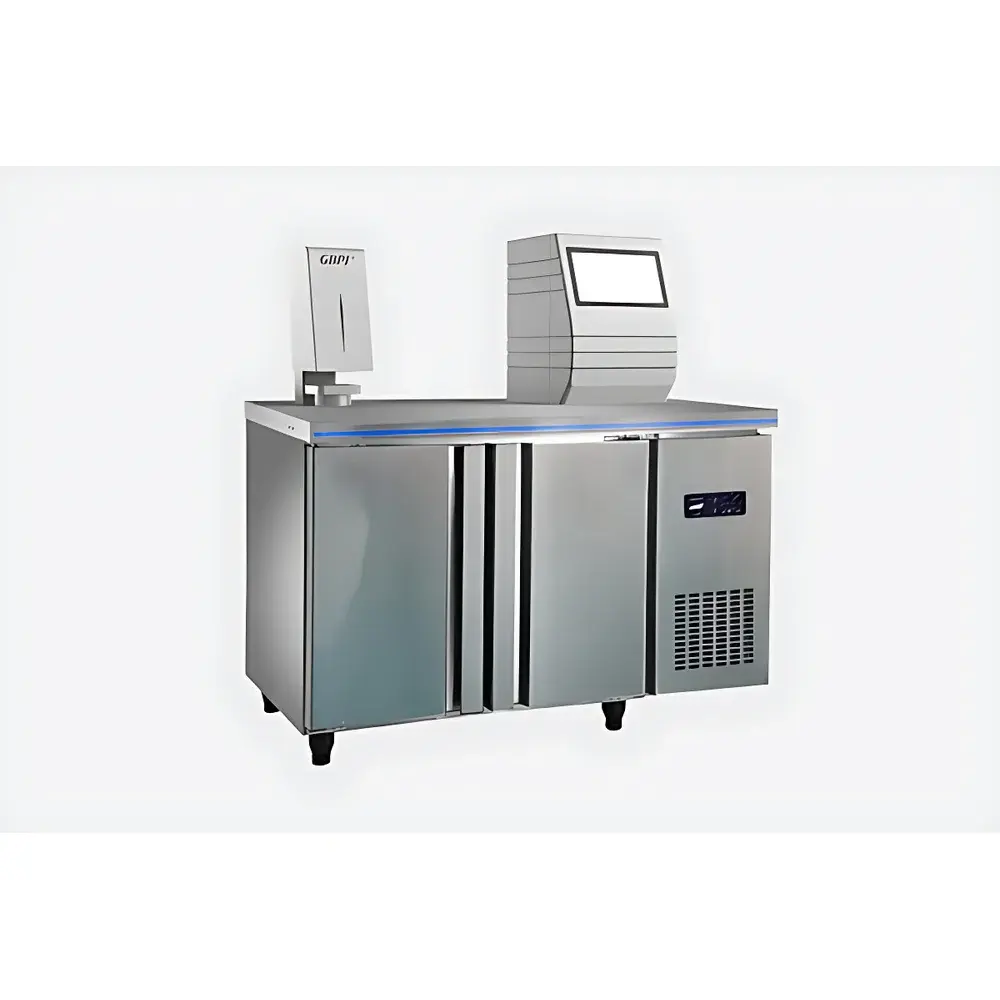
GBPI GB-KF30010G Oil-Based Particulate Filtration Efficiency Tester
| Brand | GBPI |
|---|---|
| Origin | Guangdong, China |
| Manufacturer Type | Direct Manufacturer |
| Model | GB-KF30010G |
| Filtration Efficiency Range | 0–99.999% |
| Flow Rate Range | 20–100 L/min |
| Pressure Drop Range | 0–1000 Pa |
| Test Particle Sizes | 0.3 µm, 0.5 µm, 5.0 µm |
| Aerosol Sources | DEHS (Di-Ethyl-Hexyl-Sebacate) and 2% NaCl solution |
| Standard Test Area | 100 cm² (customizable per mask geometry) |
| Dimensions | 130 × 75 × 157 cm |
| Weight | 250 kg |
| Power Supply | AC 220 V, 50 Hz |
| Power Consumption | <1500 W |
| Compliance Standards | GB/T 32610–2016, GB 2626–2006, GB 19082–2009, GB 19083–2010, GB 24539–2009, YY 0469–2011, YY/T 0969–2013, EN 1822–3:1998, YY 0469–2004 |
Overview
The GBPI GB-KF30010G Oil-Based Particulate Filtration Efficiency Tester is a precision-engineered instrument designed for quantitative evaluation of filtration performance in respiratory protective devices and textile-based barrier materials. It operates on the principle of aerosol challenge testing under controlled, constant-flow conditions, measuring both particle removal efficiency and airflow resistance—two critical parameters defined in international respirator and medical mask standards. The system generates monodisperse or polydisperse oil-based (DEHS) and salt-based (NaCl) aerosols to simulate real-world particulate challenges across three discrete size channels: 0.3 µm, 0.5 µm, and 5.0 µm. This multi-size capability enables differentiation between mechanical interception, diffusion, and inertial impaction mechanisms—essential for validating compliance with regulatory thresholds for surgical masks, N95-equivalent respirators, and medical gowns.
Key Features
- Cold-generation aerosol generator capable of stable, reproducible output of both DEHS (oil-based) and 2% NaCl (salt-based) aerosols—fully aligned with YY 0469 and GB 2626 test requirements.
- Integrated electrostatic neutralizer (e.g., 85Kr or soft X-ray source) to condition aerosol charge distribution prior to filter challenge—ensuring measurement fidelity per EN 1822–3 and ISO 16890 methodologies.
- Hermetically sealed aerosol delivery path with full containment design, minimizing operator exposure and eliminating cross-contamination risks during high-concentration testing.
- Pneumatically actuated, force-calibrated clamping mechanism with mechanical safety interlock—ensuring consistent sample loading pressure and repeatable test area sealing (standard 100 cm², configurable for custom mask geometries).
- Real-time differential pressure monitoring via calibrated digital manometers, synchronized with upstream/downstream particle counting for simultaneous ΔP and efficiency calculation.
- Embedded industrial-grade touchscreen HMI and dedicated Windows-based software suite enabling automated sequence execution, GLP-compliant data logging, and audit-ready report generation.
- Modular architecture supporting optional upgrades: gravimetric backup verification, humidity/temperature-controlled test chamber, and ISO 21501-4 compliant particle counter calibration traceability.
Sample Compatibility & Compliance
The GB-KF30010G accommodates flat-sheet filter media—including glass fiber, melt-blown polypropylene (PP), and PTFE-coated membranes—as well as finished 3D-form medical/surgical masks and industrial respirators. Its standardized 100 cm² test area complies with GB/T 32610–2016 and YY 0469–2011, while adjustable fixtures allow validation of non-planar configurations per ISO 13485 production lot release protocols. Regulatory alignment extends across multiple frameworks: it satisfies the aerosol generation, flow control, and data recording requirements of GB 2626–2006 (equivalent to NIOSH 42 CFR Part 84), EN 149:2001+A1:2009, and ASTM F2299 for initial filtration efficiency. Software supports 21 CFR Part 11–compliant electronic signatures, user access tiers, and immutable audit trails for GMP and GLP environments.
Software & Data Management
The proprietary GBPI TestSuite v4.x software provides fully automated test orchestration—from aerosol stabilization and baseline zeroing to multi-point efficiency sweeps at user-defined flow rates (20–100 L/min). All raw sensor outputs (differential pressure, particle counts per channel, flow rate, temperature, RH) are timestamped and stored in encrypted SQLite databases with SHA-256 hashing. Export options include CSV (for statistical analysis in JMP or Minitab), PDF test reports with embedded calibration certificates, and XML files compatible with LIMS integration (e.g., LabVantage, Thermo Fisher SampleManager). Data integrity safeguards include automatic backup to network drives, configurable retention policies, and role-based permissions for data viewing, editing, and deletion—meeting FDA and CNAS documentation requirements for accredited testing laboratories.
Applications
- Quality control of melt-blown PP electret filters during high-volume mask manufacturing.
- Regulatory submission testing for Class II/III medical devices under NMPA registration pathways.
- R&D evaluation of novel nanofiber or electrospun composite media for enhanced oil-aerosol capture.
- Comparative assessment of filter aging effects (electrostatic decay, hydrophobicity loss) after simulated wear or sterilization cycles.
- Third-party certification testing for PPE import/export compliance (EU CE marking, US FDA 510(k), ASEAN MRA).
- Validation of reusable fabric barriers per GB 24539–2009 chemical protective clothing standards.
FAQ
What aerosol generation methods does the GB-KF30010G support?
It utilizes cold aerosol generation via collision nebulization for both DEHS and NaCl solutions—eliminating thermal degradation artifacts common in hot-wire generators.
Is the system compatible with ISO/IEC 17025 accreditation requirements?
Yes. All critical subsystems (flow meters, pressure transducers, particle counters) are supplied with NIST-traceable calibration certificates; uncertainty budgets are documented per ILAC-G8:2009.
Can the tester evaluate filtration efficiency at elevated humidity levels?
Standard configuration operates at ambient RH; optional humidity-controlled test chamber (0–95% RH, ±2% accuracy) is available as an add-on module.
Does the software support multi-language UI and report generation?
The interface and reports are English-only by default; localized language packs (Spanish, French, Arabic) can be deployed upon request for multinational lab deployments.
What maintenance intervals are recommended for long-term metrological stability?
Aerosol generator nozzles require ultrasonic cleaning every 200 test hours; particle counter zero-check and flow meter recalibration are advised quarterly per GB/T 27418–2017 guidelines.





