
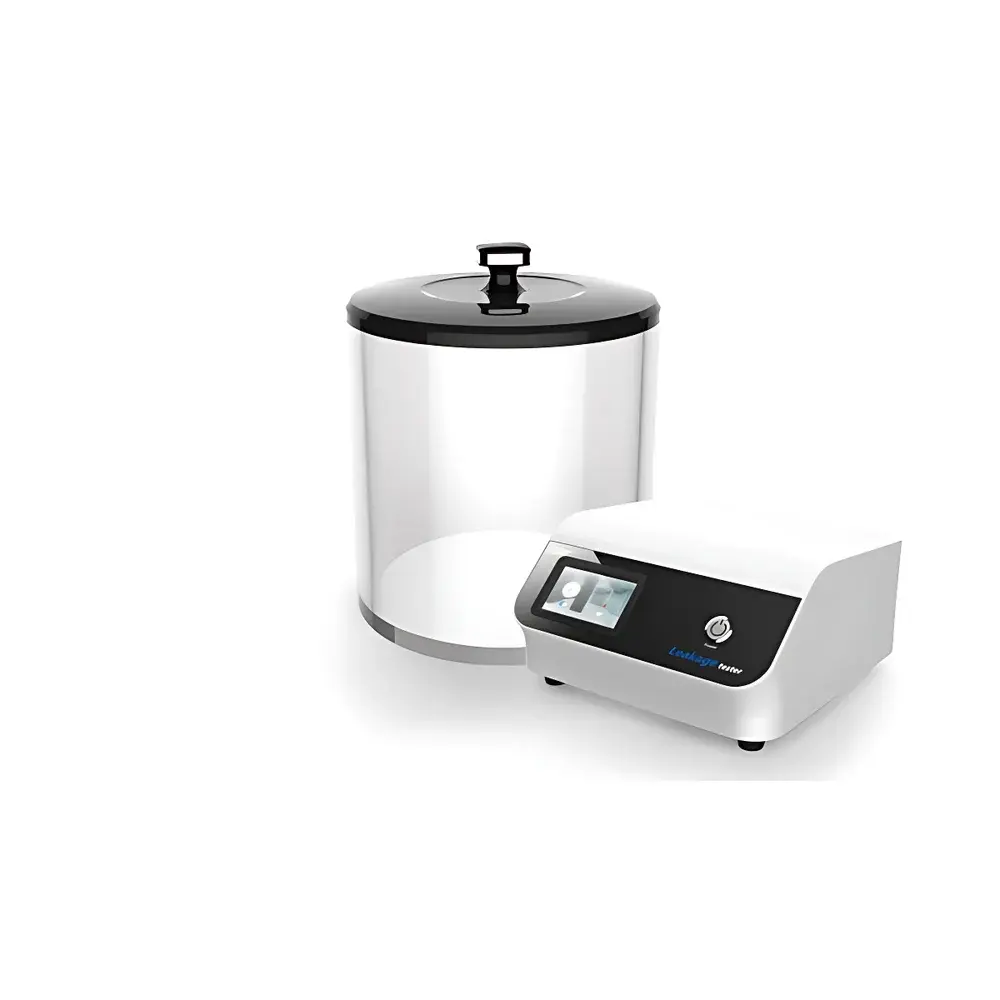
GBPI GB-M2 Seal Integrity Tester
| Brand | GBPI |
|---|---|
| Origin | Guangdong, China |
| Manufacturer Type | Manufacturer |
| Country of Origin | China |
| Model | GB-M2 |
| Price Range | USD 1,400 – 4,200 |
| Vacuum Range | 0 to –95 kPa |
| Vacuum Accuracy | ±1% of reading |
| Vacuum Hold Time | 0.1–60 min |
| Compressed Air Pressure | 0.4–0.6 MPa (4–6 kgf/cm²) |
| Air Consumption | 20 L/min |
| Power Supply | 220 V, 50 Hz |
| Instrument Dimensions | 317 × 305 × 170 mm |
| Vacuum Chamber Options | Ø300 × 300 mm (small), Ø450 × 350 mm (medium) |
| Net Weight | 12 kg |
| Operating Temperature | 10–40 °C |
Overview
The GBPI GB-M2 Seal Integrity Tester is a precision-engineered benchtop instrument designed for quantitative evaluation of package seal integrity using the vacuum decay method—compliant with ISO 11607-2, ASTM D3078-2013, and GB/T 15171-1994. It operates on the principle that a sealed package submerged in water (or placed within a vacuum chamber) will exhibit visible bubble emission or internal deformation when subjected to controlled negative pressure; the onset, rate, and location of leakage are directly correlated with seal defect severity and geometry. Unlike subjective visual inspection, the GB-M2 delivers objective, repeatable pass/fail determinations based on user-defined vacuum levels and hold durations—making it indispensable for quality assurance in regulated manufacturing environments where container closure integrity (CCI) is a critical quality attribute.
Key Features
- Automated vacuum cycle control: fully programmable vacuum application, dwell time (0.1–60 min), and atmospheric repressurization—eliminating operator variability and ensuring test consistency across shifts.
- Pneumatic actuation via clean, oil-free compressed air (0.4–0.6 MPa), minimizing maintenance requirements and eliminating risk of contamination in pharmaceutical or food-grade settings.
- High-fidelity vacuum measurement: integrated pressure transducer with ±1% full-scale accuracy across the 0 to –95 kPa range—calibrated traceable to national standards and suitable for audit-ready documentation.
- Dual-chamber configuration support: interchangeable vacuum chambers (Ø300 × 300 mm standard; Ø450 × 350 mm optional) accommodate diverse package geometries—from sachets and pouches to rigid trays and blister cards.
- Intuitive LCD interface: real-time display of vacuum level, elapsed hold time, system status, and error codes—enabling immediate troubleshooting without external software.
- Manual override capability: emergency pause and manual abort functions comply with ISO 13485 human-factor requirements for operator intervention during validation or routine testing.
Sample Compatibility & Compliance
The GB-M2 accommodates flexible and semi-rigid packaging formats including laminated plastic pouches, aluminum foil wraps, thermoformed trays, peelable lidding films, and medical device blister packs. It supports post-stress evaluation—such as after simulated distribution (ASTM D4169), drop testing (ISTA 2A/3A), or compression load exposure—to assess seal resilience under mechanical challenge. All test protocols align with regulatory expectations for CCI verification per FDA Guidance for Industry (2022), EU Annex 1 (2022), and USP . The instrument’s design enables straightforward IQ/OQ execution, and its deterministic output satisfies data integrity requirements under 21 CFR Part 11 when paired with secure lab notebook documentation.
Software & Data Management
While the GB-M2 operates as a standalone unit with embedded firmware, its analog pressure output (0–5 V or 4–20 mA optional) permits integration into centralized SCADA or MES platforms for automated data logging. For standalone use, test parameters and outcomes are recorded manually in controlled logbooks compliant with GLP and GMP Annex 11 principles. The absence of proprietary cloud connectivity ensures full data sovereignty—a key consideration for facilities handling sensitive product formulations or classified packaging designs. Calibration certificates (including as-found/as-left data) are provided with each unit and conform to ISO/IEC 17025-accredited laboratory practices.
Applications
- Pharmaceutical primary packaging: verification of sterile barrier integrity for vials, syringes, and IV bags prior to sterilization and release.
- Food and beverage: detection of micro-leaks in retort pouches, vacuum-sealed meat trays, and modified-atmosphere packaging (MAP) to prevent spoilage and extend shelf life.
- Medical device packaging: validation of heat-seal strength and channel integrity in Tyvek®-based sterile barriers used for orthopedic implants and surgical kits.
- Consumer goods QA: routine surveillance testing of cosmetic tubes, detergent pods, and single-serve coffee capsules to mitigate field failures and recall risk.
- R&D process development: comparative assessment of sealant formulations, sealing temperature profiles, and jaw design iterations during packaging line qualification.
FAQ
Does the GB-M2 meet FDA 21 CFR Part 11 requirements for electronic records?
The GB-M2 does not generate or store electronic records internally; therefore, it is inherently Part 11–neutral. When used with paper-based, witnessed test logs and signed calibration records, it fully supports compliance with predicate rule requirements.
Can the instrument be validated for use in GMP environments?
Yes—its deterministic operation, documented metrological traceability, and mechanical simplicity enable straightforward IQ/OQ execution per ASTM E2500 and PDA Technical Report No. 27.
Is bubble emission testing the only acceptable method for seal integrity verification?
No—while bubble emission (wet test) is widely accepted for non-sterile applications, the GB-M2 also supports dry vacuum decay mode for sterile products where moisture contact is prohibited.
What maintenance is required to ensure long-term measurement stability?
Annual recalibration of the pressure transducer and visual inspection of O-rings and chamber seals are recommended. No consumables or firmware updates are required during normal service life.
How is test repeatability ensured across different operators?
Through standardized operating procedures (SOPs) defining chamber loading orientation, vacuum ramp rate, and acceptance criteria—supported by the instrument’s fixed parameter setpoints and automatic cycle sequencing.






