
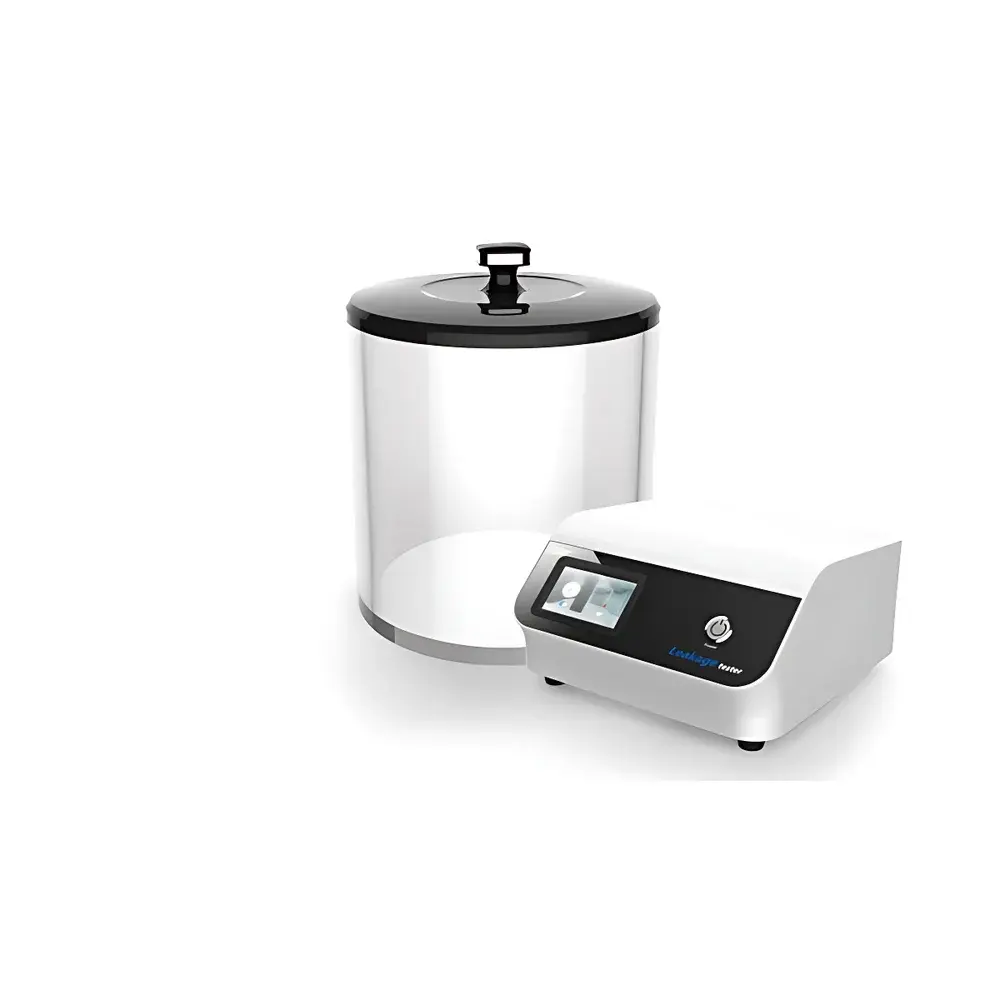
GBPI GB-M2A Leak Integrity Tester for Food Packaging Seals
| Brand | GBPI |
|---|---|
| Model | GB-M2A |
| Origin | Guangdong, China |
| Manufacturer | Guangzhou GBPI Packaging Testing Instruments Co., Ltd. |
| Vacuum Range | 0 to –95 kPa |
| Vacuum Accuracy | ±1% of reading |
| Vacuum Hold Time | 0.1–60 min |
| Compressed Air Pressure | 0.4–0.6 MPa (4–6 kgf/cm²) |
| Air Consumption | 20 L/min |
| Power Supply | 220 V, 50 Hz |
| Dimensions (Instrument) | 317 × 305 × 170 mm |
| Vacuum Chamber Options | Ø300 × 300 mm (small), Ø450 × 350 mm (medium) |
| Net Weight | 12 kg |
| Operating Temperature | 10–40 °C |
Overview
The GBPI GB-M2A Leak Integrity Tester is an automated vacuum-based seal integrity verification system engineered for quantitative assessment of package seal quality in flexible and semi-rigid food packaging. It operates on the principle of vacuum decay testing—applying a controlled negative pressure to a sealed test chamber containing the sample, then monitoring pressure stability over a user-defined dwell period. A measurable pressure rise during the hold phase indicates leakage through compromised seals, microchannels, or material defects. Designed in strict compliance with GB/T 15171–1994 “Test Methods for Seal Integrity of Flexible Package” and ASTM D3078–2002 (reapproved 2013) “Standard Test Method for Determination of Leaks in Flexible Packaging by Bubble Emission,” the GB-M2A delivers repeatable, operator-independent results essential for process validation, routine QC release testing, and post-distribution integrity evaluation—including after mechanical stress protocols such as drop testing or compression simulation.
Key Features
- Pneumatically actuated operation using regulated compressed air (0.4–0.6 MPa), eliminating reliance on electric vacuum pumps and ensuring stable, low-maintenance performance.
- Full automation sequence: automatic vacuum draw, precise dwell time control (0.1–60 minutes), timed vacuum hold, and controlled atmospheric re-pressurization—all programmable via intuitive LCD interface.
- High-fidelity vacuum measurement with ±1% reading accuracy across the full 0 to –95 kPa range, traceable to NIST-traceable calibration standards.
- Dual-chamber compatibility: interchangeable vacuum chambers (Ø300 × 300 mm and Ø450 × 350 mm) accommodate diverse package geometries—from small pouches to large tray-lid configurations—without tooling changeover.
- Manual override capability: real-time pause/resume and emergency abort functions support method development, troubleshooting, and non-standard test protocols.
- Robust industrial-grade construction with aluminum alloy frame and corrosion-resistant stainless steel chamber components; net weight of only 12 kg enables benchtop deployment in QC labs, production lines, or regulatory audit environments.
Sample Compatibility & Compliance
The GB-M2A supports a broad spectrum of food packaging formats, including heat-sealed plastic pouches (LDPE, PET/AL/PE, CPP laminates), thermoformed trays with lidding films, stand-up pouches with zippers, and retortable pouches. It accommodates both dry and moist samples, though surface moisture must be minimized prior to testing to avoid false positives from condensation-induced pressure drift. The instrument meets fundamental requirements for GLP-compliant documentation when paired with external data logging systems. While the GB-M2A itself does not embed 21 CFR Part 11 audit trails, its deterministic test logic and parameter lockout functionality support integration into validated workflows under ISO 17025-accredited laboratories and FDA-regulated facilities. All operational parameters—including vacuum setpoint, dwell duration, and pass/fail thresholds—are fully configurable and retained in non-volatile memory.
Software & Data Management
The GB-M2A operates via embedded firmware with no external PC dependency. Its monochrome LCD interface displays real-time vacuum level, elapsed hold time, cycle status, and error codes. Test parameters are stored in internal memory (up to 100 test configurations), enabling rapid recall of validated methods across shifts or operators. For traceability, each test cycle logs date/time stamp, vacuum target, actual achieved vacuum, hold duration, and pass/fail outcome—accessible via on-screen scroll navigation. Optional RS-232 or USB-to-serial interface modules (sold separately) permit connection to LIMS or Excel-based reporting platforms for batch-level statistical analysis (e.g., Cpk, defect rate trending). Exported data conforms to CSV format with ISO 8601 timestamps and SI-unit labeling, facilitating alignment with internal QA databases and regulatory submissions.
Applications
- Verification of seal strength consistency across high-speed packaging lines—identifying thermal sealing anomalies, contamination-related weak seals, or jaw misalignment.
- Pre-shipment qualification of frozen, ambient, and refrigerated food packages subject to thermal cycling or vibration stress.
- Root cause analysis of field complaints involving spoilage, oxidation, or microbial ingress—correlating leak locations with seal geometry via complementary dye penetration or helium mass spectrometry.
- Supporting shelf-life studies by establishing correlation between initial seal integrity metrics and accelerated aging outcomes (e.g., per ASTM F1980).
- Qualification of new packaging materials, closure systems (e.g., peelable vs. child-resistant), or sterilization processes (e.g., EO or gamma exposure effects on seal integrity).
FAQ
What standards does the GB-M2A directly support?
It is designed and verified for compliance with GB/T 15171–1994 and ASTM D3078–2002 (2013). Users may adapt test parameters to align with internal specifications or other regional standards such as ISO 11607–2 or EN 13828.
Can the GB-M2A detect leaks smaller than 50 µm?
Vacuum decay testing is primarily qualitative/semi-quantitative for gross leaks (>100 µm equivalent orifice). For sub-50 µm detection, complementary methods such as helium leak testing or high-voltage pinhole detection are recommended.
Is calibration certification included with shipment?
Each unit ships with a factory calibration report referencing traceable pressure standards. Full ISO/IEC 17025 calibration services are available upon request through GBPI’s authorized service centers.
How often should the vacuum chamber O-rings be replaced?
Under normal use (≤10 cycles/day), fluorosilicone O-rings maintain integrity for ≥12 months. Visual inspection for nicks, flattening, or loss of elasticity is advised before each daily shift.
Does the instrument require annual preventive maintenance?
Yes—recommended annually or after 2,000 test cycles. Service includes vacuum sensor recalibration, solenoid valve function verification, and pneumatic circuit leak check per GBPI Technical Bulletin TB-M2A-PM-2023.






