
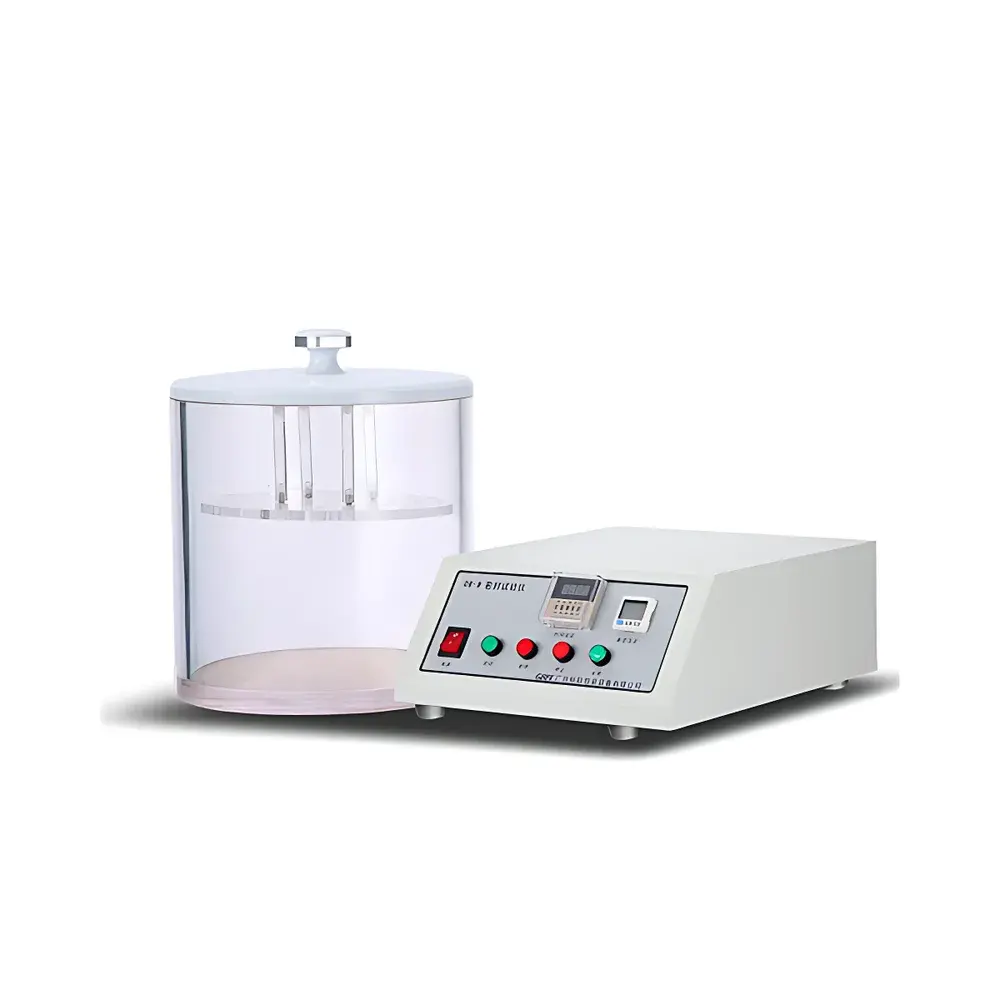
GBPI GB-MB Leak Tester for Flexible Packaging
| Brand | GBPI |
|---|---|
| Origin | Guangdong, China |
| Manufacturer Type | Direct Manufacturer |
| Region | Domestic (China) |
| Model | GB-MB |
| Price Range | USD 1,400 – 4,200 |
| Vacuum Range | 0 to −80 kPa |
| Vacuum Accuracy | ±1% FS |
| Vacuum Hold Time | 0.1–99.99 h |
| Test Chamber Dimensions | Ø300 × 350 mm |
| Inlet Air Pressure | 0.7–0.8 MPa |
| Compressed Air Consumption | 20 L/min |
| Power Supply | 220 V, 50 Hz |
| Control Unit Dimensions | 300 × 380 × 500 mm |
| Effective Vacuum Chamber Size | Ø270 × 270 mm |
| Net Weight | 20 kg |
| Power Rating | 100 W |
| Operating Ambient Temperature | 10–40 °C |
Overview
The GBPI GB-MB Leak Tester is an automated vacuum-decay-based integrity testing system engineered for rapid, non-destructive evaluation of seal integrity in flexible packaging—particularly plastic pouches, sachets, blister cards, and heat-sealed laminates. It operates on the principle of controlled vacuum application followed by pressure decay monitoring: a sealed test chamber containing the sample is evacuated to a user-defined negative pressure (up to −80 kPa), held for a programmable duration (0.1–99.99 hours), and then monitored for pressure rise indicative of leakage paths. This method conforms to the physical basis of ASTM D3078–2002 (reapproved 2013), which defines the “bubble emission test” under vacuum, and aligns with the procedural framework of GB/T 15171–1994 for soft package seal strength and leak detection. Unlike destructive dye penetration or microbial challenge methods, the GB-MB provides immediate pass/fail results without compromising package sterility or contents—making it suitable for in-process quality control in regulated manufacturing environments.
Key Features
- Pneumatically actuated operation using clean, dry compressed air (0.7–0.8 MPa input), eliminating reliance on electric vacuum pumps and reducing thermal drift and maintenance intervals.
- Full automation sequence: automatic vacuum draw-down, precise dwell-time hold, real-time vacuum stability verification, and controlled atmospheric repressurization with audible/visual end-of-test indication.
- High-resolution vacuum control with ±1% full-scale accuracy across the 0 to −80 kPa range, ensuring repeatability required for statistical process control (SPC) implementation.
- Modular chamber design featuring a standard Ø270 × 270 mm effective vacuum cavity housed within a robust Ø300 × 350 mm stainless-steel test tank—compatible with flat pouches up to 280 mm wide and 330 mm tall.
- Intuitive membrane keypad interface with digital display for direct parameter entry; supports manual intervention including emergency pause and immediate test termination.
- Low-power architecture (100 W nominal) enables continuous operation in shared lab utilities without dedicated circuitry; designed for ambient operation between 10 °C and 40 °C.
Sample Compatibility & Compliance
The GB-MB accommodates a broad spectrum of flexible packaging formats, including stand-up pouches, side-gusseted bags, pillow packs, foil-laminated sachets, and peelable lidding films used in pharmaceutical unit-dose packaging. It is routinely deployed in quality assurance labs supporting ISO 13485-certified medical device packaging lines and GMP-compliant food and pharmaceutical production facilities. While the instrument itself does not carry CE, UKCA, or FDA 510(k) certification, its test methodology is referenced in multiple regulatory guidance documents—including FDA’s Guidance for Industry on Container Closure Integrity Testing (CCIT) for Sterile Products (2022)—as a deterministic, objective technique appropriate for Phase 1–3 packaging validation when paired with documented IQ/OQ/PQ protocols. Users are responsible for verifying air supply purity (per ISO 8573-1 Class 4 or better) and integrating optional air filtration (coalescing + desiccant) to prevent moisture/oil ingress into the vacuum path.
Software & Data Management
The GB-MB operates as a standalone hardware platform with embedded firmware; no proprietary PC software is included. All test parameters and outcomes are logged locally on the control unit’s non-volatile memory with timestamping (year/month/day/hour/minute). Data export is achieved via manual transcription or optional RS-232 serial output (available upon request) for integration into laboratory information management systems (LIMS) or electronic batch records (EBR). For compliance with 21 CFR Part 11, users may implement external audit-trail-enabled data capture solutions—e.g., validated SCADA nodes or custom Python-based logging scripts—to record operator ID, test ID, vacuum setpoint, hold time, observed pressure deviation, and pass/fail status. Calibration certificates (NIST-traceable where applicable) and metrological verification reports are available as optional deliverables.
Applications
- Final seal inspection of retort pouches prior to sterilization cycle release.
- In-line QC screening of hot-fill beverage pouches after cooling stabilization.
- Validation of cold-seal adhesion performance in confectionery packaging under accelerated aging conditions.
- Leak rate benchmarking during formulation development of barrier-coated polymer films.
- Root cause analysis of intermittent seal failures in vertical form-fill-seal (VFFS) production lines.
- Supplier qualification testing per ASTM F2338–22 (vacuum decay standard for rigid and semi-rigid packages).
FAQ
Does the GB-MB meet FDA or EU regulatory requirements for package integrity testing?
The GB-MB implements a test method recognized in FDA CCIT guidance and ISO 11607–2 Annex C as a deterministic approach. However, regulatory acceptance depends on full validation (IQ/OQ/PQ), documented calibration, and integration into a compliant quality system—not on instrument certification alone.
What compressed air specifications are mandatory for reliable operation?
A minimum 2.5 HP oil-free compressor delivering ≥0.8 MPa at 20 L/min is required. Air must be filtered to remove particulates (<1 µm), oil aerosols (<0.01 mg/m³), and moisture (dew point ≤3 °C) per ISO 8573-1 Class 4.
Can the GB-MB detect leaks smaller than 50 µm?
Vacuum decay sensitivity is functionally limited by chamber volume, sensor resolution, and hold time. Under optimal conditions (small pouches, 60-min hold, stable ambient temperature), the system reliably detects gross leaks (>100 µm equivalent orifice); sub-50 µm leak quantification requires complementary methods such as helium mass spectrometry or high-sensitivity pressure decay with temperature compensation.
Is third-party calibration support available?
Yes—GBPI partners with accredited metrology laboratories in China and Southeast Asia to provide annual calibration services traceable to national standards, including vacuum transducer verification and timer accuracy assessment.
What spare parts are recommended for preventive maintenance?
Standard wear items include silicone O-rings for the vacuum chamber lid (GBPI P/N: OR-270-SI), desiccant cartridges for inline air dryers, and replacement fuses (T1.6A, 250 V). A full service manual and schematic diagram are supplied with each unit.






