
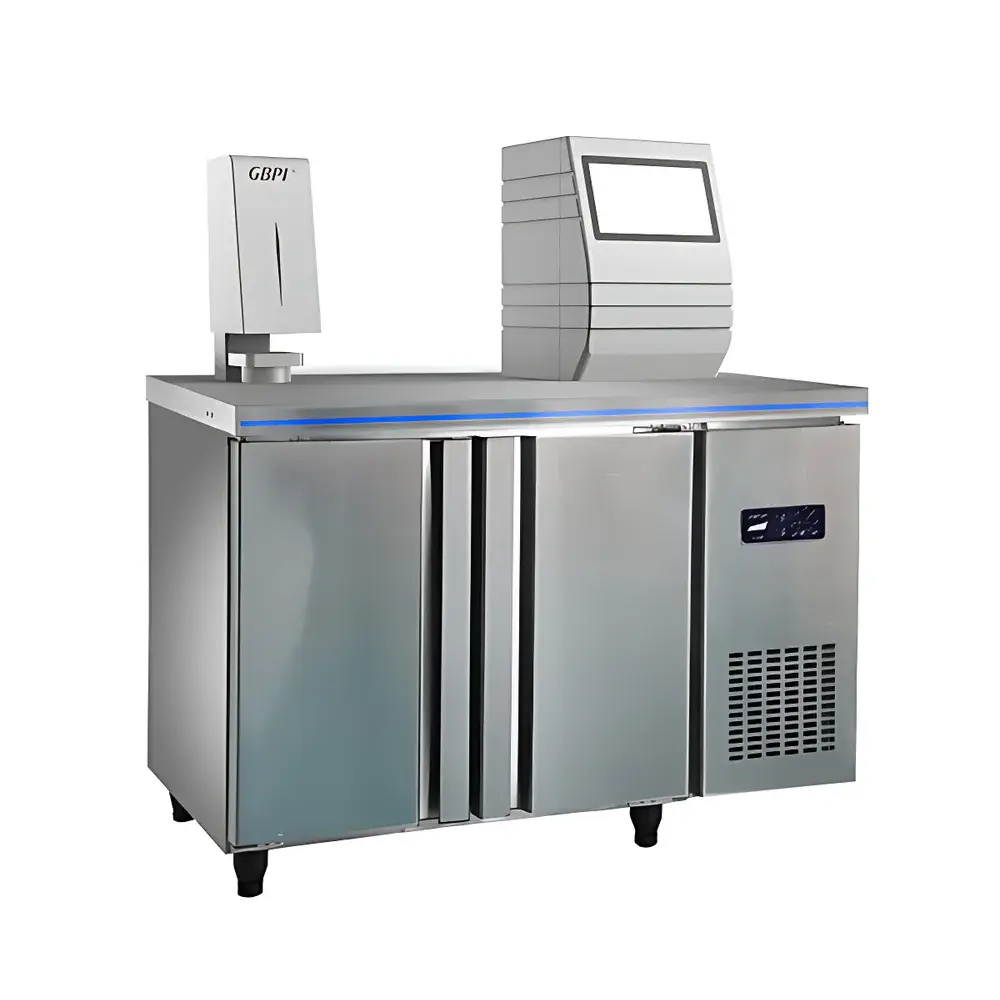
GBPI GB-PF500H Particle Filtration Efficiency Tester with Imported Optical Particle Counter
| Brand | GBPI |
|---|---|
| Model | GB-PF500H |
| Origin | Guangdong, China |
| Manufacturer | GBPI Packaging Instruments Co., Ltd. |
| Application Scope | Respiratory protective devices (surgical masks, N95-type respirators), medical textiles, and flat filter media |
| Compliance Standards | GB/T 32610–2016, GB 2626–2006, GB 19082–2009, GB 19083–2010, GB 24539–2009, YY 0469–2011, YY/T 0969–2013, EN 1822–3:1998 (principle-based) |
| Filtration Efficiency Range | 0–99.999% |
| Flow Rate Control | 20–100 L/min (±1% accuracy) |
| Pressure Drop Measurement Range | 0–1000 Pa |
| Test Aerosol Size Channels | 0.3, 0.5, 1.0, 2.5, 5.0, 10.0 µm |
| Aerosol Type | Oil-based (DEHS or paraffin oil) |
| Standard Test Area | 100 cm² (mask fixture optional) |
| Power Supply | AC 220 V, 50 Hz |
| Max Power Consumption | <1500 W |
| Dimensions | 1220 × 630 × 1225 mm |
| Weight | 250 kg |
Overview
The GBPI GB-PF500H Particle Filtration Efficiency Tester is a fully integrated, standards-compliant instrumentation platform engineered for quantitative assessment of particulate filtration performance in respiratory protection devices and flat textile filter media. It operates on the principle of aerosol challenge testing using monodisperse or polydisperse oil-based aerosols (DEHS or paraffin oil), coupled with real-time optical particle counting to determine fractional filtration efficiency across six discrete aerodynamic size channels (0.3, 0.5, 1.0, 2.5, 5.0, and 10.0 µm). The system conforms to the physical measurement framework defined in YY 0469–2011 and GB 2626–2006, while incorporating core methodological elements from EN 1822–3:1998—particularly in aerosol generation stability, mixing chamber homogeneity, and upstream/downstream particle concentration ratio calculation. Designed for regulatory-grade testing environments, the GB-PF500H supports both flat-media evaluation (e.g., meltblown PP, glass fiber, laminated membranes) and fitted-device testing (e.g., surgical masks, KN95 respirators) under constant-flow conditions.
Key Features
- Cold-generation aerosol generator delivering stable, reproducible DEHS/paraffin oil aerosols without thermal degradation; solvent refilling port designed for rapid maintenance and minimal downtime.
- Stainless-steel mixing chamber with integrated temperature and relative humidity monitoring sensors, ensuring consistent aerosol conditioning prior to filter challenge.
- Imported high-sensitivity optical particle counter (OPC) with automated zero-calibration and self-cleaning cycle—minimizing sensor drift and mitigating nozzle clogging during extended operation.
- Leak-tight pneumatic test chamber architecture certified to ISO 14644–1 Class 5 cleanroom integrity standards, preventing ambient particle ingress and operator exposure to test aerosols.
- Integrated bipolar corona discharge neutralizer upstream of the test filter, eliminating electrostatic enhancement effects and enabling true mechanical filtration assessment per ISO 16890 methodology.
- Pneumatically actuated clamping mechanism with dual-stage safety interlock—ensuring secure specimen fixation and immediate pressure release upon lid opening.
- Embedded industrial touchscreen PC running deterministic real-time control firmware; all test parameters (flow rate, pressure drop, upstream/downstream counts) acquired at ≥10 Hz sampling frequency.
- Automated calculation engine compliant with ASTM F2299–03 and ISO 29463–3:2017 data reduction protocols—including logarithmic interpolation for sub-1% efficiency values and statistical uncertainty propagation per GUM guidelines.
Sample Compatibility & Compliance
The GB-PF500H accommodates flat filter specimens (100 cm² standard aperture) and pre-fitted respiratory devices via optional mask fixtures. Compatible media include polypropylene (PP) meltblown nonwovens, glass fiber filters, PTFE membranes, and composite laminates with hydrophobic or electret-treated surfaces. All hardware and software workflows align with Good Laboratory Practice (GLP) documentation requirements. Data acquisition timestamps, user authentication logs, and audit trails are stored locally with write-protection and export capability in CSV and PDF formats. System validation documentation supports IQ/OQ protocols aligned with ISO/IEC 17025:2017 and FDA 21 CFR Part 11 electronic record compliance when deployed in regulated quality control laboratories.
Software & Data Management
The proprietary GBPI FilterTest Suite v4.2 provides full lifecycle test management: method configuration, real-time visualization of differential pressure and particle count trends, automatic pass/fail classification against selected standards (e.g., ≥95% @ 0.3 µm for GB 2626–2006 KN95 grade), and batch-level statistical reporting (mean, SD, CV%, confidence intervals). Raw datasets retain full metrological traceability—including calibration certificate references for flow meters (ISO 6706), pressure transducers (IEC 61298–2), and OPC channel response curves. Export modules support LIMS integration via HL7 and ASTM E1384 interfaces. All software binaries undergo annual third-party penetration testing and are signed with SHA-256 digital certificates.
Applications
This instrument serves as a primary verification tool in national and provincial CDC laboratories, medical device inspection institutes (e.g., NIFDC, SITI), occupational safety testing centers, and textile certification bodies (e.g., CTTC, STC). Typical use cases include: (1) type-testing of surgical and N95-equivalent masks per YY 0469–2011 and GB 2626–2006; (2) raw material qualification of meltblown filter layers for respirator manufacturing; (3) comparative evaluation of electrostatic decay behavior under humidified challenge conditions; (4) R&D screening of novel nanofiber or cellulose-based filtration media; (5) stability assessment of filtration performance after simulated aging (e.g., UV exposure, cyclic humidity). Its modular design permits future expansion with optional sodium chloride (NaCl) dry aerosol generation for hydrophilic media evaluation.
FAQ
Does the GB-PF500H support both oil-based and salt-based aerosol challenges?
No—the current configuration is optimized exclusively for oil-based aerosols (DEHS or paraffin oil) per YY 0469–2011 and GB 2626–2006. A NaCl aerosol module is available as a factory-installed option upon order specification.
Is the particle counter calibrated traceable to NIST or PTB standards?
Yes—each imported OPC is supplied with an accredited calibration certificate issued by the manufacturer’s ISO/IEC 17025-certified calibration lab, with direct traceability to NIST SRM 1963 (PSL) and PTB reference aerosols.
Can test data be exported in machine-readable format for statistical process control (SPC)?
Yes—CSV exports include timestamped raw counts, calculated efficiency values, pressure drop, flow rate, and environmental metadata; compatible with JMP, Minitab, and Python pandas workflows.
What maintenance intervals are recommended for the aerosol generator and mixing chamber?
Aerosol fluid reservoir requires cleaning every 200 hours of operation; mixing chamber internal surfaces should be wiped with isopropyl alcohol biweekly; full system performance verification (flow, pressure, counting accuracy) is required quarterly per GBPI Maintenance Protocol MP-07.
Is remote diagnostic support available for troubleshooting?
Yes—embedded VNC server enables secure technician-assisted diagnostics over encrypted TLS 1.3 tunnels; no inbound public IP exposure required.






