
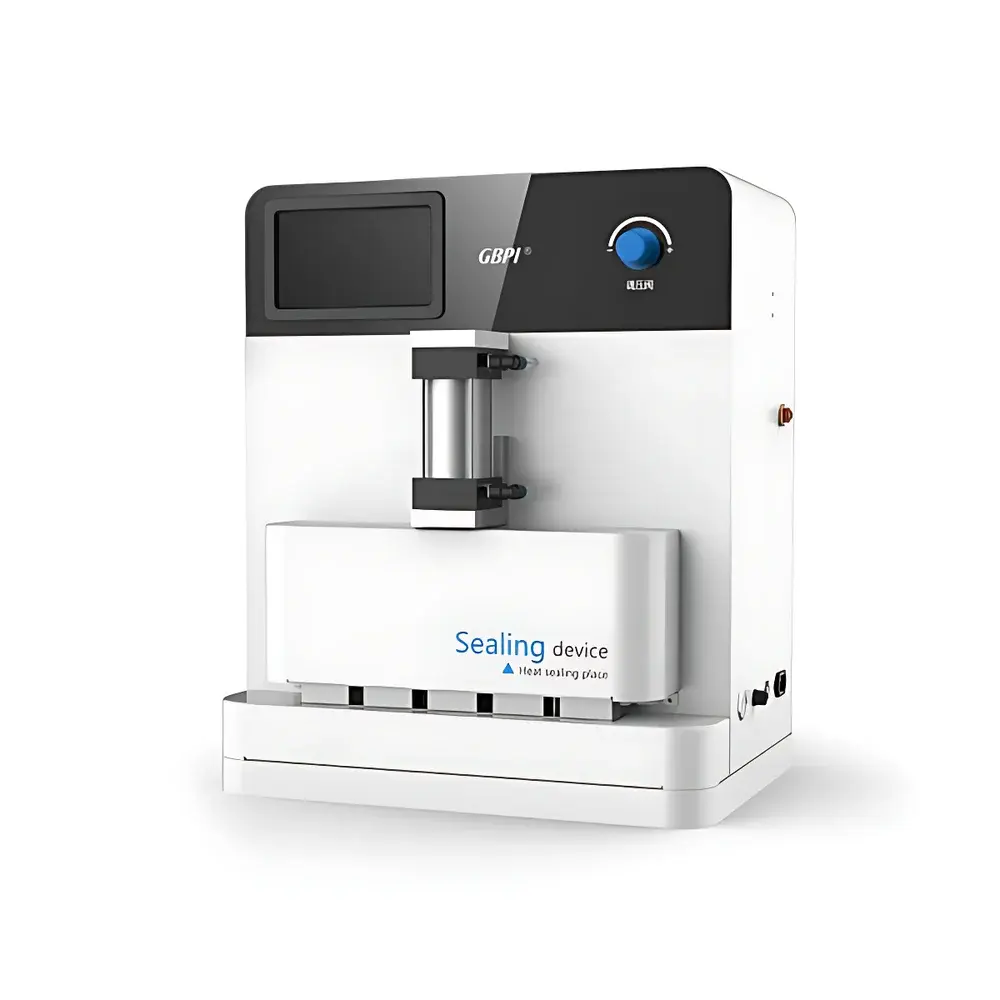
GBPI GBB-F1 Advanced Heat Sealing Tester
| Brand | GBPI |
|---|---|
| Origin | Guangdong, China |
| Manufacturer Type | Direct Manufacturer |
| Country of Origin | China |
| Model | GBB-F1-aa |
| Price Range | USD 4,200 – 7,000 |
| Sealing Temperature Range | Ambient to 250 °C |
| Temperature Control Accuracy | ±0.2 °C |
| Sealing Time Range | 0.1 s to 99.99 h |
| Sealing Pressure Range | 0.1–0.8 MPa |
| Sealing Surface Configuration | Five independent upper sealing bars (35 mm × 10 mm each) + one heated lower sealing bar with silicone pad |
| Heating Method | Dual-zone resistive heating |
| Operating Modes | Automatic and foot-switch-activated manual mode |
| Actuation | Pneumatic cylinder (externally mounted) |
| Dimensions (L×W×H) | 500 × 330 × 570 mm |
| Power Supply | AC 220 V, 50 Hz |
| Display | Touchscreen interface showing real-time upper/lower zone temperatures, pressure, and time |
Overview
The GBPI GBB-F1 Advanced Heat Sealing Tester is an engineered solution for precise, repeatable thermal seal process validation and optimization in packaging R&D and quality control laboratories. Based on the fundamental principle of controlled thermal energy transfer under defined mechanical pressure and dwell time, the instrument replicates industrial heat sealing conditions to determine optimal sealing parameters—temperature, pressure, and time—for thermoplastic films, laminates, foils, and coated substrates. Its dual-zone, five-point independent temperature control architecture enables systematic evaluation of thermal gradient effects across seal interfaces—a critical factor in evaluating seal integrity for sterile barrier systems, pharmaceutical blister packs, food pouches, and medical device packaging. Designed for compliance-driven environments, the GBB-F1 supports method development aligned with international packaging performance standards.
Key Features
- Five independent upper sealing zones (35 mm × 10 mm each) plus a single heated lower bar with replaceable silicone elastomer pad—enabling multi-parameter seal mapping and comparative analysis across heterogeneous materials.
- Dual-zone digital PID temperature control with ±0.2 °C accuracy and rapid thermal stabilization; individual setpoint programming for lower bar and each of five upper bars—facilitating asymmetric seal profile studies.
- Pneumatically actuated sealing mechanism with externally mounted cylinder, integrated pressure transducer, and adjustable 0.1–0.8 MPa output—ensuring traceable, reproducible force application compliant with ASTM F2029 calibration requirements.
- Flexible operation modes: fully automated sequence execution or foot-switch-triggered manual mode for rapid prototyping and operator-guided parameter sweeps.
- Intuitive 7-inch capacitive touchscreen interface displaying real-time zone temperatures, applied pressure, elapsed time, and system status—supporting immediate visual verification without external software.
- Customizable sealing surfaces: optional tooling for specialized geometries (e.g., curved, stepped, or micro-patterned bars), surface finish (matte, polished, or anti-adhesive coatings), and material-specific thermal mass configurations.
Sample Compatibility & Compliance
The GBB-F1 accommodates a broad range of flexible packaging substrates—including polyethylene (PE), polypropylene (PP), polyester (PET), aluminum foil laminates, paper-plastic composites, and peelable medical-grade films. Seal strength validation is performed in conjunction with tensile testers (e.g., ASTM F88, ISO 11607-2), while the instrument itself satisfies functional requirements of QB/T 2358–1998 (Chinese standard for plastic film heat seal strength), ASTM F2029–22 (Standard Test Method for Making Heat-Sealed Packages for Testing), and YBB00122003–2015 (Chinese pharmaceutical packaging standard). Its pneumatic design and calibrated pressure feedback align with GLP documentation practices, and temperature sensor accessibility supports routine in-house calibration per ISO/IEC 17025 guidelines.
Software & Data Management
While the GBB-F1 operates as a standalone instrument with embedded touchscreen control, it exports timestamped sealing parameter logs (CSV format) via USB port for integration into LIMS or electronic lab notebooks. All critical parameters—temperature setpoints, actual zone readings, pressure values, and dwell durations—are recorded with millisecond-level time stamps. Audit trail functionality supports FDA 21 CFR Part 11 readiness when paired with validated third-party data acquisition software. Firmware updates are delivered via secure encrypted USB media, maintaining configuration integrity and version traceability across laboratory deployments.
Applications
- Optimization of sealing parameters for cold-form foil, push-through blister, and sachet packaging in pharmaceutical manufacturing.
- Validation of seal integrity for retortable and microwaveable food pouches under accelerated aging protocols.
- Development of peel-open, child-resistant, and tamper-evident seals for consumer healthcare products.
- Comparative assessment of seal performance across batch variations in polymer resin formulation or surface treatment (e.g., corona, plasma).
- Supporting ISO 11607–1 Annex A risk analysis by quantifying process windows for worst-case seal conditions.
- Teaching laboratories demonstrating thermoplastic interdiffusion kinetics and melt-layer coalescence phenomena.
FAQ
What standards does the GBB-F1 directly support?
The instrument’s mechanical and thermal specifications conform to test condition requirements in QB/T 2358–1998, ASTM F2029–22, and YBB00122003–2015. It is not a certified reference standard but serves as a primary test apparatus for generating compliant seal specimens.
Can the GBB-F1 be integrated into automated packaging line qualification protocols?
Yes—its programmable parameter sets, digital I/O interface (optional), and deterministic pneumatic response enable synchronization with PLC-controlled production line simulators for PQ protocol execution.
Is temperature calibration traceable to national standards?
Temperature sensors are user-accessible and compatible with standard PT100 calibrators; GBPI provides NIST-traceable calibration certificates upon request for accredited labs requiring ISO/IEC 17025 compliance.
Does the system support pressure profiling during seal dwell?
No—the GBB-F1 applies constant pressure throughout the programmed dwell time. Dynamic pressure ramping requires external servo-pneumatic controllers interfaced via analog input (available as OEM upgrade).
What maintenance is required for long-term stability?
Annual verification of thermal uniformity across sealing zones and pressure transducer linearity is recommended. Silicone pads should be inspected and replaced after ~5,000 cycles or visible compression set.





