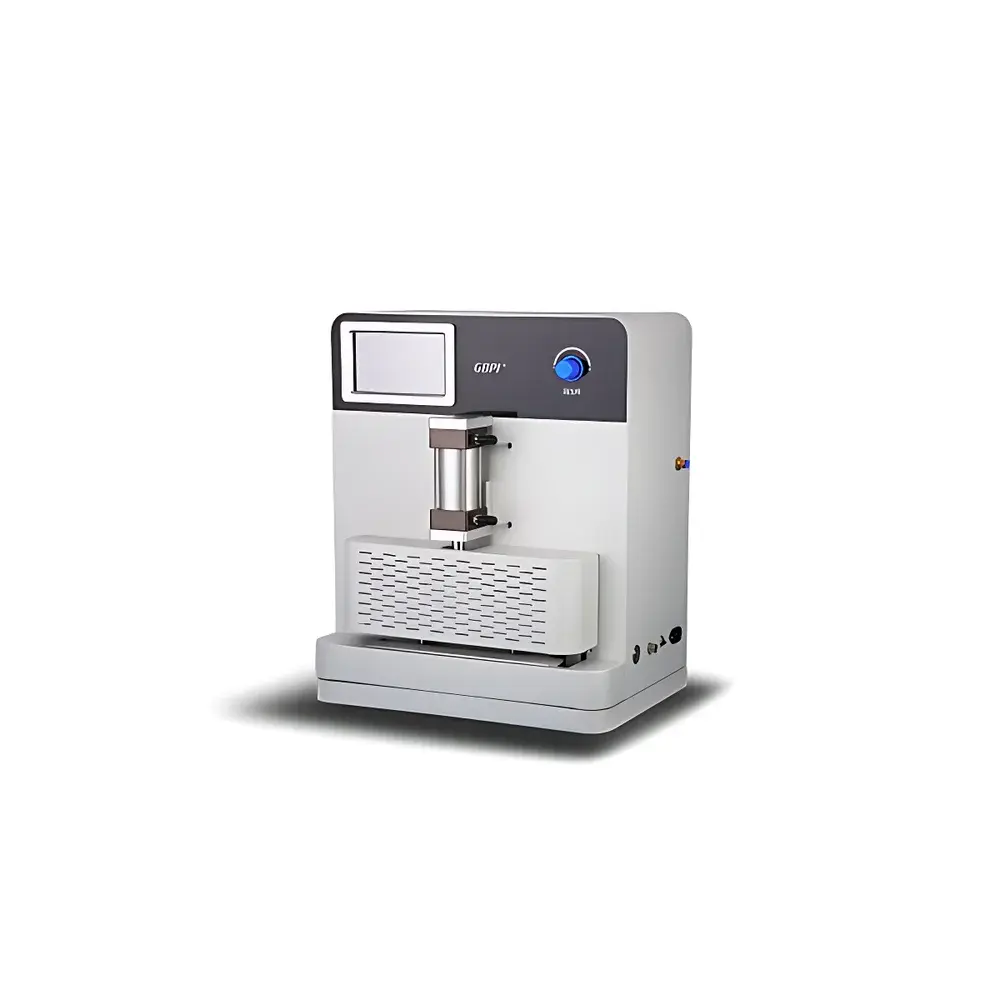
GBPI GBB-F11 Five-Point Heat Sealing Tester
| Brand | GBPI |
|---|---|
| Origin | Guangdong, China |
| Manufacturer | GBPI Packaging Instruments Co., Ltd. |
| Model | GBB-F11 |
| Temperature Range | Ambient to 300 °C |
| Temperature Control Accuracy | ±1 °C |
| Sealing Time | 0.1–999.9 s |
| Sealing Pressure | 0.05–0.8 MPa |
| Sealing Surface | Upper knife: 35 × 10 mm × 5 segments |
| Heating Mode | Electric heating with pneumatic actuation |
| Air Supply | Compressed air required (recommended: 2.5 HP, 8 bar) |
| Dimensions (W × D × H) | 700 × 400 × 540 mm |
| Weight | 55 kg |
| Power | 2000 W |
| Electrical Supply | AC 220 V, 50 Hz |
Overview
The GBPI GBB-F11 Five-Point Heat Sealing Tester is an engineered laboratory instrument designed for precise, repeatable evaluation of heat seal integrity in flexible packaging materials—primarily thermoplastic films, laminates, and pouches used across food, pharmaceutical, medical device, and consumer goods packaging. It operates on the principle of controlled thermal energy transfer under defined pressure and dwell time, simulating industrial heat sealing processes to quantify the minimum process parameters required to achieve a hermetic, mechanically robust seal. Unlike single-point testers, the GBB-F11 features five independently controllable upper sealing knives, enabling parallel assessment of seal strength across a gradient of temperatures or pressures on a single sample—critical for establishing process windows, validating sealing equipment settings, and supporting Design of Experiments (DoE) in packaging development and quality assurance workflows.
Key Features
- Five independent temperature zones: Each of the five 35 × 10 mm upper sealing knives is equipped with its own PID-controlled heating circuit and calibrated PT100 sensor, allowing simultaneous testing at discrete setpoints (e.g., 100 °C, 110 °C, 120 °C, 130 °C, 140 °C) on one specimen.
- Pneumatic actuation system: Driven by regulated compressed air (operating pressure range: 0.05–0.8 MPa), ensuring consistent, repeatable force application without mechanical hysteresis or operator-induced variability.
- Dual operation modes: Fully automated cycle control (programmable time/temperature/pressure sequences) and manual foot-switch mode for rapid prototyping or troubleshooting.
- Modular sealing interface: Lower sealing bar incorporates a replaceable silicone elastomer pad to accommodate surface irregularities and minimize thermal distortion; upper knives are interchangeable and customizable in geometry, surface finish (e.g., polished, matte, engraved), and anti-adhesion coating (e.g., PTFE-infused hard anodizing).
- Traceable temperature calibration: Integrated sensor access points and standardized reference port support routine verification per ASTM E220 or ISO/IEC 17025-compliant procedures.
- Rugged industrial construction: Stainless steel frame, reinforced linear guides, and IP54-rated electrical enclosure ensure long-term stability in QC lab or production floor environments.
Sample Compatibility & Compliance
The GBB-F11 accommodates flat film specimens up to 150 mm wide and 0.5 mm thick—including PE, PP, PET, PA, AL-laminates, retortable structures, and barrier-coated substrates. Its sealing geometry and force resolution meet the geometric and procedural requirements of major international standards: QB/T 2358–1998 (China), ASTM F2029–2016 (Standard Test Method for Hot Tack of Thermoplastic Film and Laminates), and YBB 00122003–2015 (Chinese Pharmacopoeia packaging guidance). When integrated into a validated laboratory system, it supports GLP-compliant documentation, including audit trails for parameter changes, user login logs, and electronic signature capability (when paired with compliant LIMS or standalone data acquisition software).
Software & Data Management
The instrument includes embedded firmware with real-time display of actual vs. setpoint temperature, pressure, and elapsed time. Optional USB or RS-232 connectivity enables export of timestamped test records (CSV format) containing all active parameters and sensor readings. For regulated environments, GBPI provides optional 21 CFR Part 11–compliant software add-ons featuring electronic signatures, role-based access control, and immutable audit logs—facilitating compliance with FDA, EMA, and PMDA packaging validation requirements. All firmware updates are delivered via secure authenticated channels and include version-controlled release notes.
Applications
- Determining optimal heat seal initiation temperature (onset of seal formation) and hot tack strength profile for new film formulations.
- Validating sealing parameter ranges for packaging line qualification (IQ/OQ/PQ) and change control assessments.
- Comparative analysis of seal integrity between alternative sealant layers or adhesive systems under identical thermal-mechanical conditions.
- Supporting root-cause analysis of package leakage, delamination, or seal creep during accelerated aging or distribution simulation studies.
- Generating data for regulatory submissions (e.g., USP , ISO 11607–2) demonstrating container closure integrity robustness.
- Teaching thermal bonding fundamentals in university-level packaging engineering and polymer science laboratories.
FAQ
What compressed air specifications are required for reliable operation?
A clean, dry, oil-free air supply at 6–8 bar (87–116 psi) and ≥100 L/min flow rate is recommended. An inline three-stage filter (particulate, coalescing, adsorption) must be installed upstream of the instrument’s air inlet.
Can the GBB-F11 be used for peel strength testing?
No—the GBB-F11 is a dedicated heat seal process simulator, not a tensile tester. Seal strength evaluation requires subsequent testing using a universal testing machine (e.g., ASTM F88 or ISO 11607–2 peel protocols).
Is temperature uniformity across each 35 × 10 mm sealing zone verified and documented?
Yes—each zone undergoes factory verification using NIST-traceable infrared thermography and contact probe mapping; a certificate of uniformity (±0.8 °C max deviation within zone) is supplied with each unit.
Does the instrument support custom protocol storage?
Up to 50 user-defined test methods (including temperature ramp profiles, pressure dwell sequences, and auto-shutdown logic) can be saved in non-volatile memory and recalled via front-panel navigation.
What maintenance intervals are recommended for long-term accuracy?
Annual recalibration of all five temperature sensors and pressure transducers is advised; quarterly inspection of pneumatic seals and silicone pad wear is included in the preventive maintenance checklist provided in the operator manual.