
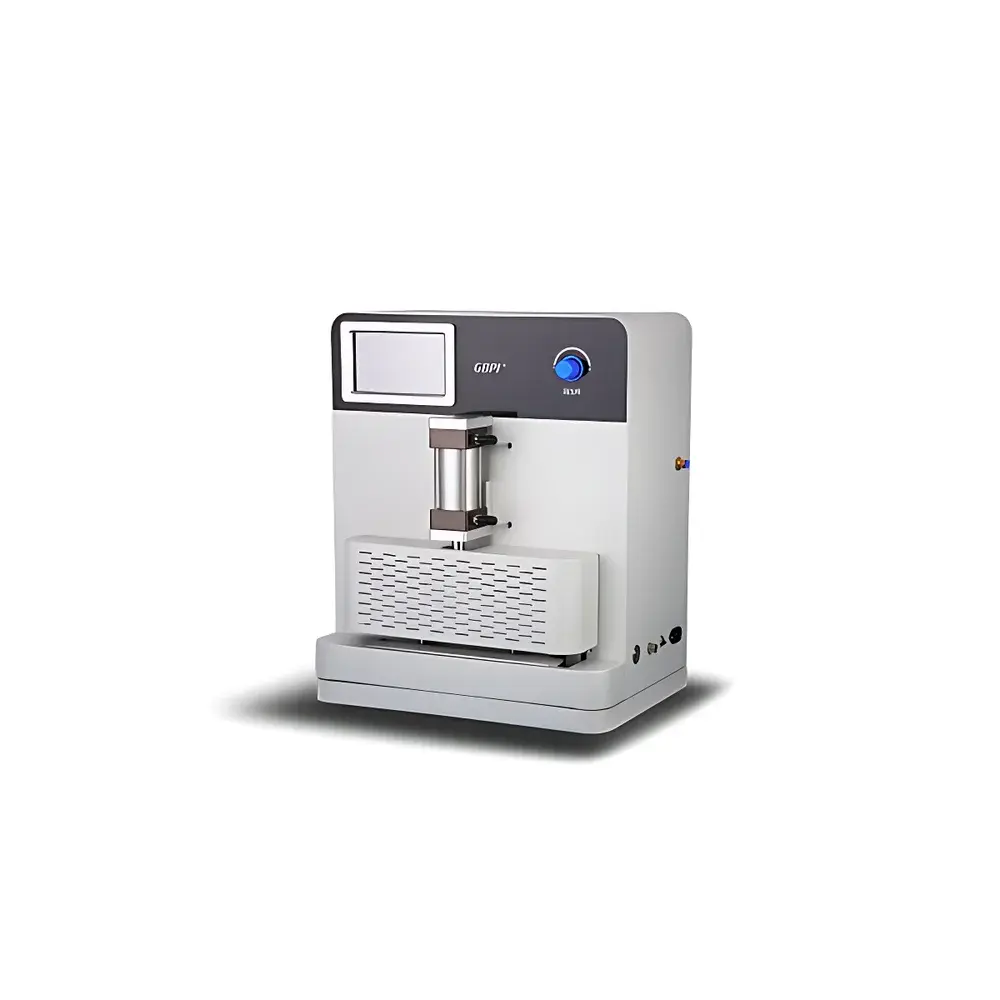
GBPI GBB-F2A Advanced Heat Sealing Tester for Packaging Films
| Brand | GBPI |
|---|---|
| Origin | Guangdong, China |
| Manufacturer Type | Direct Manufacturer |
| Origin Category | Domestic (China) |
| Model | GBB-F2A |
| Price Range | USD 7,000 – 14,000 |
| Sealing Temperature Range | Ambient to 300 °C |
| Temperature Control Accuracy | ±0.2 °C |
| Sealing Time Range | 0.01 s to 99.99 h |
| Sealing Pressure Range | 0.05–0.8 MPa |
| Sealing Surface Dimensions | 35 mm × 10 mm (smooth, lower sealing bar with silicone pad) |
| Heating Method | Dual-zone resistive heating |
| Actuation | Pneumatic (external cylinder) |
| Control Interface | Touchscreen HMI |
| Operating Modes | Automatic & Manual (foot-switch enabled) |
| Compliance Standards | QB/T 2358–1998, ASTM F2029–22, YBB00122003–2015 |
Overview
The GBPI GBB-F2A Advanced Heat Sealing Tester is a precision-engineered instrument designed to quantify the thermomechanical sealing behavior of flexible packaging materials—including polyolefin films, laminates, foils, and coated papers—under controlled temperature, pressure, and dwell time conditions. It operates on the principle of contact heat sealing, where two opposing heated sealing bars apply calibrated thermal energy and compressive force to induce polymer chain interdiffusion at the interface. This process directly correlates with seal integrity metrics such as hot-tack strength, ultimate seal strength, and delamination resistance. The tester is widely deployed in quality assurance laboratories across food, pharmaceutical, medical device, and consumer goods packaging supply chains, supporting method development, process validation, and routine QC release testing in accordance with internationally recognized standards.
Key Features
- Five independent upper sealing bars + one lower sealing bar—enabling simultaneous multi-point sealing evaluation under distinct thermal profiles;
- Individual digital PID temperature control for each sealing zone, ensuring ±0.2 °C stability across the full 0–300 °C operating range;
- Pneumatic actuation with real-time pressure monitoring (0.05–0.8 MPa), allowing precise replication of industrial heat-seal press parameters;
- Dual-mode operation: fully automated sequence execution or operator-initiated manual sealing via foot switch;
- Customizable sealing surface geometry—including width, length, edge profile (flat, rounded, or embossed), and surface finish (standard smooth or anti-adhesion coated);
- Integrated 7-inch capacitive touchscreen HMI displaying real-time values for all active zones: temperature (°C), pressure (MPa), and dwell time (s/h);
- External air cylinder design minimizes thermal interference and simplifies maintenance and calibration access;
- Modular architecture supports future upgrades—including hot-tack force integration, data logging expansion, and GLP-compliant audit trail modules.
Sample Compatibility & Compliance
The GBB-F2A accommodates standard film specimens up to 150 mm wide and 200 mm long, with seamless compatibility for ASTM F88/F1921 test strips, ISO 11607-2 pouch samples, and USP compliant packaging substrates. Its operational parameters align rigorously with key regulatory and industry benchmarks: QB/T 2358–1998 (Chinese national standard for plastic film heat seal strength), ASTM F2029–22 (Standard Test Method for Making Heat-Sealed Packages for Use in Integrity Testing), and YBB00122003–2015 (Chinese Pharmacopoeia packaging material specification). All firmware and calibration records comply with ALCOA+ principles, supporting traceability requirements for FDA 21 CFR Part 11 and EU Annex 11 environments when paired with validated software extensions.
Software & Data Management
While the base unit operates via embedded touchscreen firmware, optional PC-based software (GBPI SealLink v3.2) enables advanced data acquisition, statistical analysis (X̄–R charts, Cp/Cpk calculation), and report generation per ISO/IEC 17025 guidelines. Raw parameter logs—including timestamped temperature ramps, pressure transients, and cycle completion flags—are exportable in CSV and PDF formats. Audit trail functionality records user login events, parameter modifications, and calibration actions—fully configurable for GxP-aligned environments requiring electronic signature and role-based access control.
Applications
- Determining optimal heat-seal initiation temperature (hot-tack onset) and peak strength temperature for new film formulations;
- Validating seal robustness across shelf-life stress conditions (e.g., post-aging, humidity cycling, freeze-thaw exposure);
- Correlating laboratory seal performance with high-speed form-fill-seal (FFS) line settings;
- Supporting root-cause analysis of seal failures—such as channel leaks, incomplete fusion, or adhesive bleed;
- Qualifying alternative barrier materials during packaging redesign projects (e.g., replacing PVDC with EVOH or metallized PET);
- Generating comparative datasets for supplier qualification against internal technical agreements or CQA-defined thresholds.
FAQ
Does the GBB-F2A support automated data export to LIMS?
Yes—when equipped with SealLink v3.2 and configured with OPC UA or REST API connectivity, it integrates directly with major laboratory information management systems.
Can sealing pressure be calibrated in-house?
Yes—the integrated pressure transducer includes zero/span adjustment routines accessible via service mode; NIST-traceable calibration certificates are provided with initial delivery.
Is the lower sealing bar interchangeable for different surface geometries?
Yes—modular mounting allows rapid replacement of lower bars with custom profiles (e.g., stepped, grooved, or tapered), subject to mechanical clearance verification.
What safety certifications does the instrument carry?
It complies with IEC 61010-1:2010 for electrical safety and carries CE marking under the Low Voltage Directive (2014/35/EU) and EMC Directive (2014/30/EU).
How often does temperature sensor calibration require verification?
Per ISO/IEC 17025 recommendations, verification using a traceable reference thermometer should occur before each shift when used in regulated environments—or at minimum, daily for continuous production support applications.




