
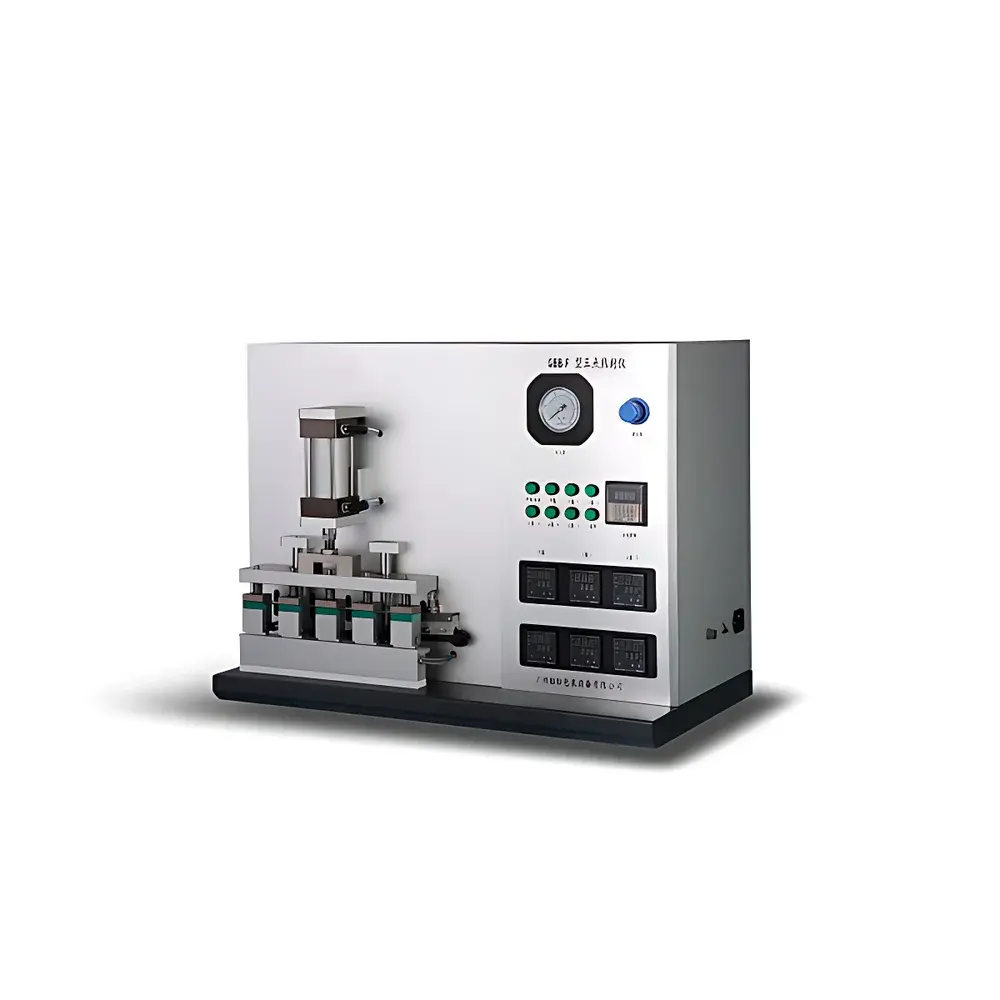
GBPI GBB-F9 Heat Sealing Tester
| Brand | GBPI |
|---|---|
| Origin | Guangdong, China |
| Manufacturer Type | Direct Manufacturer |
| Country of Origin | China |
| Model | GBB-F9 |
| Price Range | USD 4,200 – 7,000 |
| Temperature Range | Ambient to 300 °C |
| Temperature Control Accuracy | ±1 °C |
| Sealing Time Range | 0.1–999.9 s |
| Sealing Pressure Range | 0.05–0.8 MPa |
| Sealing Surface Dimensions | Upper Jaw — Five 35 mm × 10 mm independent heating zones |
| Heating Method | Electric resistive with pneumatic actuation |
| Air Supply Requirement | Compressed air (min. 0.8 MPa, 2.5 HP compressor recommended) |
| Dimensions (W×D×H) | 700 × 400 × 540 mm |
| Weight | 55 kg |
| Power Rating | 2000 W |
| Electrical Supply | AC 220 V, 50 Hz |
Overview
The GBPI GBB-F9 Heat Sealing Tester is a precision-engineered laboratory instrument designed for quantitative evaluation of heat seal integrity in flexible packaging materials. It operates on the principle of controlled thermal compression—applying calibrated temperature, pressure, and dwell time to replicate industrial sealing conditions under repeatable, documented parameters. The system enables users to determine optimal sealing parameters (i.e., minimum effective temperature, critical pressure threshold, and requisite dwell duration) that yield maximum peel strength and hermeticity without thermal degradation or melt-through. Its five-zone independent upper jaw architecture allows simultaneous multi-point thermal profiling across a single sample strip—a capability essential for assessing lateral uniformity in modern high-speed form-fill-seal (FFS) lines. Designed for compliance-driven environments, the GBB-F9 supports method development and validation in accordance with internationally recognized standards including ASTM F2029-2016 (Standard Test Method for Measuring Heat Seal Strength of Thermoplastic Films and Laminates), QB/T 2358-1998 (Chinese national standard for plastic film heat seal strength), and YBB 00122003-2015 (Chinese pharmaceutical packaging standard).
Key Features
- Five independently controlled heating zones on the upper sealing jaw (35 mm × 10 mm each), enabling spatially resolved thermal optimization and gradient analysis;
- Separate PID-controlled temperature regulation for upper jaw zones and lower heated silicone bar, ensuring thermal decoupling and measurement fidelity;
- Pneumatic actuation system driven by regulated compressed air (0.05–0.8 MPa range), delivering consistent, non-drifting force application with minimal mechanical hysteresis;
- Dual operational modes: fully automated programmable sequence mode and manual foot-switch–activated mode for rapid parameter iteration during R&D;
- Modular sealing surface design—upper jaw inserts and lower bar geometry, surface finish (e.g., polished, matte, grooved), and anti-adhesion coatings (e.g., PTFE-infused anodized aluminum) are configurable per application requirements;
- Integrated thermocouple calibration access point and NIST-traceable sensor verification protocol support routine metrological maintenance;
- Robust stainless-steel frame with vibration-damped base and EMI-shielded power electronics for stable operation in shared lab environments.
Sample Compatibility & Compliance
The GBB-F9 accommodates a broad spectrum of thermoplastic-based packaging substrates—including polyethylene (LDPE, HDPE, LLDPE), polypropylene (CPP, BOPP), polyester (PET, PETG), polyamide (PA), aluminum foil laminates, and multilayer coextrusions. It is routinely deployed in quality control laboratories of pharmaceutical primary packaging manufacturers (e.g., blister foil, sachets, pouches), food packaging converters (retort pouches, vacuum bags), and medical device sterile barrier systems (Tyvek®/poly laminate seals). All test methods executed on this platform are structured to satisfy regulatory expectations for data integrity: full audit trail logging (operator ID, timestamp, parameter set, result), electronic signature readiness, and compatibility with 21 CFR Part 11–compliant LIMS integration via optional RS-232/USB data export. Validation documentation—including IQ/OQ protocols and traceable calibration certificates—is available upon request to support GLP and GMP audits.
Software & Data Management
The GBB-F9 operates via embedded firmware with intuitive tactile interface and real-time parameter feedback. While no proprietary PC software is bundled as standard, all test records—including temperature ramp profiles, pressure transducer output, dwell timing logs, and operator annotations—are stored internally with timestamping and exportable via USB flash drive in CSV format. Optional firmware upgrade supports Modbus RTU communication for integration into centralized manufacturing execution systems (MES) or SCADA platforms. For laboratories requiring enhanced data governance, GBPI provides validated third-party software packages compliant with FDA 21 CFR Part 11, featuring role-based access control, electronic signatures, and automated report generation aligned with ISO/IEC 17025 reporting conventions.
Applications
- Determination of optimal heat seal initiation temperature (Tonset) and seal deterioration temperature (Tdegradation) for new film formulations;
- Comparative evaluation of seal strength vs. dwell time at fixed temperature and pressure (seal time curve analysis);
- Validation of sealing parameter robustness across batch-to-batch material variability (e.g., polymer MW distribution, additive migration, moisture content);
- Root cause analysis of package failure modes—leakage, delamination, channel formation, or seal embrittlement—in stability and accelerated aging studies;
- Supporting packaging process qualification per ISO 11607-2 for medical device sterile packaging;
- Method transfer between R&D, QC, and contract manufacturing organizations (CMOs) through standardized, instrument-agnostic parameter definitions.
FAQ
What standards does the GBB-F9 comply with?
ASTM F2029-2016, QB/T 2358-1998, and YBB 00122003-2015 are natively supported; additional standards (e.g., ISO 9001, ISO 11607-2) can be implemented via method adaptation.
Is compressed air supply included with the instrument?
No—users must provide a clean, dry, oil-free compressed air source meeting minimum 0.8 MPa pressure and 2.5 HP capacity; air filtration (particulate, oil, moisture) is mandatory for long-term pneumatic valve reliability.
Can the sealing jaw dimensions be customized beyond standard specifications?
Yes—both upper jaw zone geometry and lower bar profile (e.g., curved, segmented, narrow-width) are available as factory-customized options with lead-time adjustment.
Does the GBB-F9 support GLP-compliant data archiving?
Internal storage includes full parameter and result traceability; for full GLP/GMP compliance, optional software add-ons provide electronic signatures, audit trails, and 21 CFR Part 11–validated reporting.
What maintenance intervals are recommended for long-term accuracy?
Thermocouple calibration verification every 6 months; pneumatic valve inspection and seal replacement annually; full system performance qualification (SPQ) recommended biannually per ISO/IEC 17025 guidelines.




