
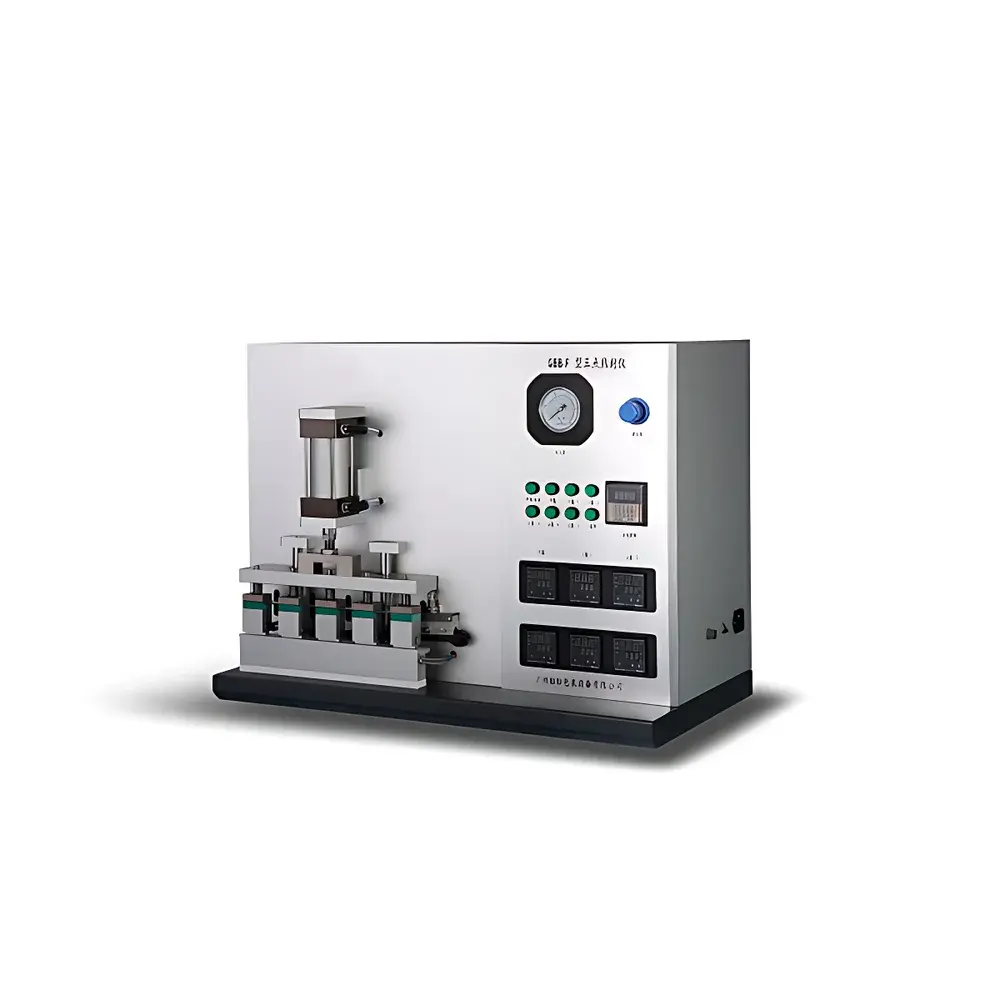
GBPI GBB-FA Five-Point Heat Sealing Tester
| Brand | GBPI |
|---|---|
| Origin | Guangdong, China |
| Manufacturer Type | Direct Manufacturer |
| Country of Origin | China |
| Model | GBB-FA |
| Price Range | USD 4,200 – 7,000 |
| Temperature Range | Ambient to 250 °C |
| Temperature Control Accuracy | ±1 °C |
| Sealing Time Range | 0.1–999.9 s |
| Sealing Pressure Range | 0.1–0.8 MPa |
| Sealing Surface | Five independent 35 mm × 10 mm upper sealing bars + silicone-padded lower sealing bar (customizable) |
| Heating Method | Electric resistive heating with dual auto/manual control mode |
| Actuation | Pneumatic (compressed air required) |
| Power Supply | AC 220 V, 50 Hz |
| Rated Power | 2000 W |
| Dimensions (L×W×H) | 730 × 400 × 535 mm |
| Weight | 35.6 kg |
Overview
The GBPI GBB-FA Five-Point Heat Sealing Tester is an engineered laboratory instrument designed for precise, repeatable evaluation of heat seal integrity in flexible packaging materials. It operates on the principle of controlled thermal compression—applying calibrated temperature, pressure, and dwell time simultaneously across five discrete sealing zones—to generate quantitative data on seal initiation temperature (SIT), hot tack strength, and seal strength profiles. This capability supports deterministic process validation and material qualification in regulated environments where package integrity directly impacts product sterility, shelf life, and compliance with Good Manufacturing Practice (GMP) and ISO 11607-1/2 requirements. Unlike single-point testers, the GBB-FA enables comparative analysis of thermal sensitivity gradients across a single sample or parallel evaluation of multiple material formulations under identical environmental conditions—critical for R&D optimization and QC release testing.
Key Features
- Five independently controllable sealing zones, each with dedicated temperature setpoint (ambient to 250 °C) and real-time monitoring via embedded Pt100 sensors.
- Pneumatically actuated sealing mechanism delivering stable, linear pressure application (0.1–0.8 MPa) with minimal hysteresis; compatible with standard industrial compressors (≥8 bar output, equipped with coalescing filtration).
- Dual operational modes: fully automated sequence control (programmable time/temperature/pressure ramps) and manual foot-switch activation for rapid prototyping or operator-led parameter sweeps.
- Modular sealing tooling system—upper sealing bars (35 mm × 10 mm) and lower silicone-elastomer pad are replaceable and configurable per user specification (e.g., embossed patterns, edge radii, anti-adhesion coatings).
- Integrated calibration interface enabling traceable sensor verification using external reference thermometers per ASTM E74 or ISO/IEC 17025 procedures.
- Rugged stainless-steel frame with ESD-safe housing, CE-compliant electrical architecture, and passive thermal shielding to ensure operator safety during extended high-temperature operation.
Sample Compatibility & Compliance
The GBB-FA accommodates films, laminates, foils, coated papers, and medical-grade pouch materials up to 300 µm total thickness. Its five-zone configuration allows simultaneous assessment of seal performance across variable substrates (e.g., PET/AL/PE vs. PP/CPP) or gradient-sealed test strips used in sealability mapping. The instrument conforms to core international standards governing packaging integrity testing, including QB/T 2358–1998 (China), ASTM F2029–2016 (Standard Test Method for Making Heat-Sealed Packages for Use in Integrity Testing), and YBB 00122003–2015 (Chinese Pharmacopoeia packaging monograph). Data outputs meet ALCOA+ principles (Attributable, Legible, Contemporaneous, Original, Accurate, Complete, Consistent, Enduring, Available) when paired with compliant LIMS or electronic lab notebook (ELN) integration.
Software & Data Management
While the GBB-FA operates as a standalone hardware platform with intuitive front-panel controls, its digital I/O interface (RS-232 or optional USB-to-serial) enables bidirectional communication with third-party acquisition software. Users may log timestamped parameter sets—including actual vs. setpoint temperature curves, pressure decay profiles, and cycle completion flags—for post-test correlation with tensile seal strength measurements (e.g., from ASTM F88 or ISO 11607-2 pull tests). Audit trails generated during calibration or routine verification comply with FDA 21 CFR Part 11 requirements when implemented within validated software environments supporting electronic signatures and role-based access control.
Applications
- Optimization of heat seal parameters for form-fill-seal (FFS) and vertical form-fill-seal (VFFS) production lines.
- Accelerated aging studies correlating seal quality with storage conditions (e.g., humidity, temperature cycling).
- Comparative evaluation of alternative sealant resins (e.g., ethylene vinyl acetate vs. ionomer-based layers) in pharmaceutical blister lidding.
- Root cause analysis of seal failures in sterile barrier systems—linking delamination onset to specific thermal thresholds.
- Validation of cleaning-in-place (CIP) and sterilization-in-place (SIP) compatibility for reusable packaging components.
- Supporting regulatory submissions (e.g., FDA 510(k), MDR Annex II technical documentation) with reproducible, instrumentally derived seal performance evidence.
FAQ
What compressed air specifications are required for reliable operation?
A minimum supply pressure of 8 bar (116 psi) with ≤5 µm particulate filtration, oil removal, and dew point ≤3 °C is recommended. A 2.5 HP compressor with ≥60 L/min free air delivery ensures consistent actuation force across all five sealing zones.
Can the GBB-FA be integrated into a GLP-compliant laboratory information management system (LIMS)?
Yes—via ASCII protocol over RS-232, provided the host LIMS supports configurable command/response parsing and stores raw parameter logs with immutable timestamps and user authentication metadata.
Is NIST-traceable calibration support available for the temperature sensors?
GBPI provides factory calibration certificates aligned to national metrology institutes; end-users may perform in-house verification using Class A Pt100 reference probes per ISO/IEC 17025 Clause 6.5.
Does the instrument support dynamic pressure ramping during the sealing dwell phase?
No—the GBB-FA applies constant pressure throughout the programmed dwell time. Variable-pressure profiles require external programmable pneumatic controllers interfaced via analog voltage input (optional accessory).
What maintenance intervals are recommended for long-term accuracy retention?
Annual verification of thermal uniformity across all five zones (using calibrated thermal imaging or contact probe mapping) and biannual inspection of pneumatic seals and solenoid valve response time are advised per GBPI Technical Bulletin TB-SEAL-02.




