
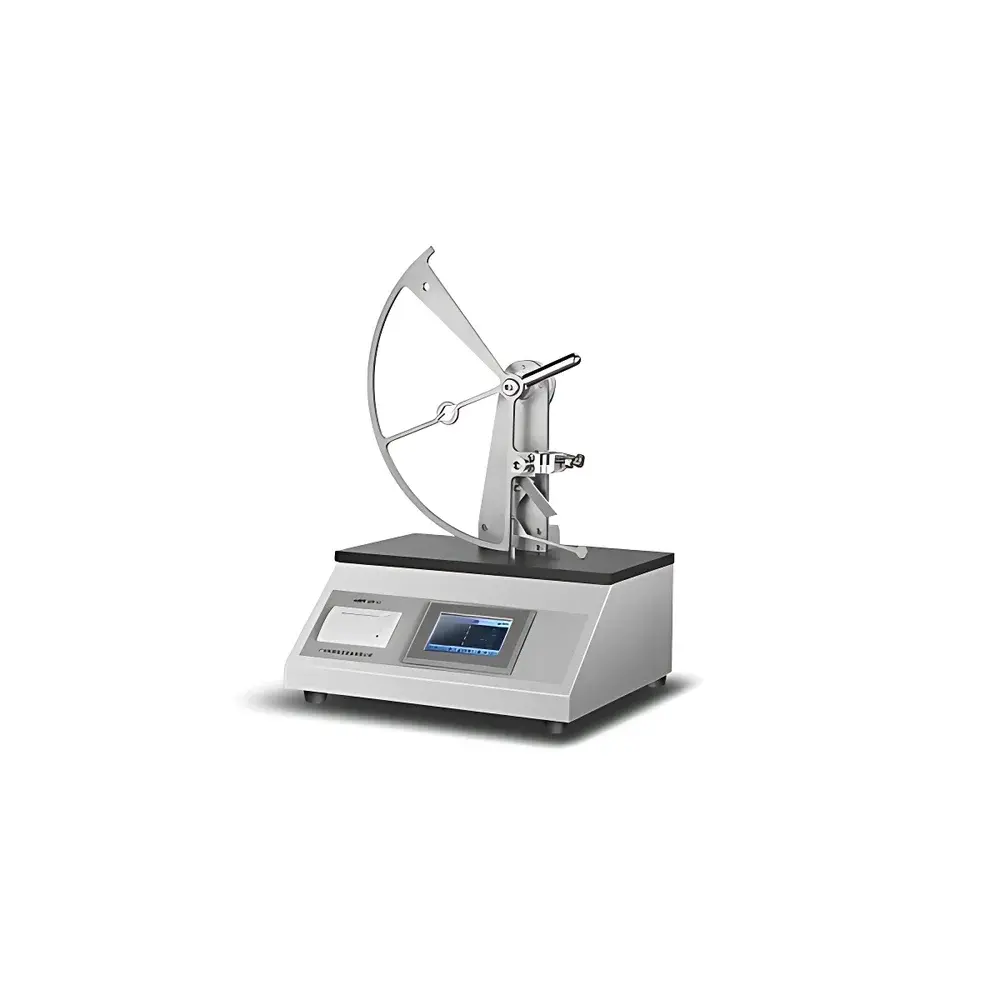
GBPI GBD-S3 Tear Resistance Tester (Elmendorf-type)
| Brand | GBPI |
|---|---|
| Model | GBD-S3 |
| Standard Compliance | GB/T 455, ASTM D1922, ISO 1974, TAPPI T414 |
| Test Range | 0–6400 gf (0–18000 mN) |
| Tear Arm Length | 104 ± 1 mm |
| Initial Tear Angle | 27.5° ± 0.5° |
| Indication Error | ≤ ±0.5% of full scale (20–90% range) |
| Relative Variation | ≤ 1% |
| Pneumatic Supply | 0.2–0.4 MPa (user-supplied) |
| Air Interface | Φ6 mm polyurethane tubing |
| Dimensions | 430 × 370 × 650 mm |
| Weight | 50 kg |
| Power | AC 220 V, 50 Hz, 100 W |
Overview
The GBPI GBD-S3 Tear Resistance Tester is an Elmendorf-type instrument engineered for precise, repeatable measurement of tear propagation resistance in thin, flexible sheet materials. It operates on the principle of pendulum impact energy absorption: a notched specimen is clamped at the base of a calibrated pendulum arm; upon release, the pendulum strikes the specimen, and the energy required to propagate the tear—expressed as mass (gram-force) or force (millinewtons)—is determined from the angular displacement of the pendulum. This gravimetric energy method aligns with internationally recognized mechanical testing paradigms for thin films and coatings, ensuring traceability to SI units via calibrated masses and geometrically defined tear geometry. Designed for compliance with GB/T 455 (equivalent to ISO 1974), ASTM D1922, TAPPI T414, and ISO 6383, the GBD-S3 delivers metrologically sound data essential for quality control, material development, and regulatory documentation in packaging R&D and production environments.
Key Features
- Integrated LCD interface with real-time display of test status, tear force value, and pendulum position—enabling standalone operation without external computing hardware.
- Pneumatically actuated specimen clamping and pendulum release mechanism ensures consistent jaw pressure and zero operator-induced timing variance.
- Built-in thermal printer generates immediate hard-copy reports including test date, sample ID, tear force (gf/mN), standard deviation, and pass/fail flag per user-defined limits.
- Dual-range force transduction system covers 0–6400 gf (0–18000 mN) with ≤ ±0.5% indication error across 20–90% of full scale, verified against NIST-traceable calibration weights (110 g to 3470 g).
- Robust cast-aluminum frame and precision-machined tear arm (104 ± 1 mm effective length) minimize mechanical hysteresis and thermal drift during extended testing cycles.
- Compliant tear geometry: fixed initial tear angle of 27.5° ± 0.5°, maintained via hardened steel knife-edge fixture and standardized specimen notch preparation protocol.
Sample Compatibility & Compliance
The GBD-S3 is validated for specimens ≤ 1 mm thickness—including biaxially oriented polypropylene (BOPP), low-density polyethylene (LDPE), metallized polyester films, laminated pouch substrates, coated paperboard, and thin metallic foils. It meets mechanical design and procedural requirements of GB/T 16578.2 (plastic film tear resistance), GB/T 9639.1 (free-fall dart impact, referenced for comparative validation), and ASTM D1424 (tongue tear for textiles). All critical dimensions—including pendulum moment of inertia, knife edge radius, and clamp gap tolerance—are documented per ISO/IEC 17025–compliant internal verification procedures. The instrument supports audit-ready documentation for GLP and GMP environments, with optional software-enabled electronic records compliant with FDA 21 CFR Part 11 when paired with validated PC-based acquisition modules.
Software & Data Management
The included GBPI TearMaster software (delivered on 4 GB USB drive) provides a validated Windows-based interface for test configuration, live curve visualization (force vs. time), statistical analysis (mean, SD, CV%), and report generation in PDF or Excel formats. Raw data files are stored in ASCII-delimited format for third-party integration with LIMS or ERP systems. Audit trail functionality logs all user actions—including parameter changes, calibration events, and report exports—with timestamp, operator ID, and reason-for-change fields. Software installation includes digital signature verification and checksum validation to ensure integrity per IEC 62304 Class B medical device software guidelines (applicable where used in pharmaceutical packaging QA).
Applications
- Quality assurance of seal integrity and film toughness in flexible food and medical packaging lines.
- Comparative evaluation of resin formulations during polymer extrusion process development.
- Validation of coating adhesion and substrate tear resistance in printed electronics and battery separator manufacturing.
- Regulatory submission support for ISO 13485-certified medical device packaging dossiers.
- Teaching laboratories for hands-on instruction in polymer mechanics and standardized test methodology per ASTM E29 and ISO 5725.
FAQ
What standards does the GBD-S3 directly support out-of-the-box?
GB/T 455, ISO 1974, ASTM D1922, ASTM D1424, TAPPI T414, and ISO 6383 — all implemented via pre-configured test modes and calibration protocols.
Is compressed air supply included with the instrument?
No. Users must provide a clean, dry, oil-free air source (0.2–0.4 MPa) with filtration (particulate, moisture, and oil removal) and Φ6 mm polyurethane tubing.
Can test data be exported to LIMS or SAP systems?
Yes. ASCII-formatted CSV output and optional OPC UA interface enable direct integration with enterprise laboratory informatics platforms.
What calibration artifacts are supplied?
Six certified stainless-steel calibration masses (110 g, 220 g, 440 g, 880 g, 1730 g, 3470 g), each with individual uncertainty statements traceable to China NIM.
Does the instrument require annual recalibration by an accredited lab?
Per ISO/IEC 17025, internal verification using supplied masses is mandatory before each shift; external recalibration is recommended every 12 months or after mechanical impact or relocation.



